Certificate of Origin (COO) in India: The 2026 Guide for Importers and Exporters
Certificate of Origin in India for importers claiming FTA duty under CAROTAR and exporters applying on trade.gov.in. Updated for 2026
Listen to article
Audio version (0% complete)
A certificate of origin in India is the document that proves where goods were made, and it decides whether an importer can claim the lower customs duty agreed under a trade agreement. Importers produce it at the time of filing the Bill of Entry to claim that rate. Exporters obtain it on DGFT's trade.gov.in portal so their overseas buyer can do the same. Since March 2025 the law calls it a proof of origin, a term that covers both certificates from issuing authorities and, where an agreement allows, self-declarations by exporters.

The short answer
If you are importing and claiming FTA duty: your Bill of Entry must carry the origin details from your supplier's proof of origin, item by item, at the time of filing. You must also hold the information showing how the goods meet the origin rules, in the format prescribed as Form I, and keep the supporting documents for five years from the date of filing the Bill of Entry. If customs has reason to doubt the claim, you have 10 working days to provide information.
If you are exporting: log in at trade.gov.in with the same credentials as the DGFT portal, go to Get Certificate of Origin >> Apply, complete the eight tabs, sign with a DSC or Aadhaar e-sign, and pay the issuing agency's fee. Non-preferential certificates must be filed electronically on eCoO 2.0.
The decision rule: check the proof of origin before the goods ship. Rule 3(1) needs it at the time of filing the Bill of Entry, and Rule 3(2) lets customs deny a defective one without verification.
What changed in 2025 and 2026
Four changes, each of which alters what you file or what you hold.
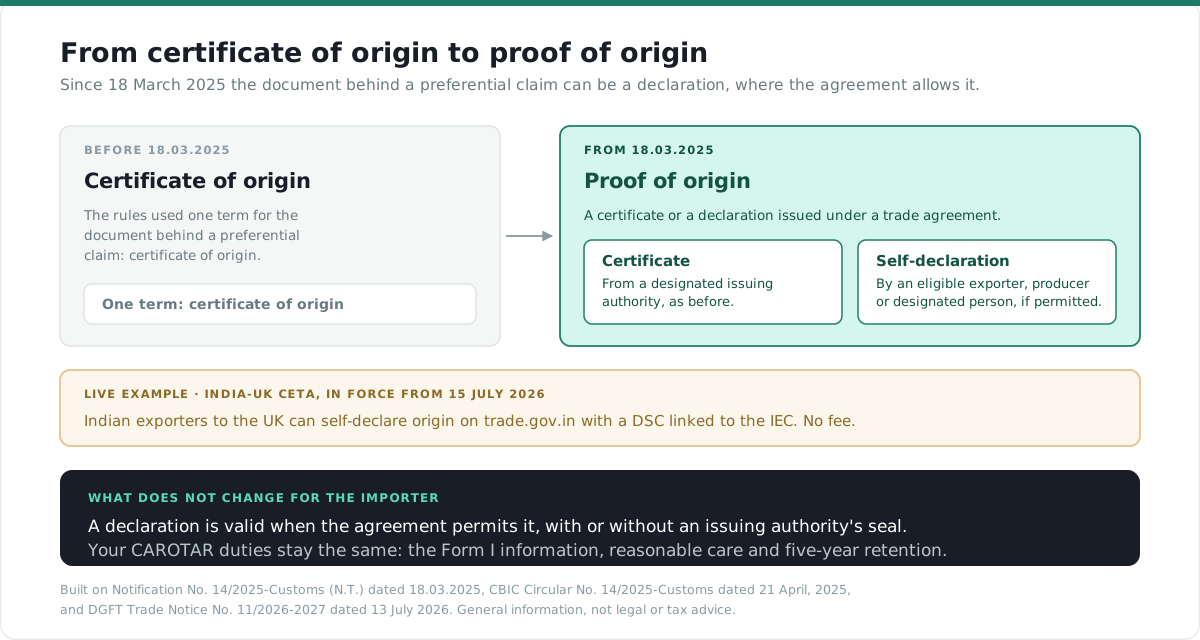
1. "Certificate of origin" became "proof of origin" (18 March 2025). Notification No. 14/2025-Customs (N.T.) dated 18.03.2025 substituted the term in the Customs (Administration of Rules of Origin under Trade Agreements) Rules, 2020, known as CAROTAR, aligning them with the amended section 28DA of the Customs Act, 1962. CBIC Circular No. 14/2025-Customs dated 21 April, 2025 explains that a proof of origin is a certificate or a declaration issued under a trade agreement. It covers certificates from designated issuing authorities and self-declarations by eligible exporters, producers or other designated persons, as provided under the relevant trade agreement. Operationally: a self-declaration is not invalid for lacking an issuing authority's seal. What matters is whether the agreement permits it.
2. Non-preferential certificates went fully electronic (1 January 2025). From 1 January 2025, electronic filing of non-preferential certificates of origin became mandatory on DGFT's eCoO 2.0 platform. The same upgrade added multi-user access under one IEC, Aadhaar e-sign alongside DSC, and an in-lieu certificate for correcting one already issued. Public Notice 43/2024-25 dated 27.01.2025 added an online Back-to-Back certificate (non-preferential) for goods not of Indian origin that are re-exported, trans-shipped or moved under merchanting trade. For how merchanting trade itself works, see the merchanting trade transaction guide.
3. Self-declared origin arrived for UK exports (15 July 2026). The India-UK CETA came into force on 15 July 2026. Under DGFT Trade Notice No. 11/2026-2027 dated 13 July 2026, an exporter can generate a preferential eCoO for the UK either through an authorised agency or by self-declaration. The self-declaration route needs a DSC linked to the IEC and a scanned ink signature, and carries no fee. It is a live example of the proof of origin change working in the exporter's favour.
4. Exporters can now file from their own software (September 2026). DGFT Trade Notice No. 25/2026-27 dated 07.09.2026 opened an API that lets an exporter's ERP or accounting system connect to the certificate of origin system for submission, processing, issuance and verification of both preferential and non-preferential applications. For a business filing dozens a month, it removes the manual re-entry of invoice data into the portal.
For importers: claiming FTA duty under CAROTAR
CAROTAR was notified by Notification No. 81/2020-Customs (N.T.) dated 21 August 2020 and has applied since 21 September 2020 to every import where a preferential rate is claimed. Kill this misconception now: holding a valid-looking certificate is not the same as having a valid claim. Rule 4 puts the duty of reasonable care on the importer.
What the Bill of Entry must carry
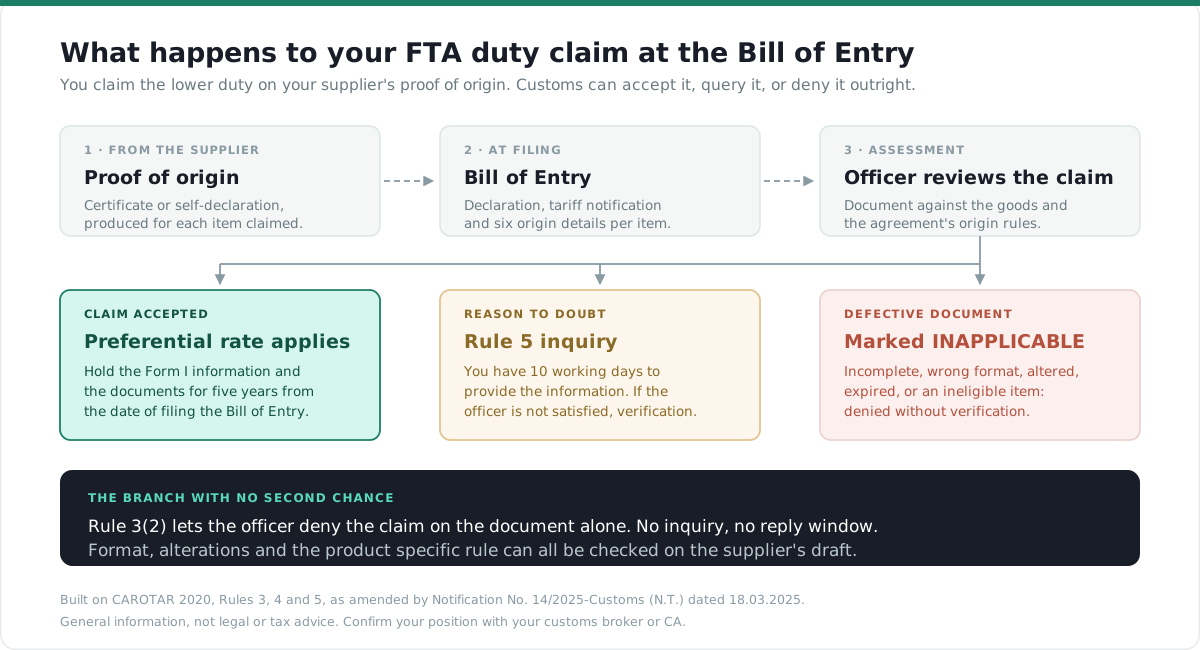
Under Rule 3(1), at the time of filing you declare that the goods qualify as originating, cite the tariff notification against each item, produce the proof of origin for each item, and enter six origin details into the Bill of Entry.
What the Bill of Entry asks for | What goes in it |
Reference number of the proof of origin | The number on your supplier's certificate or declaration |
Date of issuance | The issue date on the same document |
Originating criteria | The criterion claimed on the proof of origin |
Whether accumulation or cumulation is applied | Yes or no |
Whether issued by a third country | Yes if the proof of origin is a back-to-back document |
Whether goods were transported directly | Yes or no |
For the Bill of Entry itself, including which type applies to your consignment, see what a Bill of Entry is and the types of Bill of Entry.
When customs can deny the claim without verification
Rule 3(2) is the part that costs money fastest. The officer may deny the preferential rate without verification, and mark the certificate "INAPPLICABLE", if:
- the proof of origin is incomplete or not in the format the agreement prescribes
- it carries an alteration that has not been authenticated
- it is produced after its validity has expired
- it covers an item that is not eligible under the agreement, including where the product specific rule shown on it does not apply to your goods
Because the rule allows denial without verification, do not count on a Rule 5 query giving you time to put these right. Three of the four can be checked on the supplier's draft before shipment: the format, any alteration, and whether the product specific rule fits your goods.
What you must hold: Form I and the five-year rule
Rule 4 requires the importer to possess the information showing how the goods meet the origin criteria, including regional value content and product specific criteria, in the format prescribed as Form I. You keep the supporting documents for at least five years from the date of filing the Bill of Entry, not from the date of import, and you exercise reasonable care to satisfy yourself that the claim is correct.
Where the criterion is value content, that information depends on cost data that sits with the manufacturer. Ask for it before you place the order, not when customs asks you.
The ten-day clock
Where the officer has reason to believe the origin criteria are not met, Rule 5 gives you 10 working days to provide the information. If the officer is satisfied, you are told within 15 working days. If not, a verification proposal goes to the nodal officer. The Commissioner can also disallow the claim without further verification if you give it up, or if the information you supplied itself shows the criteria are not met.
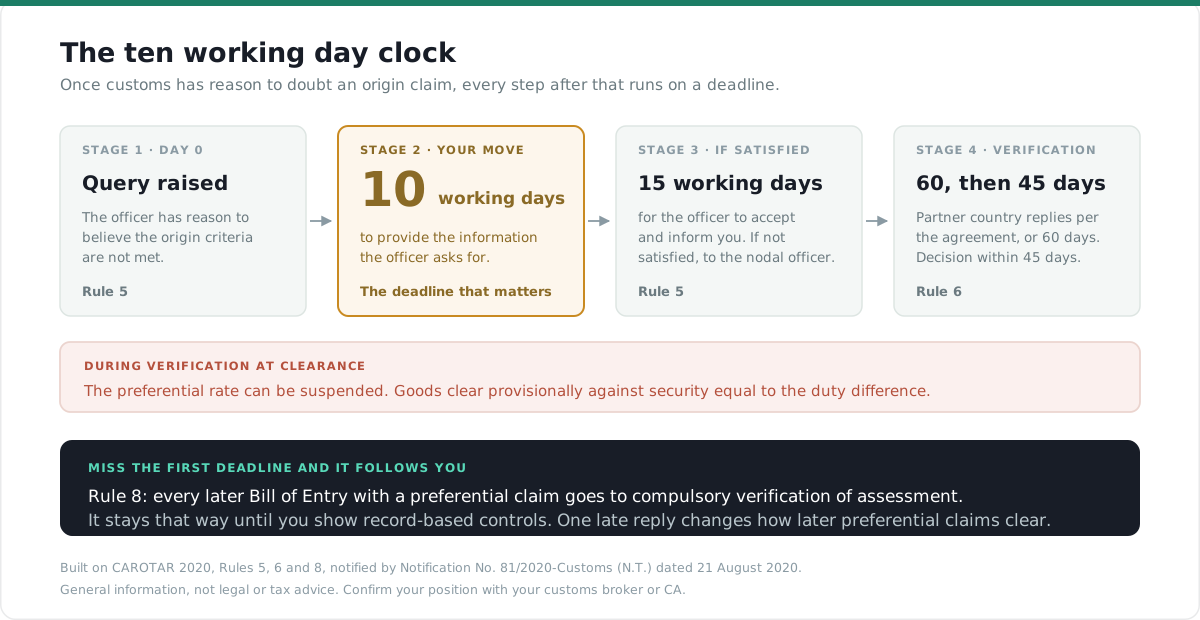
Under Rule 6, verification goes to the exporting country's verification authority, whether because a seal or signature does not match, because the officer believes the criteria are not met, or as a random check. If it starts during clearance, the preferential rate can be suspended and the goods provisionally assessed and cleared against security equal to the duty difference. The partner country answers within the time the agreement sets, or sixty days where it sets none. The officer then concludes within forty five days of receiving the information.
Two consequences are worth knowing before you ever receive the first query.
Rule 7: one bad shipment affects the supplier's other shipments. Once goods from an exporter or producer are found non-originating, the Commissioner can reject other claims for identical goods from the same exporter or producer, filed before or after, without further verification.
Rule 8: missing the deadline affects you. If you miss the Rule 5 deadline or fail the reasonable care standard, every later Bill of Entry with a preferential claim goes to compulsory verification of assessment under section 17(2) of the Customs Act, until you show that record-based controls are in place. Where there is suppression, wilful mis-statement or collusion, the claim is disallowed and penal action follows.
The practical reading: the ten working days are the deadline that matters. Diarise them the day the query arrives, and if your supplier's data will not reach you in time, take it up with your customs broker before the window closes, not after.
What to collect from your supplier before you pay
Run this checklist on every FTA consignment, before the payment goes out:
- A draft of the proof of origin before shipment. Check the agreement name and the criterion against the tariff notification you intend to cite.
- The product specific rule for your HS code. Confirm the criterion on the draft is one that rule allows.
- Cost and sourcing data sufficient to complete Form I, especially where the criterion is value content.
- Routing confirmation. Whether the goods will be transported directly is one of the six Bill of Entry details, so know the answer before the goods move.
- Invoice alignment. Description, quantity and value on the commercial invoice should match the proof of origin line for line.
Pay the supplier once the paperwork is right.
Once the proof of origin draft checks out against your HS code, pay your overseas supplier from an EximPe AD1 Trade Account, through an RBI-authorised entity (PA-CB Cert. 291/2026). See how AD1 Trade Accounts work
For exporters: how to apply on trade.gov.in
Before you start
Two prerequisites come before the form. Your IEC must be linked to the email you log in with, and your DSC or Aadhaar e-sign must be registered under My Dashboard >> View and Register Digital Signature Token. If you already use the DGFT portal, the same credentials work. If you do not have an IEC yet, start with how to apply for an IEC online.
The eight tabs
Go to Get Certificate of Origin >> Apply. The application has eight tabs: Basic Details, Certificate Details, Export Details, Import Details, Shipment Details, Attachments, Declaration and Application Summary.
Two rules on the invoice details:
- The invoice number and date must be unique for your IEC within the same financial year.
- The sum of item values must equal the invoice value. And do not type the country name in the importer address field, because it prints twice on the certificate.
Attachments are limited to one file of up to 5 MB, in PDF or JPG, and the invoice is mandatory. Sign with DSC or Aadhaar, then pay. The fee varies by issuing agency, so check it on the payment screen rather than assuming one figure.
What to enter in Preference Criterion and Preference Criterion Value
This is Tab 4, Import Details, and it is the field behind many of the questions people search on this topic. For each export item you click edit and fill four fields: whether imported or undetermined-origin raw material is used in the manufacture of the export product, the Preference Criterion, the Preference Criterion Value (in %), and the Preference Criterion Value (in String).
For a non-preferential certificate, raw material details are not mandatory. Select "India" as the Preference Criterion, and the Preference Criterion Value can be entered as 0. The issued certificate then shows "India Origin".
For a preferential certificate, the criterion must be the one the specific agreement allows for your product, and the value is the qualifying content under that agreement's rule. The codes differ by agreement, so take them from the agreement's own rules, and keep the working behind the percentage.
Status, deficiencies and corrections
An application shows one of five statuses: In-Process, Deficient, Approved Pending Issuance, Approved or Rejected. Deficient means the officer has raised a query. Answer it through Respond Deficiency, choosing Yes if you are amending the application and No if you are only clarifying.
If a certificate has already been issued with an error, use the in-lieu certificate request rather than applying afresh.
For UK exports, select "India UK CETA (Self-Declaration)" to self-certify, or "India-UK CETA (Agency Issued)" for the agency route. The self-declared status reads "Auto Approved Pending Issuance" until you choose Generate Self-Declared CoO.
The DGFT helpdesk for the portal is 1800-572-1550. For the other documents a shipment needs, see documents required for export customs clearance.
Preferential vs non-preferential certificates
Type | What it does | Who issues it | Where it is used | Watch-outs |
Preferential | Lets the buyer claim the reduced rate under a trade agreement | Agencies designated under that agreement, or the exporter by self-declaration where the agreement allows | In the partner country of that agreement | The criterion must match the product specific rule for the exact HS code |
Non-preferential | Certifies origin without any duty benefit | Authorised issuing agencies, including chambers of commerce | Wherever a buyer or authority asks for proof of origin | Electronic filing on eCoO 2.0 is mandatory from 1 January 2025 |
Back-to-Back (non-preferential) | Certifies the origin of goods not of Indian origin | Applied for online under Public Notice 43/2024-25 | Re-export, trans-shipment and merchanting trade | Issued on documentary evidence from the foreign country of origin |
Rules of origin, briefly
Every preferential agreement tests origin in one of a few ways. Goods can be wholly obtained in the partner country, such as crops, minerals or livestock. They can undergo a change in tariff classification, where processing moves the product into a different heading from its imported inputs. They can meet a value content threshold, where a minimum share of the value must come from the partner countries. And many products carry a product specific rule that applies to that product. The thresholds, the cumulation rules and the arithmetic differ by agreement. That working is covered in the free trade agreements guide for importers.
Why claims and applications get rejected
Importer side
- The criterion on the certificate is valid under the agreement but not for your HS code. Rule 3(2) lets customs deny it without verification. Check the product specific rule before the goods ship.
- Description or value mismatch with the invoice. A proof of origin line that does not match the commercial invoice gives the officer reason to doubt the claim.
- A back-to-back proof of origin not declared as one. Rule 3(1) has a Bill of Entry field for whether the proof of origin was issued by a third country. Fill it to match the document.
- A missed ten-day reply. Under Rule 8 it moves every later preferential claim into compulsory verification of assessment.
Exporter side
- Invoice number and date reused within the financial year for the same IEC.
- Item values not summing to the invoice value.
- Wrong criterion selected. "India" is the entry for a non-preferential certificate; a preferential application needs the criterion the agreement allows.
How to verify a certificate of origin
An Indian electronic certificate carries a QR code for verification, and on trade.gov.in the Verify Certificate option under Get Certificate of Origin checks an issued certificate. For certificates coming into India from partner countries, CBIC's FTA Cell uploads the specimen seals and signatures of the partner countries' officials to ICES, so the customs officer can compare against those. If you want to know what is at stake before you file, the HSN code finder shows the tariff with its FTA rates, the import duty calculator works out the landed cost, and the wider picture of how duty is built up is in the customs duty guide.
Frequently asked questions
Frequently Asked Questions
Exporters apply online at trade.gov.in under Get Certificate of Origin, using DGFT login credentials, a linked IEC and a DSC or Aadhaar e-sign. The application has eight tabs. The certificate is issued after approval, or self-declared where the agreement allows it.
Yes. Non-preferential certificates must be filed electronically on eCoO 2.0 from 1 January 2025, and preferential certificates are applied for through the same portal.
The fee varies by issuing agency and is shown on the payment screen before you pay. Self-declared certificates under the India-UK CETA carry no fee.
It is needed when the buyer wants to claim a lower duty under a trade agreement, or when the buyer or an authority asks for proof of origin. Without it, the buyer cannot claim the preferential rate.
Issuing agencies authorised on the eCoO platform, including chambers of commerce for non-preferential certificates. Under agreements that allow it, the exporter can self-declare, as with the India-UK CETA.
A preferential certificate under a CEPA is applied for on trade.gov.in like any other preferential certificate, and issued by the agency designated for that agreement, or self-declared where the agreement allows it.
Preferential origin qualifies goods for a reduced duty under a specific trade agreement. Non-preferential origin simply certifies where goods were made, with no duty benefit.
It is the qualifying content declared for an item in Tab 4 of the application. For a non-preferential certificate you select "India" as the criterion and can enter 0 as the value. For a preferential certificate it is the qualifying percentage under that agreement's rule.
The Customs (Administration of Rules of Origin under Trade Agreements) Rules, 2020. They set what an importer must declare, hold and answer when claiming a preferential duty rate in India.
At least five years from the date of filing the Bill of Entry, under Rule 4 of CAROTAR.