SWIFT Code: Full Form, Format & How to Find Your Bank's Code (2026)
What a SWIFT code means, how to read its 8 or 11 characters, and how to find your bank's code. Includes Indian bank codes and 2026 ISO change.
Listen to article
Audio version (0% complete)
A SWIFT code is the 8- or 11-character identifier that tells the global banking network exactly which bank, and often which branch should receive an international payment. It's governed by ISO 9362, and it's also called a BIC (Bank Identifier Code); the two terms mean the same thing and banks use them interchangeably. Think of it as the postal address for a financial institution: without it, money moving across a border has no idea where to land.
If you're sending or receiving money internationally from India, this is the one detail you cannot afford to get wrong. A single incorrect character doesn't cause a polite error message, it causes a transfer that gets delayed for days, bounced back minus fees, or routed to the wrong institution entirely. This guide covers what the code actually means, how to read it, where to find yours, and the 2026 change that's quietly making beneficiary details stricter than they used to be.
In a hurry? Use the SWIFT Code Finder to search by country, city, and bank and pull the exact code in seconds - then cross-check it against your bank's own website before you send anything.
What changed in 2026: ISO 20022 and why your payment details are being rejected
This is the part no older guide mentions, and it's now the most common reason a technically "correct" SWIFT transfer gets held up.
On 22 November 2025, SWIFT ended the coexistence period for its Cross-Border Payments and Reporting Plus (CBPR+) programme. The legacy MT message formats - including MT103 for customer transfers and MT202 for bank-to-bank transfers were formally retired in favour of their ISO 20022 equivalents (pacs.008 and pacs.009). All cross-border payment instructions between financial institutions now move in the richer, structured ISO 20022 format.
Why this matters to you as a sender, not just to your bank: unstructured postal addresses have been retired under CBPR+. Beneficiary and originator addresses must now be submitted in structured or hybrid format, and messages that don't comply get rejected. Practically, that means the free-text "just type the address in one box" habit is over. If your remittance is bouncing back with a vague validation error despite a correct SWIFT code, incomplete or unstructured beneficiary details are now a prime suspect.
The SWIFT code itself hasn't changed - the format, length, and structure are the same. What changed is how much surrounding data has to be correct alongside it.

What a SWIFT code actually is
SWIFT stands for the Society for Worldwide Interbank Financial Telecommunication, a member-owned cooperative that runs the secure messaging network connecting more than 11,000 financial institutions worldwide.
An important distinction most guides blur: SWIFT doesn't move your money. It moves instructions. When you send an international transfer, your bank transmits a secure, standardised message to the receiving bank telling it to credit a specific account. The actual funds settle through correspondent banking relationships between those institutions. That's why the code identifies a bank, never your personal account - you always supply your account number separately.
It's also why transfers can take 1-5 working days and pick up charges along the way: the money may pass through one or more intermediary banks, each of which can deduct a fee. (If you want the mechanics of how banks hold balances with each other, our explainer on nostro and vostro accounts covers the plumbing.)
How to read a SWIFT code: the format explained
Every SWIFT/BIC is either 8 characters (the institution's head office) or 11 characters (a specific branch). Using HDFC Bank's code as the worked example:
Segment | Characters | Example | What it identifies |
Bank code | 4 letters | HDFC | The financial institution |
Country code | 2 letters | IN | The country, per ISO 3166-1 (IN = India) |
Location code | 2 letters/digits | BB | The city or head-office location (BB is Mumbai for most Indian banks) |
Branch code | 3 letters/digits, optional | XXX | The specific branch - XXX means the primary/head office |
So HDFCINBBXXX reads as: HDFC Bank, India, Mumbai, head office.
Two things worth knowing. First, an 8-character code and the same code with XXX appended are functionally the same thing, both point to the primary office. Second, if your branch has its own 11-character code, use it. Falling back to the head-office XXX code usually still works for most transfers, but branch-specific routing is cleaner and avoids an internal hop.
SWIFT vs IFSC vs IBAN
This is the single biggest source of failed transfers among Indian businesses new to international payments. These three are not interchangeable:
Code | Used for | Format | Applies in India? |
SWIFT / BIC | International transfers | 8 or 11 characters | Yes - this is what you give an overseas sender |
IFSC | Domestic Indian transfers (NEFT/RTGS/IMPS | 11 characters | Yes - domestic only |
IBAN | nternational transfers in Europe and parts of the Middle East | Up to 34 characters | No - India does not use IBAN |
The rule that saves you the most grief: if someone abroad wants to send you money, give them your SWIFT code. If you're paying a domestic supplier, use the IFSC. Handing an IFSC to an international sender gets the transfer rejected outright. And if a European counterparty asks for your IBAN, the correct answer is that Indian banks don't issue them - give them your SWIFT code and account number instead. We've broken the first pair down further in our comparison of SWIFT codes and IFSC codes, and covered what an IBAN number is for anyone dealing with European suppliers.
Where to find your bank's SWIFT code: five reliable methods
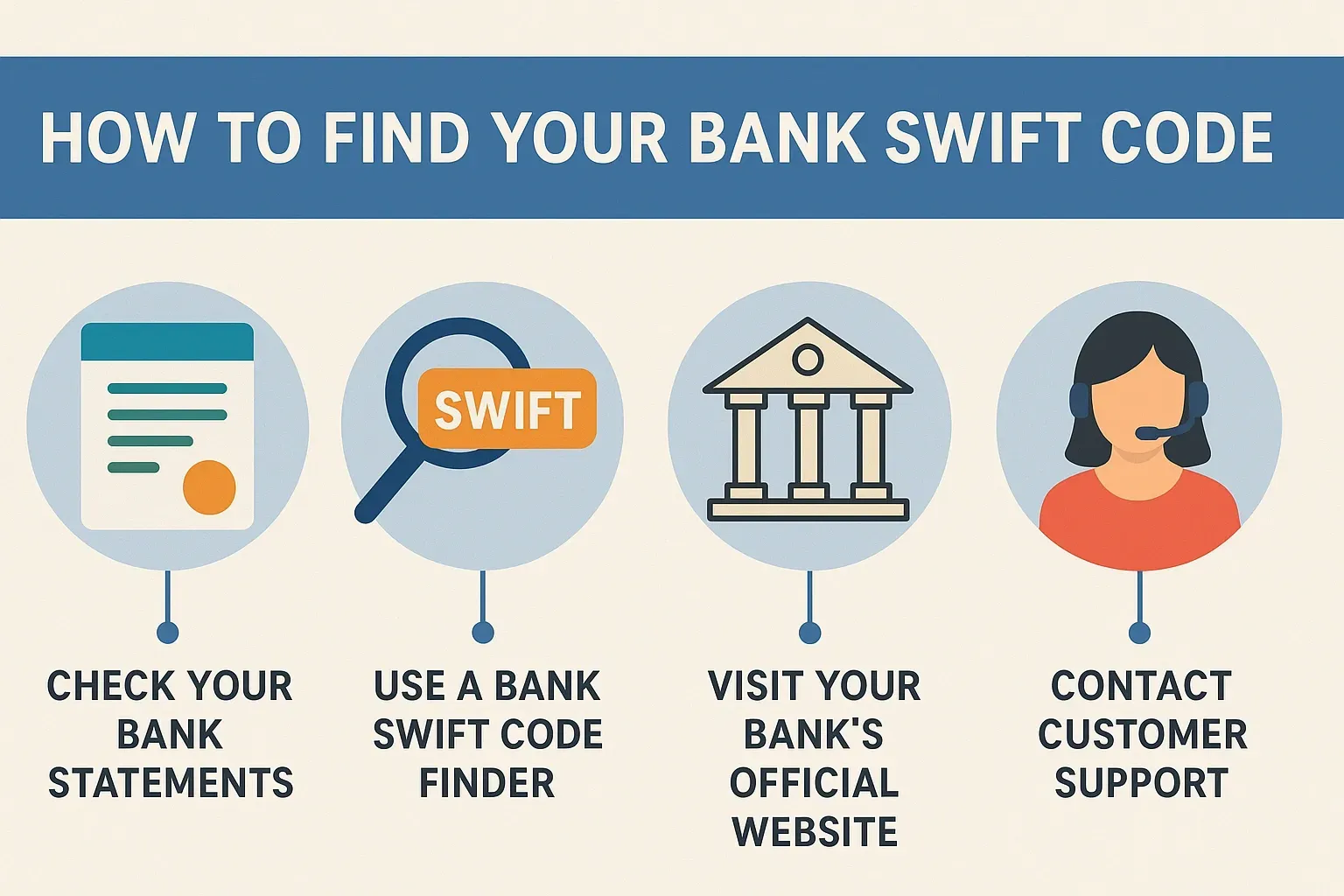
1. Use a SWIFT code finder
The fastest route if you don't have a statement to hand. EximPe's SWIFT Code Finder lets you search by country, city, and bank, and returns the exact SWIFT/BIC in seconds - including the branch-level code where one exists, rather than defaulting you to the head-office XXX.
2. Check your bank statements
Your account statement paper or PDF, usually carries the code under a heading like "International Transfers," "Wire Transfer Details," or "Bank Details." For most people this is the quickest offline check.
3. Log in to online banking or your mobile app
Most banks display the SWIFT/BIC on the account-details or international-transfer screen. If you bank with a large Indian institution, it's usually two taps from the account summary.
4. Visit your bank's official website
Banks publish their codes in the FAQ, International Banking, or Wire Transfer sections. Search "[your bank] SWIFT code" restricted to the bank's own domain - not the open web.
5. Call customer support or your branch
Worth doing if your bank has many branches, or if you're dealing with a smaller cooperative or regional bank where the code isn't published clearly. Ask specifically for the code used for international transfers.
Important: never take a SWIFT code from a random directory, a forwarded message, or a supplier's email signature without verifying it. Codes change when banks merge or restructure, and a stale code is indistinguishable from a correct one until the money doesn't arrive. Cross-check anything you find against the bank's own website or a statement.
Quick reference: SWIFT codes for major Indian banks
These are the primary head-office codes. Your branch may have its own 11-character variant - verify before you send.
Bank | Head-office SWIFT code |
State Bank of India (SBI) | SBININBBXXX |
HDFC Bank | HDFCINBBXXX |
ICICI Bank | ICICINBBXXX |
Axis Bank | AXISINBBXXX |
Kotak Mahindra Bank | KKBKINBBXXX |
Punjab National Bank | PUNBINBBXXX |
Bank of Baroda | BARBINBBXXX |
Indian Bank | IDIBINBBXXX |
Canara Bank | CNRBINBBXXX |
Union Bank of India | UBININBBXXX |
What actually goes wrong, and what it costs you
A wrong or mismatched SWIFT code fails in one of four ways, in rough order of how painful they are:
- Delay. The most common outcome. The payment sits in an intermediary bank's queue pending manual investigation, days, not hours.
- Return. The transfer bounces back to the sender, typically minus the fees already deducted by each bank in the chain. You lose money on a payment that never arrived.
- Misrouting. Funds reach the wrong institution. Recovery is possible but slow, and it depends on the cooperation of a bank you have no relationship with.
- Rejection on data, not code. Increasingly common since the ISO 20022 cutover, the code is right, but the beneficiary details are incomplete or unstructured.
There's also a cost that shows up even when everything works: the FX margin and intermediary charges buried in the transfer. The exchange rate your bank applies is rarely the mid-market rate, and each correspondent in the chain can take a cut. If you're moving trade payments regularly, that spread compounds fast, our guide to forex markup fees shows where it hides.
If your bank has no SWIFT code: some smaller cooperative banks and digital-only institutions aren't on the SWIFT network. In that case the payment routes through a correspondent bank, you'll need that correspondent's SWIFT code plus your own account details.
Once you have the code
Getting the code right is step one. Actually executing the transfer cleanly is step two, the step-by-step process for sending money with a SWIFT code walks through the form field by field.
And if you're receiving trade payments into India, there's a compliance layer beyond the routing: your bank must report the transaction against an RBI purpose code that classifies why the money came in. Get it wrong and reconciliation gets messy later, particularly against EDPMS on the export side. Our explainer on purpose codes in banking covers which one applies to what.
For Indian exporters and importers moving money regularly, the deeper issue isn't finding the code, it's that the correspondent-banking route is slow and the FX spread is opaque. That's the problem EximPe exists to solve: RBI-licensed cross-border payments with transparent pricing and compliant documentation built in, so the money side of a shipment moves as predictably as the cargo.
Frequently asked questions
Frequently Asked Questions
Society for Worldwide Interbank Financial Telecommunication, the cooperative that operates the secure messaging network banks use for cross-border payments.
Yes. SWIFT code and BIC (Bank Identifier Code) refer to the same identifier and are used interchangeably.
Either 8 (head office) or 11 (specific branch). The last three characters are the optional branch code; XXX denotes the primary office.
No. SWIFT codes route international transfers; IFSC codes route domestic Indian transfers via NEFT, RTGS, and IMPS. Giving an IFSC to an overseas sender will get the payment rejected.
No. India does not use the IBAN system. Provide your SWIFT code and account number instead.
Usually yes, the head-office code ending in XXX works for most transfers. But if your branch has its own 11-character code, use it for cleaner routing.
The transfer may be delayed, returned minus fees already deducted, or routed to the wrong institution. Always verify the code before sending.
Smaller cooperative and digital-only banks may not be on the network. Your payment will route through a correspondent bank, whose SWIFT code you'll need along with your account details.
Typically 1-5 working days, depending on the number of intermediary banks, currency corridors, and cut-off times.