Anti-Dumping Duty in India: Meaning, Calculation, Types & Real-World Examples
Learn what anti dumping duty is, how India calculates it, margin of dumping, lesser duty rule, and 2025 aluminium foil & steel cases.
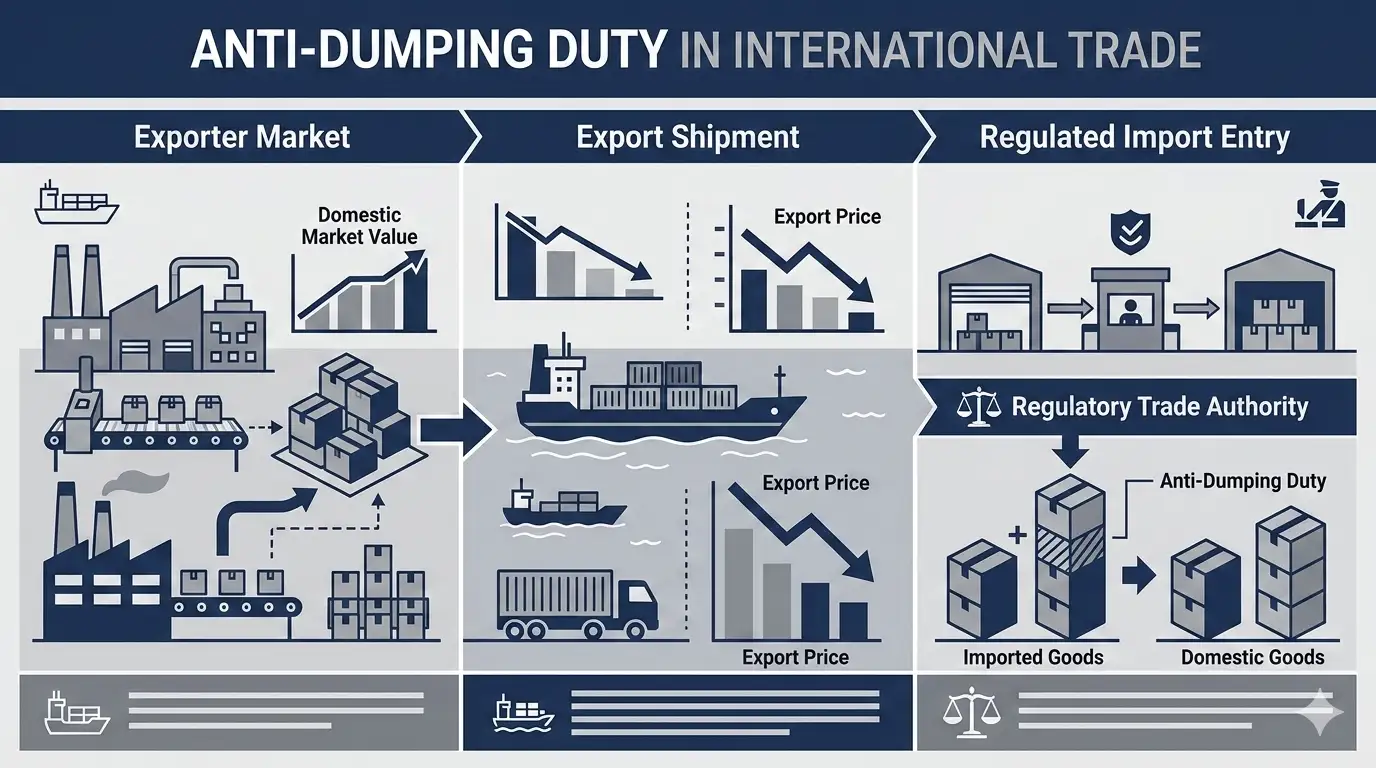
Anti-dumping duty is a special tariff that India imposes on underpriced imports when foreign exporters sell goods in India below their fair value, hurting domestic producers. It is calculated separately from normal customs duty and is targeted at specific products, exporters, and countries rather than applied across the board.
What Is Anti-Dumping Duty?
Anti-dumping duty (ADD) is a protectionist tariff imposed by a country on imports that are sold at a price below their fair market value in the exporter’s home market. In simple terms, if the export price to India is less than the normal value (home market price) for the same product, the difference is called the margin of dumping, and ADD is imposed to neutralise the unfair price advantage.
India is one of the most active users of anti-dumping measures in the world. Studies based on WTO data show that India has initiated roughly 17–20 percent of all global anti-dumping investigations, even though its share of global imports is only around 2 percent. This tells how seriously India uses anti-dumping duty to protect domestic industry from unfair trade.
ADD is:
- Country-specific and exporter-specific, different rates can apply to different producers/exporters of the same product.
- Product-specific, limited to defined HS codes and descriptions.
- A trade-remedy measure, not a revenue measure, its legal purpose is to remove injury, not to raise government income.
Why Countries Use Anti-Dumping Duty
Governments use ADD to:
- Restore fair competition when foreign suppliers dump goods at artificially low prices.
- Prevent long-term damage to domestic capacity, employment, and investments.
- Deter predatory pricing strategies aimed at capturing market share and then raising prices.
In India, ADD is the most commonly used trade-remedy tool compared to countervailing and safeguard measures.
Role of DGTR and Ministry of Finance
- DGTR (Directorate General of Trade Remedies) under the Ministry of Commerce investigates dumping, determines normal value, export price, margin of dumping, and injury.
- Ministry of Finance (Department of Revenue) finally imposes ADD through customs notifications, often producer-wise and country-wise, under Section 9A.
Types of Dumping
There are Three Main Types of Dumping
How Is Anti-Dumping Duty Calculated?
The calculation revolves around two margins:
- Margin of Dumping (MOD) – difference between normal value and export price.
- Injury Margin – difference between non-injurious price and landed cost of imports.
By law and practice, India applies the “lesser duty rule”, the recommended ADD is the lower of MOD and Injury Margin, i.e., just enough to remove injury, not to punish exporters.
Working Formula and Example
Margin of Dumping (MOD)=Normal Value−Export Price
Injury Margin=Non-Injurious Price−Landed Cost
Anti-Dumping Duty=min(MOD,Injury Margin)
Example:
- Normal Value (NV) = ₹120/unit.
- Export Price (EP) to India = ₹80/unit >> MOD = ₹40/unit.
- Non-Injurious Price (NIP) of Indian product = ₹130/unit.
- Landed Cost of imports (CIF + BCD etc.) = ₹100/unit >> Injury Margin = ₹30/unit.
Under the lesser duty rule, ADD = ₹30/unit (lower of ₹40 and ₹30).
If NV/EP data is unreliable in non-market economies, DGTR may determine NV using a surrogate third-country price or constructed value, consistent with WTO rules.
Recent Anti-Dumping Actions by India (2025–26)
Aluminium Foil from China
In March 2025, the Ministry of Finance imposed a provisional ADD on aluminium foil up to 80 microns (excluding certain ultra-light foils) imported from China, ranging from USD 619 to 873 per metric tonne for six months via Notification 02/2025-Customs (ADD).
Soft Ferrite Cores and Vacuum Flasks from China
On 18 March 2025, the government imposed ADD on Soft Ferrite Cores (used in EVs, chargers, and telecom devices) from China under Notification 04/2025-Customs (ADD). Duties go up to 35 percent of CIF value for many Chinese producers, with some cooperative exporters getting lower or nil rates, for a 5-year period.
Chemicals, Steel and Other Inputs
- Acrylic Solid Surfaces from China – Notification 07/2025-Customs (ADD) dated 25 March 2025 imposes ADD up to USD 0.18/kg for 5 years on various acrylic solid surfaces used in kitchens and interiors.
- R‑134a Refrigerant Gas from China – India has imposed ADD up to USD 5,251 per tonne for 5 years on this key refrigerant used in cooling applications.
- Hot-Rolled Flat Steel from Vietnam – Notification 32/2025-Customs (ADD) imposes ADD of USD 121.55 per tonne on most Vietnamese producers of hot-rolled flat products of alloy or non-alloy steel for 5 years.
- Toluene Di-Isocyanate (TDI 80:20) from EU and Saudi Arabia – in 2026, India extended ADD for another 5 years with rates up to USD 344.33 per MT, based on DGTR’s findings of likely continuation of dumping and injury.
Advantages and Disadvantages of Anti-Dumping Duty
Advantages
- Protects domestic industry and jobs by neutralising unfairly low-priced imports that can otherwise wipe out local producers.
- Creates a level playing field for Indian manufacturers to compete on efficiency and quality rather than fighting predatory pricing.
- Encourages long-term investment and innovation by giving industry protection against sudden dumping shocks.
- Acts as a deterrent, repeated use against certain product lines and countries discourages systematic dumping.
- WTO-consistent remedy, when implemented as per ADA rules, ADD is a legitimate trade-remedy, not pure protectionism.
Disadvantages
- Raises input costs for downstream industries and consumers who rely on cheaper imported raw materials or intermediates.
- Risk of overprotection, if duties are kept for too long or set too high, domestic firms may become complacent and less competitive globally.
- Possibility of trade friction, affected countries may challenge measures at the WTO or retaliate with their own trade actions.
- Complex, time-consuming process, investigations typically take 12–18 months and require significant data from all parties.
- Circumvention risks, exporters may reroute goods via third countries or make minor product changes to avoid ADD, forcing authorities to run anti-circumvention probes.
Common Mistakes to Avoid for Importers
- Mistake #1: Ignoring ADD notifications, Many importers only check basic customs duty and GST, and miss product- and country-specific ADD notifications.
- Mistake #2: Wrong HS code, Misclassification can either hide ADD liability or wrongly trigger it, both of which invite penalties and disputes.
- Mistake #3: Not checking producer/exporter-specific rates, ADD rates often vary by producer/exporter; using a generic rate can lead to over- or under-payment.
- Mistake #4: Undeclared circumvention, Routing goods through third countries or small product tweaks to avoid ADD can attract anti-circumvention investigations and retrospective duties.
- Mistake #5: Poor documentation, Not maintaining contracts, invoices, and technical specs that prove the product is outside scope (e.g., excluded grades or thicknesses).
FAQs on Anti-Dumping Duty in India
Is anti-dumping duty calculated on CIF or FOB value?
Most ADD notifications specify the duty as either a fixed amount per unit (e.g., USD/MT) on the CIF value or as a percentage of CIF value.So, in practice, anti-dumping duty is linked to CIF-based landed value, not FOB.
How long does anti-dumping duty last?
Definitive anti-dumping duty is usually imposed for 5 years from the date of imposition
Can importers challenge anti-dumping duty?
Yes. Importers and exporters can challenge ADD before CESTAT under Section 9C and, in appropriate cases, before High Courts and the Supreme Court through written petitions.They can also participate actively in DGTR investigations and reviews to present their data and arguments.
Can anti-dumping duty be imposed retrospectively?
Under WTO rules and Indian law, ADD can, in certain circumstances, be levied retrospectively for up to 90 days prior to the date of provisional measures, particularly where there is a history of dumping causing injury or where massive dumped imports threaten to undermine the remedial effect of duties.