Special Economic Zone (SEZ): Meaning, Types, Benefits, GST Treatment & Complete Guide for Exporters & Importers
Learn what SEZ means, SEZ full form, types, GST zero-rated supplies, tax benefits, and how many SEZs are operational in India
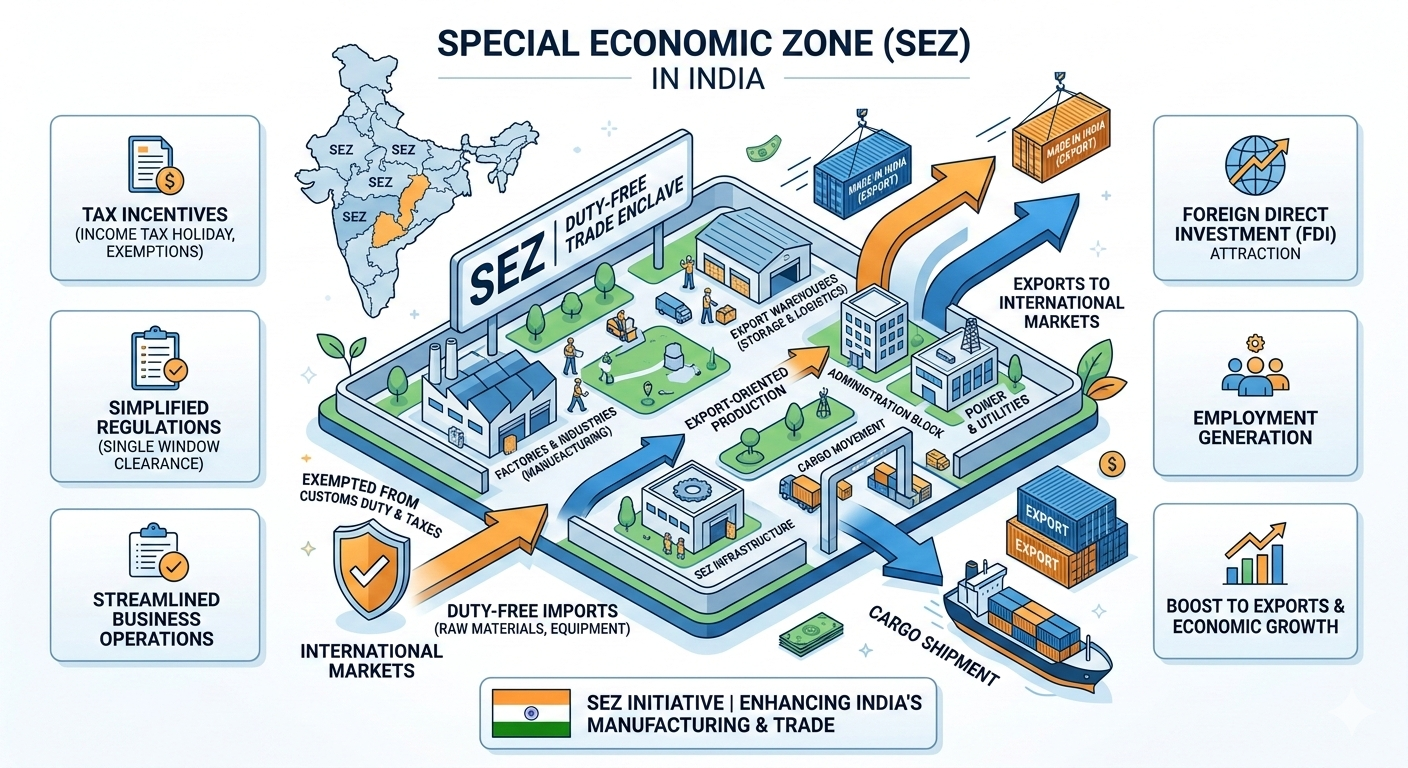
A Special Economic Zone (SEZ) is a geographically designated, duty-free enclave within India that is deemed foreign territory for the purposes of trade operations, customs duties, and tariffs. India currently has 276 operational SEZs that contributed $172.27 billion in exports in FY 2024-25, accounting for a substantial share of the country's total merchandise and services exports.
This guide covers the SEZ full form and meaning, types of SEZs, how they work under GST, customs benefits, income tax incentives under Section 10AA, DTA sales rules, top operational SEZs in India, Budget 2026 reforms, & the proposed DESH Bill.
What Is a Special Economic Zone (SEZ)? — Full Form & Meaning
SEZ stands for Special Economic Zone. It is a specially demarcated, duty-free geographical area within a country's national borders that is treated as outside the customs territory of the country for the purpose of industrial activity, trade operations, duties, and tariffs. Goods entering an SEZ from the rest of India (the Domestic Tariff Area or DTA) are treated as "exports," and goods leaving an SEZ into the DTA are treated as "imports".
Current scale
India currently has 276 operational SEZs with 6,279 units, providing employment to 31.94 lakh persons and attracting a cumulative investment of approximately ₹7.07 lakh crore. Total exports of goods and services from SEZs reached $176.6 billion in FY 2024-25, with goods exports at $69 billion and services exports at $107.6 billion.
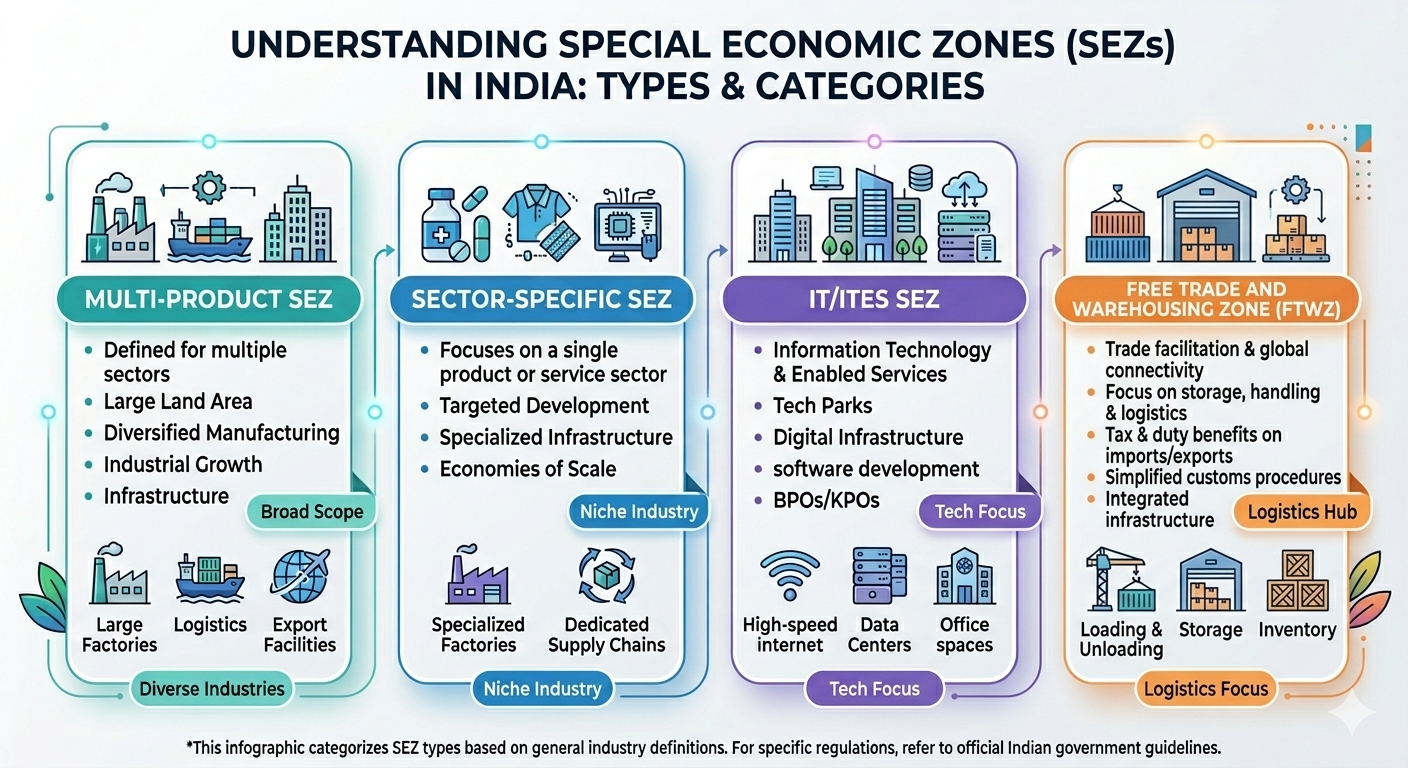
Types of Special Economic Zones in India
SEZs in India are classified based on the type of economic activity they support and their minimum area requirements:
How Does an SEZ Work? — Customs & Trade Operations
SEZ units can import raw materials, capital goods, office equipment, and consumables without paying any customs duty, i.e., BCD, SWS, and IGST are all exempt. Goods procured from DTA suppliers are also treated as "exports" from the DTA, meaning the DTA supplier can claim export benefits.
Exports from SEZ (to Foreign Buyers)
Goods manufactured or services rendered in the SEZ are exported directly, the SEZ is deemed a port/airport/ICD under the Customs Act. Shipping bills are filed and cleared within the SEZ customs office, and there is no routine examination of export cargo by customs authorities. Export proceeds contribute towards the unit's Net Foreign Exchange (NFE) earnings.
SEZ to DTA Sales (Domestic Market)
When an SEZ unit sells goods to a buyer in the rest of India (DTA), the transaction is treated as an import into India. The DTA buyer must file a Bill of Entry for home consumption and pay all applicable customs duties - BCD + SWS + IGST. Online duty payment for SEZ-to-DTA transactions is facilitated through the SEZ Online portal integrated with ICEGATE.
SEZ Under GST: Zero-Rated Supply Explained
Under Section 16 of the IGST Act, 2017, two types of supplies are "zero-rated":
- Exports of goods or services.
- Supply of goods or services to an SEZ developer or SEZ unit
"Zero-rated" means the entire value chain of the supply is exempt from GST, not only is the outward supply tax-free, but the supplier retains full Input Tax Credit (ITC) on all inputs used.
SEZ Tax Benefits & Incentives: The Complete List
Customs duty benefits
- Duty-free imports: All goods (capital goods, raw materials, consumables, spares) imported for authorised operations are exempt from BCD, SWS, IGST, and any other customs duties.
- Duty-free DTA procurement: Goods procured from Indian suppliers in the DTA are treated as zero-rated supplies, no customs duty or GST is applicable.
- Five-year utilisation period: Imported or domestically procured goods can be used for up to five years as per SEZ Rules.
- No routine customs examination: Export/import cargo is not subject to routine physical examination by customs.
- On-site customs office: Authorised Officers posted within the zone ensure faster clearance.
Income tax benefits (Section 10AA)
Sunset Clause: Section 10AA benefits are only available to units that commenced manufacturing or production before 1 April 2021. New units set up after this date cannot claim income tax deduction under 10AA. However, units set up before the cut-off and still within their 15-year window continue to claim deductions.
Other benefits
- 100% FDI allowed through the automatic route for manufacturing.
- Exemption from state-level levies (historically Central Sales Tax, now subsumed under GST).
- Single-window clearance for central and state-level approvals.
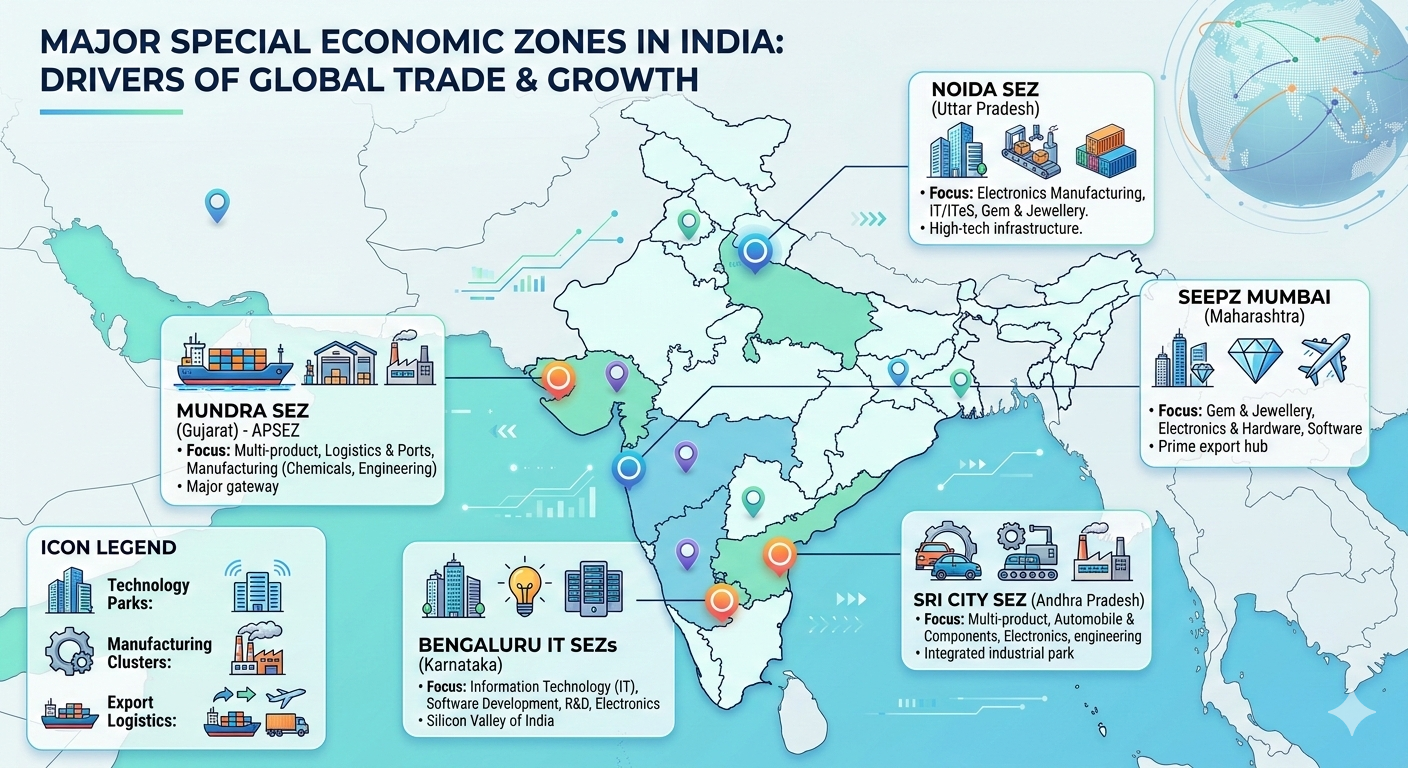
Top Operational SEZs in India
India's 276 operational SEZs were responsible for $172.27 billion in exports in FY 2024-25. The leading SEZs by scale, exports, and strategic importance include:
FTWZ (Free Trade and Warehousing Zone): The SEZ for Importers & Traders
FTWZ is a specialised category of SEZ designed for warehousing, trading, and re-export, not manufacturing. It is governed under the same SEZ Act, 2005 and SEZ Rules, 2006.
Key benefits for importers
- Duty deferment: Import goods into FTWZ without paying customs duty, duty is only payable when goods are cleared into DTA.
- Quality checks before duty payment: Inspect, test, and reject goods before paying any duty, no duty on rejected goods.
- Part consignment clearance: Unlike regular CFS/ICD, goods can be cleared in part consignments from FTWZ, improving inventory flexibility.
- Re-export without duty: If goods are re-exported from FTWZ, zero customs duty is payable.
- Value addition services: Labelling, packing, kitting, bar-coding, palletisation are allowed within the FTWZ.
- 100% FDI permitted for setting up units in FTWZ.
- Foreign entities can stock and sell in India as non-residents without establishing a permanent establishment.
Operational FTWZs in India
Arshiya is the only FTWZ developer in India with two operational zones — Arshiya FTWZ at Panvel (165 acres, near Mumbai, catering to western India) and Arshiya Northern FTWZ at Khurja (135 acres, near Delhi, catering to north India). Both offer integrated logistics infrastructure including warehouses, container yards, inland container depots, and on-site customs offices.
SEZ Online Portal: The Digital Backbone of SEZ Transactions
SEZ Online (sezonline-ndml.co.in) is the official portal developed by NDML (a National Securities Depository Limited subsidiary) as per the directive of the Department of Commerce, Ministry of Commerce & Industry.
The system enables electronic filing and processing of all SEZ-related transactions between SEZ units/developers and SEZ administration, facilitating uniform validations and processes across all zones/units, transparency in government transactions, and internet-based access from anywhere.
Common Mistakes to Avoid for Businesses Dealing with SEZs
Mistake #1 — Not getting separate GST registration for SEZ unit: An SEZ unit or developer must have a separate GSTIN from the DTA entity, using the same registration will lead to ITC complications.
Mistake #2 — DTA supplier not filing LUT before supplying to SEZ: Without a valid LUT, the supply cannot be made without IGST, if IGST is charged, the refund process is longer.
Mistake #3 — Ignoring NFE tracking: Failing to monitor NFE cumulatively can result in negative NFE at the end of the 5-year block, leading to duty recovery and LOA cancellation.
Mistake #4 — Assuming income tax holiday is still available for new units: The Section 10AA sunset clause means no new units (post-April 2021) get income tax deduction, do not factor this into ROI calculations for new SEZ setups.
Mistake #5 — SEZ to DTA sales without proper Bill of Entry, DTA buyers must file a Bill of Entry assessed by the Authorised Officer, skipping this is a customs violation.
Mistake #7 — Not using SEZ Online for filings: All transactions must go through the SEZ Online portal, manual paper filings are not accepted for most zones.
FAQs
What is the full form of SEZ?
SEZ stands for Special Economic Zone, a duty-free enclave within India's national borders treated as outside the customs territory for trade, duties, and tariffs.
How many SEZs are operational in India?
India currently has 276 operational SEZs with 6,279 units across sectors like IT/ITES, pharmaceuticals, textiles, multi-product manufacturing, and gems & jewellery.
What is SEZ in GST?
Under GST, an SEZ is a zone where supplies made to SEZ units/developers are treated as zero-rated (0% GST) under Section 16 of the IGST Act, 2017, and suppliers can claim ITC refund.
What is the difference between SEZ unit and SEZ developer?
A developer builds and maintains SEZ infrastructure, a unit operates within the SEZ to manufacture goods or provide services for export. Both need separate GST registrations.
What is the NFE obligation for SEZ units?
SEZ units must achieve positive Net Foreign Exchange (FOB value of exports minus CIF value of imports minus all forex outflows > 0) over a cumulative 5-year block period. Capital goods are amortised at 10% per year.
What is the DESH Bill?
A proposed legislation to replace the SEZ Act 2005, converting SEZs into "Development Hubs" that serve both export and domestic markets without mandatory NFE obligations. It has been under discussion since 2022 but has not yet been passed.
Can I set up a unit in an SEZ for both export and domestic sale?
The primary purpose of an SEZ unit is export. Domestic sales are permitted but treated as imports with full duty. The NFE obligation means exports must significantly exceed imports and forex outflows. Budget 2026 may ease domestic sale terms with concessional duty rates for manufacturing units.
Dipankar Biswas
I am an international trade, Supply Chain & Logistics Management professional with more than 8 years of in-depth experience in the Industry. I also create youtube videos @Global Vyapar (200K+ Subscribers).