Importing Furniture & Home Decor into India: Fumigation, BIS & Duty
Learn furniture import duty in India, fumigation rules, ISPM-15 wood packaging, BIS requirements, and PQ compliance for smooth customs clearance.
Listen to article
Audio version (0% complete)

Furniture and home décor imports into India look straightforward on paper but are risky in practice because they combine plant health rules for wood and a relatively high customs duty structure. Importers who ignore fumigation, wood packaging and HS classification details often face Plant Quarantine (PQ) holds, re-fumigation costs, storage at port and unexpected duty impact on margins.
Regulatory framework in India
Imports of wooden furniture, bamboo products and decor are governed by the Plant Quarantine (Regulation of Import into India) Order, 2003 issued under the Destructive Insects and Pests Act, 1914. This order sets conditions for importing timber, wood, bamboo products and wood packaging, including mandatory treatments and phytosanitary certification for many items.
While the main focus for wood-based furniture is on Plant Quarantine, fumigation and ISPM-15, many importers now also need to factor in BIS quality control rules for certain furniture categories. The Government has notified the Furniture (Quality Control) Order, 2025 under the Bureau of Indian Standards Act, making BIS certification and use of the Standard Mark (ISI mark) compulsory for specified types of furniture sold or imported into India after a transition period
For a deeper understanding on BIS, please check this internal blog on "BIS Certification in India".

Wood, fumigation and PQ rules
The PQ Order 2003 and its amendments require timber and wood/bamboo products to be treated before export, usually by fumigation with methyl bromide or by approved heat treatment such as kiln drying. A key amendment specifies that timber and wood/bamboo with or without bark must be fumigated with methyl bromide at 48 g/m³ for 24 hours at 21°C or above, or kiln-dried or heat-treated at 56°C for at least 30 minutes at the core, or receive any other approved treatment.
The treatment details must be endorsed on the phytosanitary certificate issued by the exporting country, stating the method, dosage and exposure time where applicable. At Indian ports, PQ officers verify the phytosanitary certificate and may inspect the consignment physically to ensure that declared treatments are credible and match the nature of the goods.
If a consignment arrives without proper treatment or documentation, PQ may order inspection, re-fumigation at the point of entry, or even deportation or destruction, all at the importer’s cost. This can add several days for arranging approved fumigation providers, create additional handling and storage charges, and block working capital while goods are stuck at the port.
Heat treatment vs methyl bromide fumigation
Aspect | Heat treatment / kiln drying | Methyl bromide fumigation |
Typical requirement under PQ Order 2003 | 56°C for at least 30 minutes at wood core, endorsed on phytosanitary certificate | Methyl bromide at 48 g/m³ for around 24 hours at 21°C or above (or equivalent), endorsed on phytosanitary certificate |
Where used | Common for sawn timber, manufactured wooden furniture and bamboo products, especially when done during production | Often used for raw timber, pallets or when heat treatment facilities are not available at origin |
Pros | No chemical residue, can be integrated into kiln-drying at factory, globally accepted | Fast treatment, can be done closer to shipment date, widely recognised under ISPM-15 for wood packaging |
Cons | Requires proper control of time and temperature, needs certified facilities | Chemical use, phase-out pressure in some countries, fumigation certificates closely scrutinised |
For importers, the practical point is to agree upfront with suppliers which treatment will be used and ensure the phytosanitary certificate and any separate fumigation or heat treatment certificates clearly reflect it.
ISPM-15 and wood packaging (pallets, crates, dunnage)
ISPM-15 is an international standard under the International Plant Protection Convention that sets phytosanitary measures for wood packaging material such as pallets, crates, dunnage and similar items used in global trade. India has adopted ISPM-15 through the PQ Order 2003 and Customs instructions, requiring that raw or solid wood packaging used in export or import consignments be appropriately treated and marked as per ISPM-15 or accompanied by a phytosanitary certificate with treatment details.

HS classification, BIS and Chapter 94 scope
Wooden furniture such as bedroom sets, cabinets and tables usually fall under headings within 9403, while plastic furniture may fall under 9403 or 9401 depending on design, and bamboo furniture can be classified under specific subheadings like 9403 82 for bamboo furniture. Wood content drives PQ scrutiny because it brings plant health risk, whereas the HS code drives the applicable customs duty rate and IGST rate.
Furniture products such as work chairs, general-purpose chairs and stools, tables and desks, storage units, beds and bunk beds must conform to their respective Indian Standards (IS 17631–17636) and bear the BIS Standard Mark under a valid licence before they can be manufactured, stocked, sold or imported into the Indian market. The order was issued via DPIIT notification S.O. 801(E) in February 2025 and comes into force after twelve months, meaning that covered products imported on or after early 2026 must be BIS-compliant unless they fall under a specific exemption
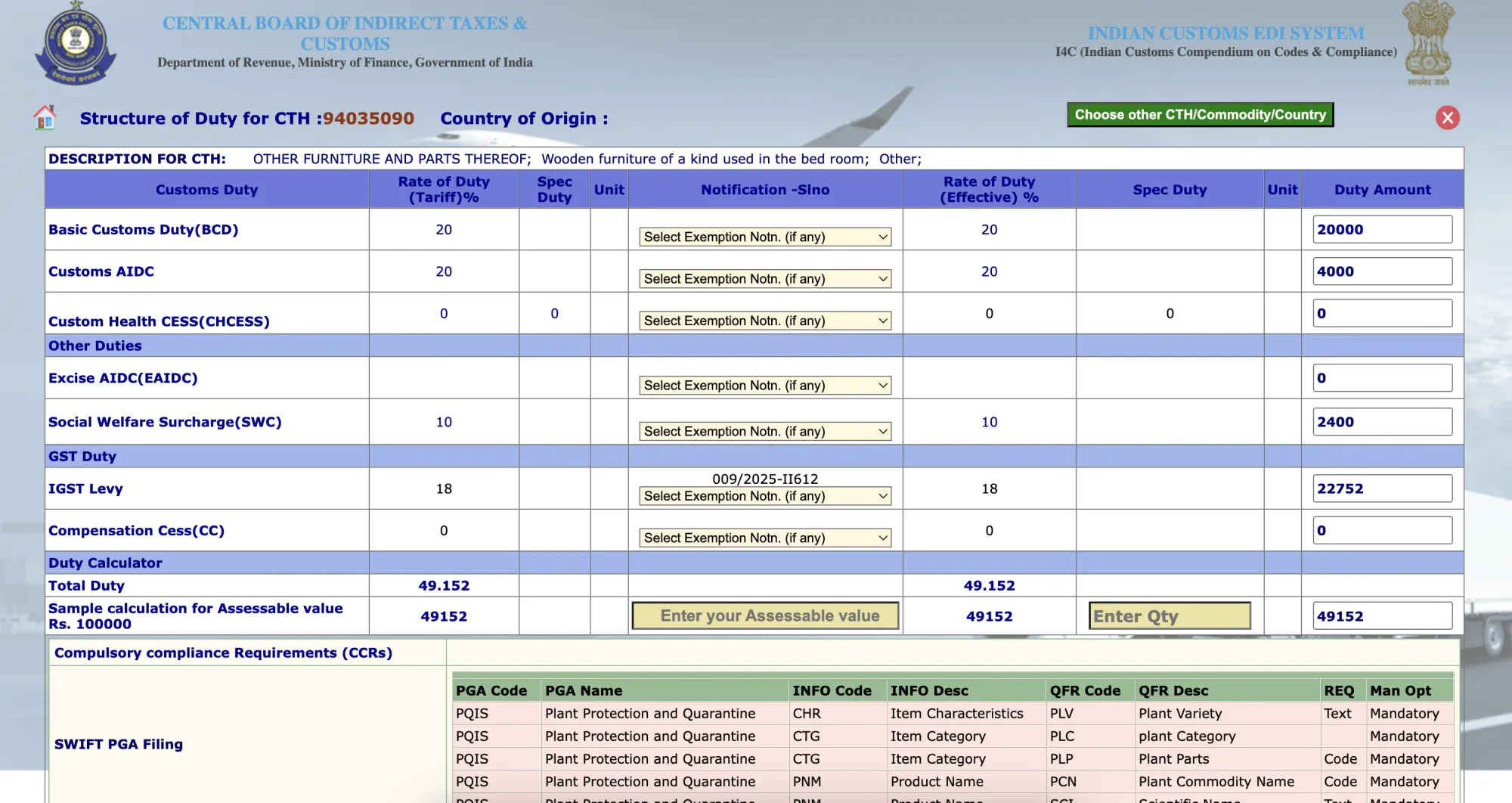
Duty structure and sample calculation
Assume a shipment of wooden furniture with a CIF assessable value of INR 10,00,000 and a duty structure of BCD 25 percent, SWS 10 percent of BCD and IGST 18 percent (illustrative, importers must check live tariff):
Component | Basis | Rate | Amount (INR) |
Assessable value | CIF | – | 10,00,000 |
Basic Customs Duty (BCD) | On assessable value | 25% | 2,50,000 |
Social Welfare Surcharge (SWS) | On BCD | 10% | 25,000 |
Subtotal for IGST | Assessable value + BCD + SWS | – | 12,75,000 |
IGST | On subtotal | 18% | 2,29,500 |
Total duties and taxes | BCD + SWS + IGST | – | 5,04,500 |
Landed cost (duty-paid value) | Assessable value + total duties | – | 15,04,500 |
If you want to know more about customs duty please check this blog on "Customs Duty: Complete Guide to Import".
Common mistakes, holds and how to avoid them
Mistake 1 is missing or incorrect treatment details on the phytosanitary certificate, such as no mention of methyl bromide dosage or incomplete heat treatment description, which triggers PQ suspicion.
Mistake 2 is using non-ISPM-15 pallets or mixed compliant and non-compliant wood packaging, which Customs officers flag and refer to PQ for action.
Mistake 3 is misdeclared HS codes or materials, for example declaring bamboo furniture as generic wooden furniture or mixing plastic and wood content in one description, which can lead to reassessment of duty and possible penalties.
Mistake 4 is incomplete documentation, such as missing fumigation certificates, unclear packing lists or inconsistent descriptions between invoice, packing list and Bill of Lading, leading to queries and delays.
These errors can lead to storage and demurrage at port, re-fumigation or re-packaging costs, risk of destruction or re-export orders by PQ and cash-flow pain from delayed sales and blocked capital. Simple preventive checklists with suppliers and logistics partners covering treatment, packaging, documents and HS codes can significantly reduce these risks.
Sample importer checklist
- Confirm supplier’s ability to meet PQ Order 2003 treatment requirements for wood/bamboo products.
- Specify heat treatment/fumigation and ISPM-15 packaging in purchase contracts.
- Collect draft phytosanitary and treatment certificates before shipment and correct errors.
- Align HS classification with customs broker and verify BIS requirements, duties and IGST estimates.
- Ensure all wooden pallets/crates bear valid ISPM-15 marks or equivalent certificates.
- Pre-alert broker with full document set for pre-arrival compliance checks.
FAQs
Frequently Asked Questions
Not every item needs fumigation, but timber and many wood/bamboo products must receive approved treatments such as methyl bromide fumigation or heat treatment, which must be endorsed on the phytosanitary certificate as per the PQ Order 2003.
Evidence usually includes visible ISPM-15 marks on pallets or crates and, where requested, supporting documentation from an authorised treatment provider or a phytosanitary certificate mentioning the treatment applied to wood packaging.
Work with your customs broker to confirm the correct HS code under Chapter 94, then apply the prevailing BCD, SWS and IGST rates from the tariff for that code, remembering that BCD and SWS are calculated first and IGST is applied on the duty-paid value.
Yes, if a consignment poses unacceptable pest risk or cannot be brought into compliance through treatment, PQ authorities may order deportation or destruction at the importer’s cost under the PQ Order 2003.
The broker helps confirm HS codes, advises on duties, checks document completeness, files the Bill of Entry, coordinates with PQ officers for inspections and arranges re-treatment or clarifications, but the legal responsibility for compliance still rests with the importer.