Why Is Indian Rupee Falling Against Chinese Yuan? [Complete Analysis]
Complete Analysis of INR Vs Chinese Yuan, Effect on importer & Exporter, US Tariff, Merits, Demerits and FAQs
![Why Is Indian Rupee Falling Against Chinese Yuan? [Complete Analysis]](https://eximpe-blog.ghost.io/content/images/2026/01/Untitled-design--2--1.png)
The Indian rupee has depreciated 6-7.5% against the Chinese yuan in recent months, hitting record lows and creating ripple effects across India's economy. If you're an exporter, importer, investor, or simply someone who sends money to someone in China, this matters to your business.
Let's break down the seven key reasons why the rupee is falling against the yuan, and what it means for different stakeholders in India.
1. The $99.2 Billion Trade Deficit With China
India's trade deficit with China is the elephant in the room. As of 2025, India imports $99.2 billion worth of goods more from China than it exports. This is the highest bilateral trade deficit India has with any country.
Every time an Indian importer buys goods from China, they prefer yuan to pay. But Indian exporters selling to China bring in rupees, not yuan. This creates constant demand for yuan and constant supply of rupees in the forex market, pushing the rupee lower.
The math is simple: More money flowing out (yuan needed) than flowing in (rupees earned) = rupee depreciation.
Since 2021, India's trade deficit with China has more than doubled, from $44 billion to $99.2 billion. This accelerating deficit is a major pressure point on the rupee.
2. US Tariffs: India Faces Higher Rates Than China
Here's a critical factor many people miss: The US imposed 50% tariffs on Indian goods but only 30% average tariffs on Chinese goods (as of August 2025).
This seemingly small difference has a massive currency implications. When Indian exporters face higher tariffs, their products become less competitive in the US market. Fewer export orders = fewer dollars flowing into India = less demand for rupees globally.
Meanwhile, Chinese exporters still have better tariff access, allowing them to maintain stronger export flows and currency inflows.
This tariff disparity directly weakens the rupee's position against the yuan in the global market.
3. Foreign Portfolio Investment (FPI) Outflows: $16.5 Billion Left in 2025
Foreign investors pulled out $16.5 billion in 2025, this is the largest outflow in recent years. There are two reasons behind this:
First, China looks cheaper: After China's stimulus announcements, valuations in Chinese stocks suddenly looked attractive compared to India's higher valuations.
Second, capital rotation: Global investors rotated from India's growth story to China's stimulus-backed markets, drawn by better near-term earnings upgrades and lower entry prices.
When FPIs exit India, they need to convert rupees back to dollars, increasing rupee supply in the forex market and pushing the currency lower. Additionally, hedging against further currency risk increases demand for yuan (as a proxy for Asian currency strength).
4. Rising Crude Oil Prices: Widening Import Bill
When crude oil prices surge, India's oil import bill skyrockets (India imports ~80% of its oil). In 2025, rising oil costs pushed the import bill higher, requiring more foreign currency to settle these payments.
The mechanism: More imports need payment in foreign currencies → More demand for yuan (to pay Chinese suppliers) → Rupee weakens against yuan.
Oil price volatility creates unpredictable currency pressure because India has limited domestic supply and must pay in foreign currency.
5. China's PBOC Actively Strengthening the Yuan
This is the factor India cannot control: China's central bank (PBOC) has been actively strengthening the yuan.
Unlike 2018 when China allowed the yuan to weaken to counter US tariffs, the PBOC in 2025 is doing the opposite, they are using daily midpoint fixes to gradually appreciate the yuan. Why?
China wants to internationalize the yuan and position it as a global reserve currency. A stronger, more stable yuan builds international confidence.
Result: While the rupee weakens due to trade deficit and capital outflows, the yuan strengthens due to deliberate central bank support. The rupee falls against the yuan on both counts.
6. Speculators and Hedging Demand Amplify the Move
Beyond fundamental factors, traders are piling on bearish bets on the rupee. When importers and investors see rupee weakness, they rush to hedge by buying yuan, which adds to depreciation pressure.
Speculators seeing this trend also take short positions on the rupee, amplifying the downward movement. This creates a self-reinforcing cycle: weakness → more hedging → more weakness.
7. Weak Economic Indicators Eroding Foreign Investor Confidence
India's manufacturing PMI slowed, and corporate earnings growth disappointed in 2025. This eroded foreign investor confidence in rupee assets.
When investors lose faith in an economy's growth prospects, they pull capital. Currency weakness follows.
The Historical Breakdown
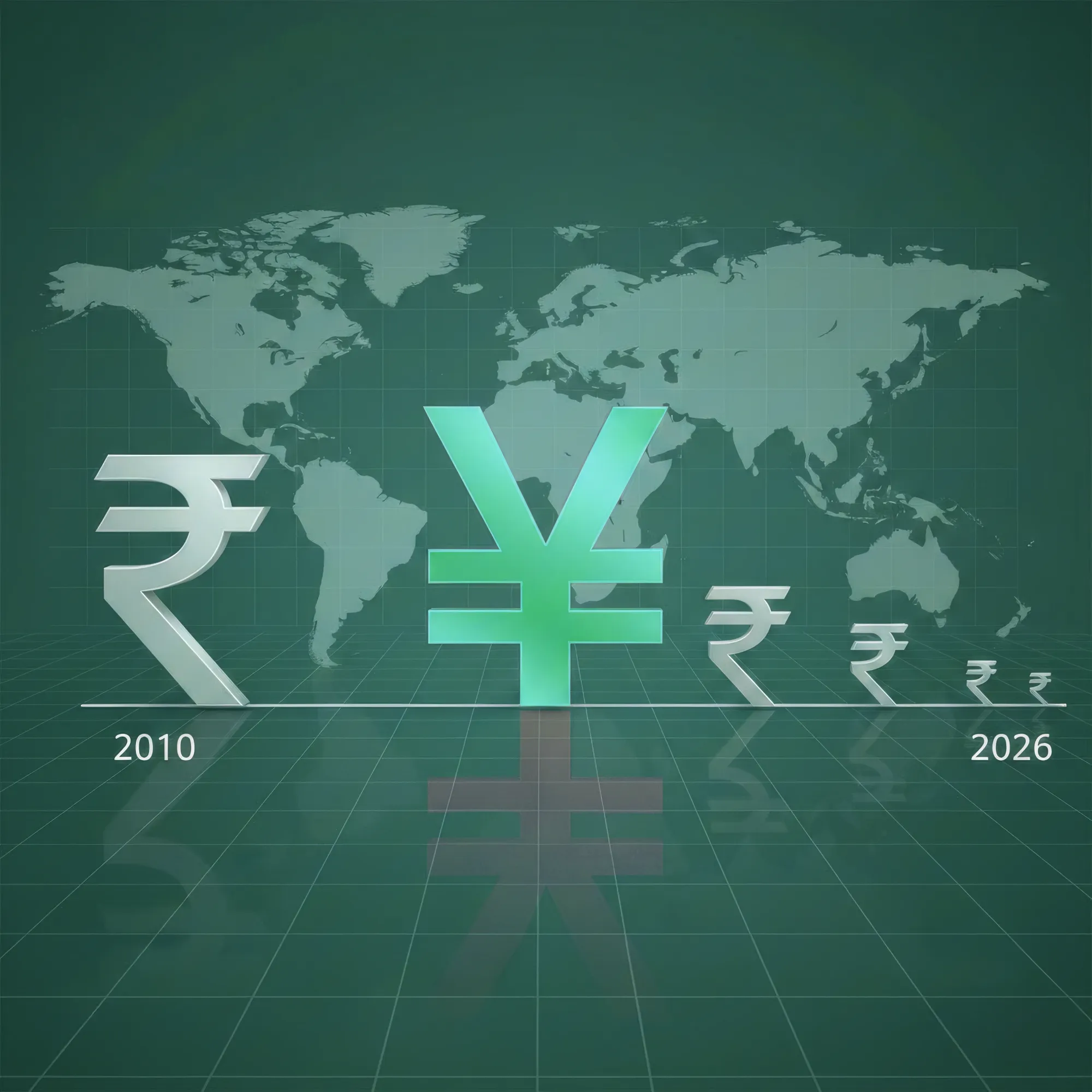
In 2010, 1 Chinese yuan was worth just 6.75 rupees. Today, it's worth 13.18 rupees. That's a 95% depreciation of the rupee against the yuan over 16 years—approximately 4.5% annually.
The Historical Breakdown
Three Crisis Periods Stand Out:
2013-2015: The Taper Tantrum CrisisWhen the US Federal Reserve announced it was ending stimulus, global capital fled emerging markets like India. The rupee fell 11% annually during this period—the fastest depreciation in recent history.
2016-2018: Policy Adjustments Demonetization, GST implementation, and US-China trade tensions created secondary waves of weakness, though at a slower 5-7% annual rate.
2025-2026: The Tariff Shock, The current depreciation is happening at 9.1% in just 6 months—nearly 2x faster than the long-term average. This shows how severe the current situation is compared to typical years.
Who Gets Hurt? & Who Benefits?
Understanding these causes helps us see the impact on different groups:
For Importers: The Pain Is Real
Indian importers buying from China now pay 6-7.5% more rupees for the same goods than they did a year ago. This is particularly painful for MSMEs that can't absorb additional costs or don't have scale to hedge currency risk.
For Exporters: A Silver Lining
Indian exporters get a competitive advantage. When the rupee weakens, Indian products become cheaper in global markets. An exporter selling textiles or engineering goods suddenly finds Chinese buyers more interested.
India has an untapped $161 billion export potential to China. A weaker rupee helps unlock this opportunity in price-sensitive sectors like textiles, chemicals, and machinery.
For Investors: Capital Erosion Risk
Foreign investors holding rupee assets see their returns eroded by currency depreciation. This adds to the capital outflow problem and creates more downward pressure on the rupee.
For NRIs: Remittance Benefit
For Indians living in China, rupee depreciation is actually good news. A 1,000 yuan remittance now converts into more rupees than before, helping families back home stretch their budgets.
The RBI's Balancing Act
The Reserve Bank of India isn't panicking. It's deliberately allowing some depreciation because a weaker rupee helps Indian exporters and reduces the trade deficit, both long-term benefits.
What the RBI won't tolerate is rapid, uncontrolled depreciation. In June 2025, the RBI sold $3.6 billion from forex reserves to smoothen the rupee's fall and prevent panic.
India's Real Effective Exchange Rate (REER) at 98.35 in July indicates the rupee has depreciated enough to maintain competitiveness without spiraling out of control.
Conclusion
The rupee is falling against the yuan because of a combination of factors:
- Massive trade deficit requiring yuan payments
- Higher US tariffs making Indian exports less competitive
- Foreign investors exiting India for China
- Rising oil import bills
- China's central bank deliberately strengthening the yuan
- Speculators adding to the decline
- Weakening economic signals
For importers and businesses: Hedging becomes critical to protect margins.
For exporters: This is an opportunity to compete harder in Chinese and global markets.
For India as a nation: The real challenge isn't the rupee's fall, it's whether India can compete with China on scale, efficiency, and innovation before the trade deficit grows even larger.
The depreciation will likely continue until either the trade deficit shrinks, FPI inflows resume, or global conditions improve. Until then, the rupee against the yuan remains under pressure.
Is weak rupee good or bad for India?
winners - exporters, NRIs, tourism & losers - importers, consumers, borrowers
How does rupee depreciation affect my import costs?
Importers buying from China now pay 6-7.5% more rupees for the same goods than they did a year ago
What should NRIs do when rupee is depreciating?
For Indians living in China, rupee depreciation is actually good news. A 1,000 yuan remittance now converts into more rupees than before, helping families back home stretch their budgets
How does rupee depreciation affect stock market returns?
Rupee depreciation generally hurts the broader stock market by increasing import costs and fueling inflation
How does this affect my ability to buy Chinese products (for resale)?
One container of goods will cost you 5-7.5% more compared to a year ago prices, thus making the landing cost more. Your product will become more expensive for the end customer