Virtual Bank Accounts: The Complete Guide to Meaning, Types & How They Work (2026)
Global virtual bank accounts give Indian businesses US/UK/EU bank details. No SWIFT fees, 1-2 day settlement, auto FIRA. 2026 provider guide
Listen to article
Audio version (0% complete)
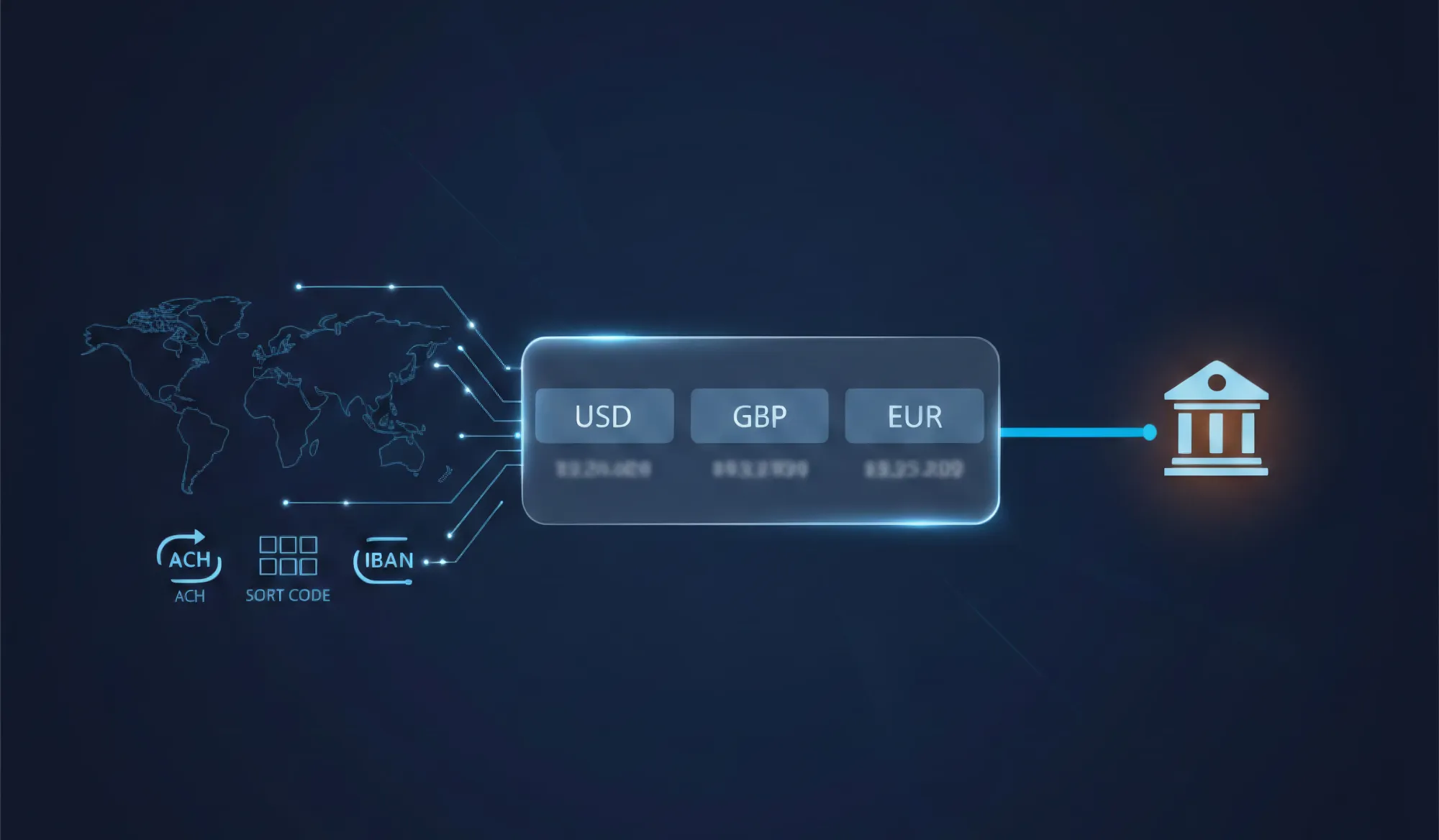
A global virtual bank account gives your business a local bank account number in the US (ACH routing), UK (sort code), or Europe (IBAN) without opening a physical account in that country. Your international clients pay you like a local transfer. Funds convert and settle into your Indian bank account within 1-2 days, saving 50-75% on fees vs traditional SWIFT wires.
What Is a Global Virtual Bank Account?
A global virtual bank account is a fully digital bank account in a foreign currency (USD, EUR, GBP) provided by a fintech or digital bank that lets you receive international payments as if you had a local bank account in that country. The virtual account doesn't replace your bank. It sits on top of your existing Indian bank account as a receiving layer for international payments.
How Global Virtual Accounts Work — Step-by-Step
Scenario: Indian SaaS company receiving $5,000 from a US client.
Step 1: You sign up with a RBI licensed cross-border payment provider like EximPe.
Step 2: EximPe issues you a local US bank account with ACH routing number and account number in your company/ personal name.
Step 3: You share these "US bank details" on your invoice to your American client.
Step 4: Client pays via ACH transfer (like paying any local US vendor). No SWIFT. No intermediary banks required.
Step 5: Funds hit your virtual account >> provider converts USD to INR at live mid-market rate >> INR settles in your Indian bank account within 1-2 business days.
Step 6: EximPe auto-generates FIRA (Foreign Inward Remittance Advice) for RBI compliance.
The same model works for GBP, EUR, CAD, AUD.
Global Virtual Account vs EEFC Account
Feature | EEFC Account | Global Virtual Account |
What it is | Foreign currency current account at your Indian bank | Digital account with local details in US/UK/EU |
Hold foreign currency? | Yes, 100% of export earnings | Most route to INR |
How clients pay | SWIFT wire transfer | Local ACH/SEPA/FPS |
Fees | Bank TT charges + FX markup | Flat fee or 0.3-1% |
Settlement speed | 2-5 days | 1-2 days |
FIRA/FIRC | Manual request | Auto-generated |
Best for | Holding forex for future payments | Regular receivables, speed, savings |
Who Should Use Global Virtual Accounts
Exporters: Receive payments from international buyers without SWIFT deductions. Save ₹15,000-25,000 per transaction on a $10,000 payment.
Freelancers & Consultants: Get paid from direct US/UK clients. Avoid PayPal's 4-5% conversion markup.
SaaS Companies: Collect subscription payments from global customers via local transfers. Better conversion rates than card payments.
Import-Export Businesses: Use virtual accounts for the export leg (receive foreign currency cheaply) while managing import payments through the same channels.
RBI Compliance: What You Must Know
Global virtual accounts for Indian businesses must operate under RBI's FEMA regulations.
Key compliance requirements:
- Provider must have a PA-CB RBI License
- Every inward remittance needs a purpose code
- FIRA (Foreign Inward Remittance Advice) must be generated for each receipts
- IEC (Import Export Code) required for goods trade, not mandatory for services
- GST compliance: Export of services is zero-rated under LUT, goods exports follow standard GST rules

Limitations
- Not all currencies supported, most providers focus on USD, EUR, GBP, SGD, CAD, AUD only.
- FX risk conversion at market rates means fluctuation exposure.
- Provider dependency, if your fintech faces issues, your virtual accounts are affected.
- Not a full bank account, most virtual accounts don't let you hold balances or make outward payments.
- Regulatory changes, RBI frameworks evolve, stay updated on PA-CB and FEMA rules.
- Transaction limits, some providers cap per-transaction or monthly volumes.
FAQs
Frequently Asked Questions
A digital account with local bank details (US routing number, UK sort code, EU IBAN) that lets you receive international payments via local rails, with funds converting and settling into your Indian bank account.
SWIFT routes through intermediary banks (slow, expensive, unpredictable deductions). Virtual accounts use local payment rails (ACH, SEPA, Faster Payments), faster, cheaper, transparent.
Yes. Platforms like EximPe has a RBI license and generate FIRA for every remittance.
VPA is your UPI ID for domestic INR transfers. A global virtual bank account is for receiving international foreign currency payments.
For goods trade, yes. For service exports (freelancing, SaaS, consulting), IEC is generally not required.