RoDTEP Scheme in 2026: Meaning, Rates, Claim Process & Practical Guide for Exporters
Learn RoDTEP scheme meaning, rates, claim process, and ICEGATE steps for exporters in 2026.
Listen to article
Audio version (0% complete)

If you are exporting from India in 2026, RoDTEP is now a non-negotiable part of your pricing and margin planning. It replaces MEIS for most products, refunds embedded taxes that were earlier stuck in your cost, and is confirmed to continue at existing rates at least till 30 September 2026.
RoDTEP stands for Remission of Duties and Taxes on Exported Products and is India’s main WTO-compliant export remission scheme, designed to refund hidden central, state and local levies that are not refunded anywhere else. India shifted from MEIS to RoDTEP after MEIS was successfully challenged at the WTO as a prohibited export subsidy, forcing a move towards pure "tax remission" instead of incentive‑style scrips.
What Is the RoDTEP Scheme? (Meaning, Objectives, and Full Form)
Meaning and Objective
The RoDTEP scheme’s core objective is to refund embedded, non‑creditable taxes and duties incurred along the export supply chain that were previously sitting inside your cost. These refunds are given as duty credit (e‑scrips) based on a percentage of the FOB value or sometimes a fixed amount per unit.
RoDTEP typically covers levies such as:
- Central, state and local taxes on fuel used in transport and captive power.
- Electricity duty and other state-level power levies.
- Mandi fees, market cess and municipal taxes.
- Some embedded GST components that are not otherwise refunded via ITC or drawback.
Sectors Covered
RoDTEP is open to a wide range of sectors, with product‑wise coverage and rates notified through DGFT in Appendix 4R (and 4RE for AA/EOU/SEZ in later expansions). Key labour‑intensive sectors include:
- Textiles and garments.
- Agriculture and marine products.
- Leather and footwear.
- Chemicals and plastics.
- Engineering goods, automobiles and auto components.
- Electronics and machinery.
RoDTEP Scheme Rates
RoDTEP rates are notified as a percentage of FOB value (and sometimes with a per-unit value cap) for each HS code.
Across most goods, rates:
- Generally fall in the 0.3% to 4.3% band of FOB value.
- Tend to be higher (roughly 3–4%) for certain textile, apparel and similar labour‑intensive lines.
This is not a "profit bonus" like MEIS felt earlier, it is a small but important margin stabiliser that offsets hidden levies over many shipments.
How to Find Your Rate in Appendix 4R
In practice, exporters should:
- Identify the correct HS code for each product from the Customs Tariff or DGFT website.
- Visit the DGFT RoDTEP page, download the latest Appendix 4R (and 4RE where applicable).
- Look up each HS code to find:
- Percentage rate (e.g., 0.8%, 1.2%, 3.4%).
- Per‑unit value cap, if any (e.g., ₹5 per kg, ₹15 per piece).
- Apply the lower of "rate × FOB value" and "value cap x quantity" while estimating your benefit.
Illustrative Sector-wise Rate Ranges
(Indicative only-actual rates must be checked in DGFT Appendix 4R.)
Sector (Indicative) | Typical RoDTEP Rate Band | Comment |
Textiles & garments | ~1.0% - 4.0% FOB | Many lines at higher end to support labour-intensive exports. |
Leather & footwear | ~0.8% - 3.0% FOB | Often supported due to employment intensity. |
Agriculture & marine | ~0.5% - 3.0% FOB | Rates reflect fuel, mandi and local levies. |
Chemicals & plastics | ~0.3% - 2.5% FOB | Varies widely by HS code and value cap. |
Auto parts & machinery | ~0.3% - 2.0% FOB | Typically lower, but significant in high‑value shipments. |
RoDTEP Eligibility and Ineligible Categories
Typical Eligibility Conditions
While details change via notifications, common conditions include:
- Goods must be exported from India, with proper shipping documents and FOB value declared.
- Export proceeds must be realised within RBI timelines (usually nine months for most exports, unless extended).
- Exporter must declare RoDTEP in the electronic Shipping Bill at the time of filing-no back‑dated claims.
- Only un refunded levies are remitted, taxes already neutralised via drawback/ITC/IPL etc. are not meant to be double-refunded.
- Exporter must hold a valid IEC and be registered on ICEGATE to create an e-scrip ledger and use benefits.
Over time, RoDTEP has been extended to certain AA/EOU/SEZ exports via separate appendices and notifications, with specific conditions.
Common Ineligible / Restricted Cases
Notifications and FAQs highlight several restricted categories, such as:
- Particular HS codes explicitly marked as "no RoDTEP or kept out due to policy reasons.
- Certain deemed exports or supplies where other forms of refund/subsidy already exist.
- Specific periods where AA/EOU/SEZ/DTA combinations were gradually brought into or kept out of the scheme.
Because these lists evolve, exporters should always:
- Check the latest DGFT RoDTEP page and Appendix 4R/4RE notes before quoting benefits.
- Review recent DGFT and CBIC notifications or consult a trade advisor for edge cases.
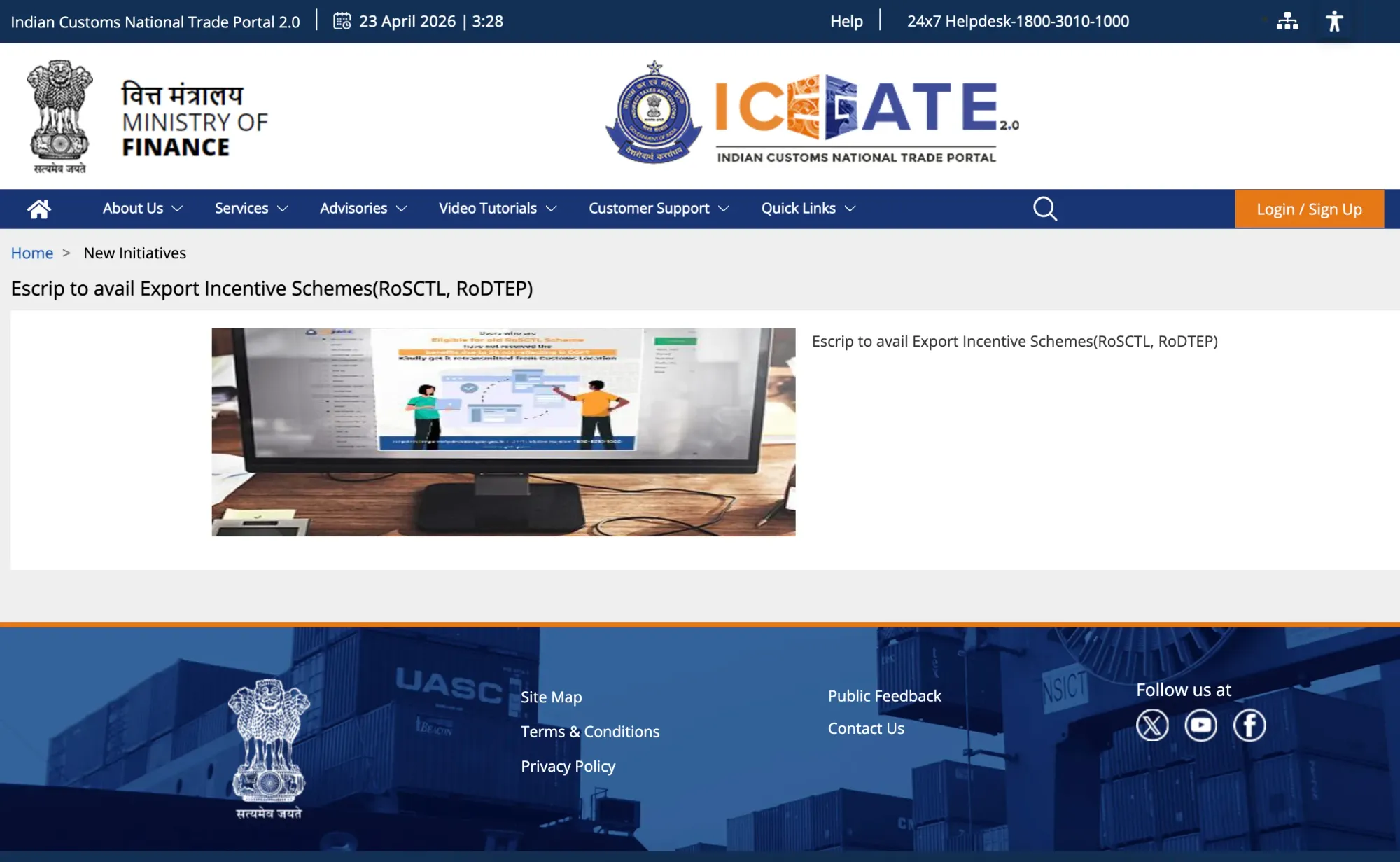
Step-by-Step: How to Claim RoDTEP in Your Shipping Bill and on ICEGATE
The good news: RoDTEP is largely system‑driven.
The bad news: if you miss a step in the shipping bill or ICEGATE, money is left on the table.
The typical flow is:
Step 1 - Declare RoDTEP in the Shipping Bill
- While filing the electronic Shipping Bill, your CHA or internal team must select the RoDTEP scheme code/flag for each eligible item.
- From 01.01.2021, it is mandatory to indicate whether you want to claim RoDTEP-if you don’t declare, you generally cannot claim later.
Step 2 - Wait for EGM Filing and Customs Processing
- After the vessel/flight leaves, the Export General Manifest (EGM) is filed by the carrier.
- Once EGM is successfully filed, Customs systems process RoDTEP eligibility and amounts per shipping bill.
Step 3 - RoDTEP Scroll Generation
- Post-processing, a RoDTEP scroll is generated containing all eligible shipping bills with their respective credit amounts.
- This scroll is made available in your ICEGATE account, tagged to your IEC.
Step 4 - Create RoDTEP e-Scrip Credit Ledger on ICEGATE
- Log in to ICEGATE with your IEC (and DSC where required).
- Under the relevant "RoDTEP" or "e‑scrip" section, create your RoDTEP credit ledger account, a pre‑condition to using any credits.
Step 5 - Generate RoDTEP e‑Scrips
- In ICEGATE, select the relevant scroll and shipping bills, and generate e-scrips that move the credit from "scroll" to "usable scrip".
- These e-scrips appear in your account and can be used for duty payment or transfer.
Step 6 - Use or Transfer the e-Scrips
- At the time of import, you can apply e-scrips against basic customs duty (BCD) in your Bill of Entry.
- Alternatively, you may transfer the e-scrip to another IEC holder through the ICEGATE portal.
Using RoDTEP e‑Scrips: Import Duty, Transfer and Practical Tips
What RoDTEP e‑Scrips Can and Cannot Pay
RoDTEP e-scrips are transferable duty credit instruments stored in your ICEGATE e‑ledger. They can:
- Be used to pay Basic Customs Duty (BCD) at the time of import.
- Be transferred/sold to other IEC holders who then use them for their imports.
They cannot be used to pay:
- IGST on imports.
- Anti-dumping duty, safeguard duty, or similar trade-remedial duties.
- Social Welfare Surcharge and other non-BCD levies.
How to Transfer a RoDTEP e‑Scrip
The transfer flow on ICEGATE works like this:
- Log in to ICEGATE and go to your RoDTEP e-scrip ledger.
- Select the e-scrip you want to transfer and choose the "Transfer" option.
- Enter the IEC of the buyer (recipient) and confirm details.
- Authenticate via OTP/DSC as required.
- Once confirmed, the scrip moves out of your ledger and appears in the recipient’s ledger.
This is why a secondary market has developed for RoDTEP scrips-exporters with no immediate imports often sell credits to importers for cash, improving short‑term liquidity.
Example: Using RoDTEP for a Machinery Import
Imagine a mid-size textile exporter:
- Annual exports: ₹10 crore FOB.
- Average RoDTEP rate on their HS codes: ~1.2% (illustrative).
- Annual RoDTEP credit: about ₹12 lakh.
Three months later they import new machinery with BCD of ₹12 lakh. By using accumulated RoDTEP e-scrips, the exporter can offset the entire BCD, effectively making the machinery import cheaper, improving payback and cash flow.
Common RoDTEP Mistakes and How to Avoid Them
Mistake #1: Not Selecting RoDTEP in the Shipping Bill
- If the RoDTEP flag/scheme code is not selected while filing, you generally cannot claim later.
- Fix: Create a checklist with your CHA; explicitly mention "Claim RoDTEP" on every export job sheet.
Mistake #2: Wrong or Outdated HS Code Mapping to Appendix 4R
- Using an incorrect HS code means you may get lower or zero benefit than you’re entitled to.
- Fix: Periodically review HS codes with your CHA or consultant, always cross-check the current Appendix 4R before quoting rates.
Mistake #3: Mismatch Between Invoice and Shipping Bill Data
- Value/quantity mismatches can lead to processing delays or partial credits.
- Fix: Ensure strong internal SOPs so invoice, packing list and shipping bill data are aligned before EGM.
Mistake #4: Not Creating the ICEGATE RoDTEP Credit Ledger
- Some exporters stop after scroll generation and never create the e‑scrip ledger, leaving credits idle.
- Fix: Treat ICEGATE registration and RoDTEP ledger creation as a one-time onboarding task and document it.
Mistake #5: Ignoring DGFT/CBIC Notifications on Rate Changes and Extensions
- Planning margins on old rates can make you over‑promise or under‑price.
- Fix: Subscribe to DGFT updates or follow a trusted trade advisory, review RoDTEP notifications quarterly.
Mistake #6: Assuming RoDTEP Covers All Duties on Imports
- Many exporters think RoDTEP scrips can pay IGST or anti‑dumping duty, they cannot.
- Fix: Train your finance and CHA teams: RoDTEP is BCD‑only, plan IGST and other duties separately.
Mistake #7: No Reconciliation Between RoDTEP Credits and BOE Duty Payments
- If you’re using RoDTEP to pay BCD but not reconciling with your Bill of Entry records, you can lose track.
- Fix: Use EximPe’s guides "What Is Bill of Entry? Complete BOE Guide 2026", and "How to Check Bill of Entry Status Online on ICEGATE Portal" to build a simple reconciliation process.
FAQs
Frequently Asked Questions
RoDTEP stands for Remission of Duties and Taxes on Exported Products, a scheme that refunds embedded, unrefunded taxes and duties on exported goods.
Go to the DGFT RoDTEP page, download the most recent Appendix 4R (and 4RE if relevant), and search for your product’s HS code to see the percentage rate and any value cap.
For most products, RoDTEP rates currently range from around 0.3% to 4.3% of FOB value, depending on the HS code and sector.
In many textile and apparel lines, RoDTEP and RoSCTL are structured to cover different layers of levies, but actual combinability depends on current notifications, exporters must check the latest DGFT/CBIC rules for their HS codes.
After export, once the EGM is filed and Customs processes the claim, RoDTEP amounts appear in the scroll and then in your ICEGATE account for conversion into e-scrips, the timeline depends on port systems but is typically a matter of days to a few weeks.
RoDTEP e-scrips can only be used to pay Basic Customs Duty (BCD), they cannot be used for IGST, anti-dumping duty, safeguard duty or similar charges.
Recent notifications and DGFT updates have progressively extended RoDTEP coverage to certain AA/EOU/SEZ exports, via separate appendices and timelines, but eligibility is specific to product and period, so units must verify the latest DGFT circulars and Appendix 4RE entries.