What is an HSN Code & How to find the Right One? Beginner’s Guide (2026)
Complete HSN code guide for import-export: What is HSN, how to find correct code, HSN Vs SAC, India’s context and FAQs
Listen to article
Audio version (0% complete)
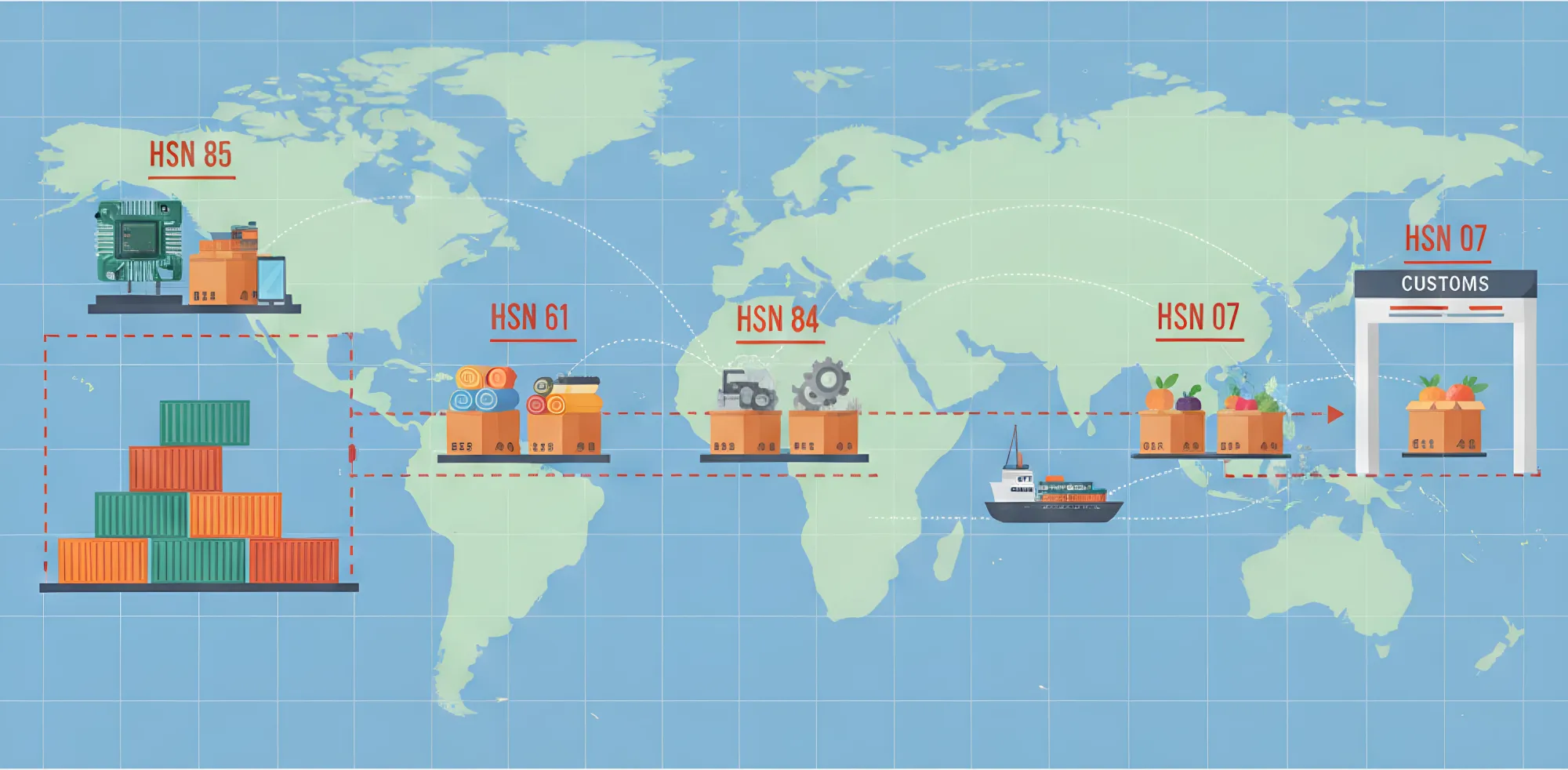
If you are importing or exporting from India, your HSN code determines your customs duty, IGST, export incentives, and even whether your shipment is stopped at the port. The full form of HSN code is Harmonized System of Nomenclature, and using the wrong code can literally be the difference between paying 5% and 25% duty on the same product.
What is an HSN Code?
HSN code is a globally standardised numerical system used to classify goods in international trade.
In simple words, it is the "product identity number" that customs, GST and trade systems use worldwide.
- HSN code full form: Harmonized System of Nomenclature.
- Developed by: World Customs Organization (WCO), in use since 1988.
- Purpose: Identify what you are shipping, calculate duty and taxes, and keep trade statistics consistent across countries.
How HSN Codes Are Structured
Think of HSN like a family tree: from broad "chapters" down to very specific "tariff items".
Six‑digit international base
The first 6 digits form the international HSN code:
- First 2 digits: Chapter (broad category - e.g., textiles, machinery).
- Next 2 digits: Heading (narrower group within the chapter).
- Last 2 digits: Subheading (more specific product).
Example:
- 61 – Articles of apparel, knitted or crocheted
- 6109 – T‑shirts, singlets, and vests
- 610910 – T‑shirts of cotton
8‑digit HSN code in India (ITC‑HS)
India adds 2 more digits to create the 8‑digit ITC‑HS code.
- First 6 digits: International HSN
- Last 2 digits: India‑specific break‑up for duty, restrictions, benefits etc.
Example:
HSN code 6109.10.00:
- 61 – Apparel & clothing accessories, knitted or crocheted
- 09 – T‑shirts, singlets, vests
- 10 – Of cotton
- 00 – Indian national sub‑classification
Level | Digits | Example | What it represents |
Chapter | 2 | 61 | Apparel, knitted or crocheted |
Heading | 4 | 6109 | T‑shirts, singlets, vests |
Subheading | 6 | 6109.10 | Cotton T‑shirts |
Tariff item | 8 | 6109.10.00 | India‑specific tariff line |
Why HSN Code Matters So Much
For Indian importers and exporters, HSN code is not just "a field in the invoice"; it directly impacts money, time, and compliance.
Impact areas
- Customs duty & IGST
Every HSN code is mapped to a set of duty rates and exemptions. A single‑digit mistake can push your product into a higher duty slab. - Export incentives
Schemes like RODTEP and Duty Drawback are linked to the correct HSN code. Wrong code can mean losing benefits worth lakhs. - Compliance & penalties
Misclassification may trigger queries, reassessment, penalties and even confiscation in extreme cases. - Data & planning
Governments and trade bodies use HSN‑wise data to monitor trade and design policies.
Mistakes importers commonly make
- Mistake #1: Copying HSN from a supplier’s invoice without checking if it matches your product’s specs.
- Mistake #2: Using a generic 4‑digit code instead of the correct 8‑digit ITC‑HS.
- Mistake #3: Assuming same HSN can be used even when material, use, or specifications change.
- Mistake #4: Relying only on old Excel lists or PDFs instead of using updated HSN code search tools like EximPe's "HSN Code Finder".
Simple checklist
- Always work with 8‑digit Indian HSN for imports/exports.
- Cross‑check duty and restrictions for that exact 8‑digit line, not just the chapter.
- Use a modern HSN code search tool before you finalise your documentation.
Step‑by‑step HSN code search process
- Step 1: Define your product clearly
Note material, usage, level of processing, and key specs (e.g., "men's cotton T‑shirt, knitted, printed"). - Step 2: Start with a digital HSN code search
Use a tool like EximPe’s HSN Code Finder and search by keyword (e.g., "cotton t‑shirt") or by partial code if you know the chapter (e.g., 61). - Step 3: Drill down through chapters and headings
Confirm you are in the correct chapter, then narrow down to the exact 8‑digit tariff item. - Step 4: Confirm duty structure and compliance
Before shipping, verify duty rates, preferential trade benefits and required compliances for that 8‑digit code.
Recommended sources for HSN classification
- EximPe HSN Code Finder (for fast HSN code search + duty view)
- CBIC customs tariff / ICEGATE
- DGFT portal
- Indian Trade Portal (indiantradeportal.in)
Using EximPe’s HSN Code Finder (More Than Just HSN Search)
You’ve probably used the ICEGATE customs duty calculator or scrolled through PDF tariff lists. They work, but they are not built for busy MSME exporters or importers. EximPe’s HSN Code Finder is designed exactly for that.
What EximPe’s HSN code finder shows
For every 8‑digit Indian HSN code, EximPe’s tool helps you see:
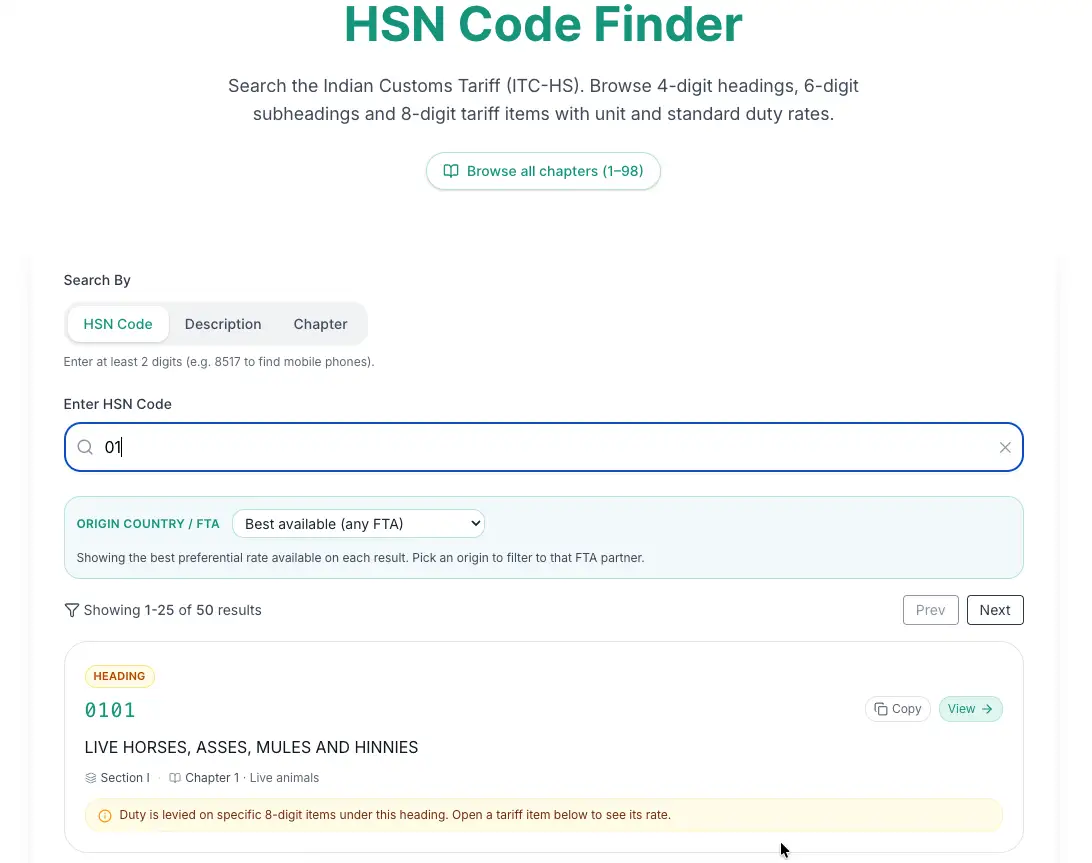
- HSN code details – Chapter, heading, product description across 2, 4, 6 and 8 digits.
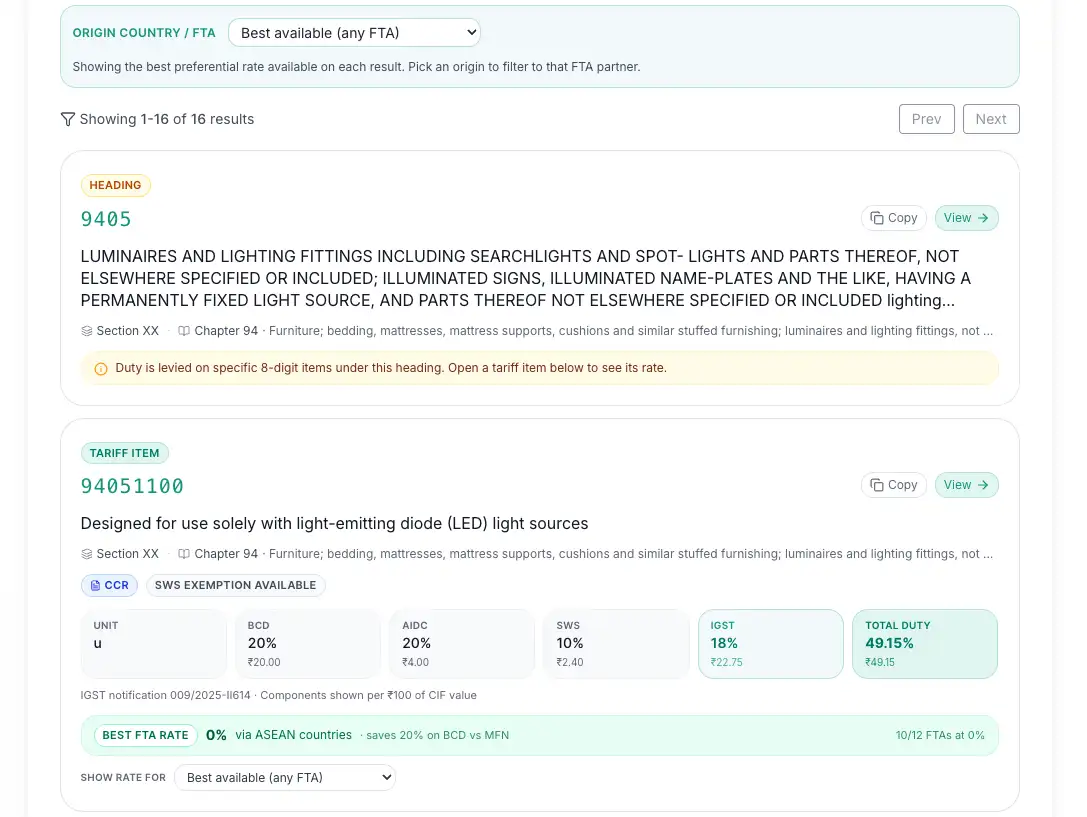
- Import customs duty structure – Standard customs duty components for that HSN (e.g., BCD, SWS, IGST and other applicable levies).
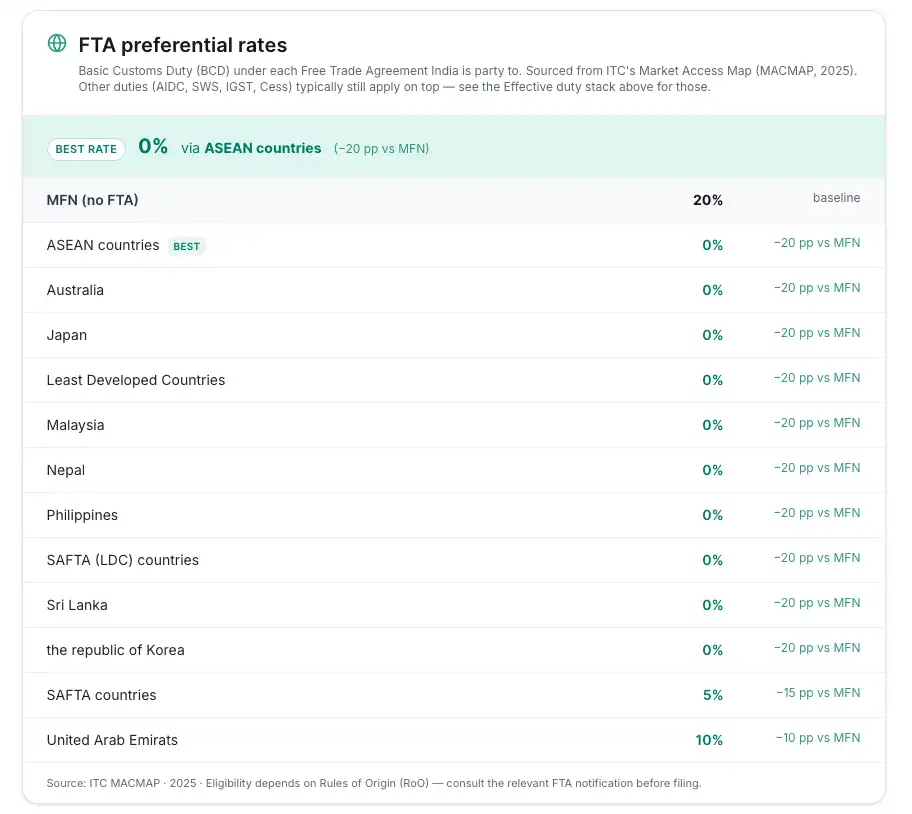
- Preferential trade duty (if applicable) – Reduced duty under FTAs / trade agreements when importing from eligible countries.
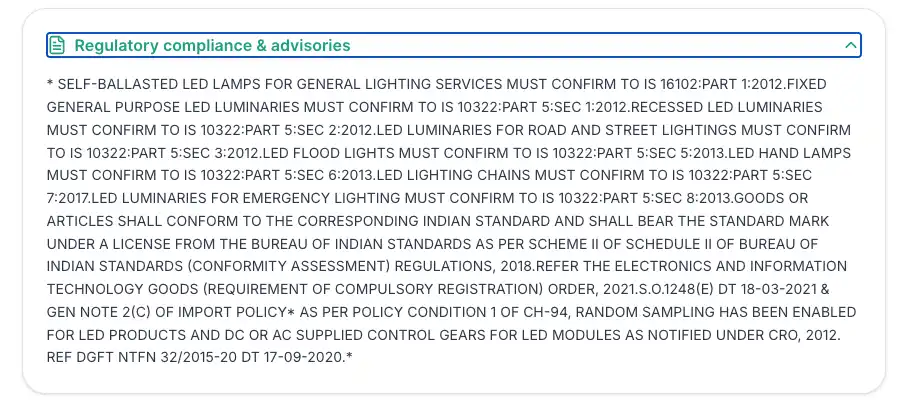
- Compulsory compliance & restrictions – BIS, FSSAI, Plant Quarantine, DGFT conditions etc. associated with that code.
In one screen, you move from "What is my HSN?" to "What duty and compliance will I face?" instead of jumping between multiple websites.
Why it’s easier than ICEGATE
- Single interface for HSN code search + duty + compliance, instead of separate calculators and PDF notifications.
- Search by keywords, partial HSN or chapter, with results prioritising the most specific 8‑digit items.
- Clean, trade‑friendly language instead of only legal jargon.
HSN Code in Import & Export Documentation
Once you’ve found the correct HSN, you need to place it consistently across all trade documents.
Where HSN code must appear
- Commercial invoice - For both imports and exports.
- Packing list - Especially for multi‑item shipments.
- Bill of Entry - Filed by customs broker.
- Shipping Bill - Filed by exporters/ customs broker.
- GST documents - For domestic sale/purchase of goods, as per notification thresholds.
HSN Code vs SAC Code (Don’t Confuse Them)
A lot of traders search for “HSN code for freight” when they actually need a SAC code for the service. Let’s clear this up.
Basic difference
- HSN code – Used to classify goods (physical products).
- SAC code – Used to classify services under GST (like freight, consulting, rent).
If you are paying freight charges to a transporter within India, that is a service, so GST treats it under a SAC code (for example, transport of goods by road/air/sea).
However, when you import goods into India, customs duty and IGST are calculated based on the HSN code of the goods, not on a “freight HSN code”. The “freight HSN code” phrase is widely searched, but technically, you are either:
- Looking for the HSN code of the goods you are shipping, or
- Looking for the SAC code for freight services under GST.
Comparison table: HSN vs SAC
Parameter | HSN code | SAC code |
Used for | Goods (tangible items) | Services (intangible) |
Digits | Globally 6, in India usually 8 (ITC‑HS) | 6‑digit codes under GST |
Example | 6109.10.00 – Cotton T‑shirts | 9965 – Goods transport services |
Appears on | Import/export docs, GST on goods | GST invoices for services |
Typical confusion | People search “freight HSN code” | Freight is actually classified under SAC |
FAQs: HSN Code & Its Uses in Trade
Frequently Asked Questions
It is a globally standardised system of names and numbers used to classify traded goods so that customs authorities and traders across different countries speak the same “product language”.
Start with EximPe’s HSN Code Finder, search by keyword or partial code, drill down to the exact 8‑digit Indian HSN, and then cross‑check with CBIC/ICEGATE or your customs broker for high‑risk items. This saves hours compared to scrolling through PDF lists and reduces the risk of misclassification.
When you import goods, customs uses the HSN code of the goods to calculate duty and IGST. When you pay freight to a transporter, that charge is classified under a SAC code for transportation services. People often search "freight HSN code", but what they really need is the correct HSN for the goods and the SAC for transport services.
While ICEGATE and CBIC provide the legal tariff and duty calculator, the interface can be fragmented and technical. EximPe’s tool lets you search the Indian customs tariff (ITC‑HS) by code or description, see standard duty rates, check available preferential trade duty and view compulsory compliances in a more intuitive, trade‑friendly format.
The first 4 digits (heading) and 6 digits (subheading) are too broad for duty and policy. Customs assesses your shipment at the 8‑digit line, which may have different duty rates, exemptions or restrictions. Using only 4 digits on commercial documents can cause confusion, delays and even duty disputes.
The first 6 digits are standard worldwide; the last 2-4 digits can differ by country.
Export schemes are notified HSN‑wise. If your product is misclassified, your shipping bill and EDI records may not match the incentive schedule. This can lead to rejection of claims or issues during audits. A quick check through EximPe’s HSN Code Finder before filing documents is a simple way to reduce that risk.