CIF, FOB, and Assessable Value: How Customs Calculates Duty on Imports
Learn how Indian customs calculates duty on imports using CIF‑based assessable value. Understand CIF vs FOB, BCD, SWS and IGST calculation.
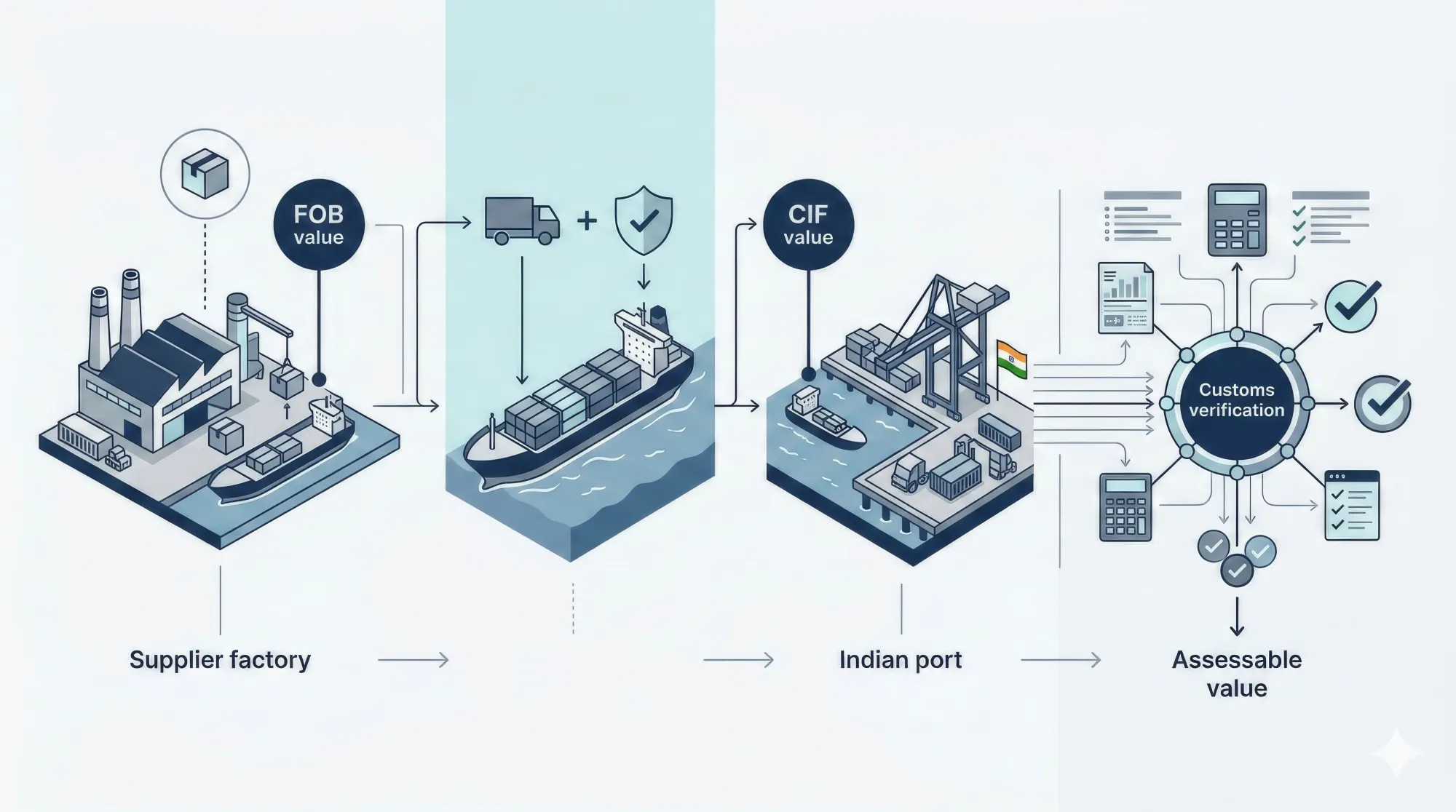
Customs duty in India is always calculated on the assessable value, which is effectively the CIF value of the goods at the Indian port of import. If an importer misunderstands how to move from FOB to CIF and then to assessable value, they either overpay duty or face valuation disputes and penalties. This guide explains assessable value, CIF vs FOB, conversion rules, duty calculation steps, Rule 10 additions, and common valuation mistakes in a practical way for importers, customs brokers, and logistics professionals.
What Is Assessable Value in Customs?
In Indian customs, assessable value is the base value on which all customs duties (BCD, SWS, IGST and others) are calculated. For imported goods, this assessable value is derived from the price actually paid or payable for the goods plus specific additions prescribed under law.
Practically, this means that for most imports, Assessable Value = CIF value of the goods at the Indian port, provided CIF already includes cost, insurance, freight and other Rule 10 components up to the place of importation. When certain elements like freight or insurance are not known, standard percentages are applied under the Customs Valuation Rules, 2007 to compute CIF.
Understanding CIF and FOB: Key Differences
What Is FOB?
FOB (Free On Board) is an international trade term where the seller’s responsibility ends once the goods are loaded on board the vessel (or aircraft) at the port of shipment. The FOB value generally includes ex‑factory cost, inland transport to the loading port, export packing, documentation, and loading charges up to the point the goods cross the ship’s rail at the foreign port.
What Is CIF?
CIF (Cost, Insurance and Freight) means the seller’s price includes cost of goods plus international freight and insurance up to the destination port (here, Indian port of import). CIF is therefore closer to the customs concept of transaction value at the time and place of importation, because it already covers transport and insurance to India.
CIF vs FOB: Practical Comparison
Indian customs always calculates duty on CIF‑based assessable value, even if your commercial contract is on FOB terms. This is why understanding CIF vs FOB and how to move from one to the other is crucial for correct duty estimation and avoiding penalties.
How to Convert FOB to CIF for Customs Valuation
When your supplier invoices on FOB basis, customs needs to convert it to CIF to arrive at assessable value. The basic calculation is:
CIF=FOB+Freight+Insurance
If actual freight and insurance amounts are known from supporting documents, those figures are used directly. If not, the Customs Valuation Rules, 2007 prescribe standard norms.
When Insurance Is Not Present
If the insurance amount is not known, it is standard practice under the valuation rules to take 1.125 percent of FOB value as notional insurance.
Worked Example: FOB to CIF Conversion
Assume:
- FOB value: 10,000 USD
- Freight (not known for air cargo) >> deemed as 20 percent of FOB = 2,000 USD
- Insurance (not known) >> deemed as 1.125 percent of FOB = 112.50 USD
Then:
CIF=10,000+2,000+112.50=12,112.50 USD

Step-by-Step: How Customs Calculates Import Duty in India
- Determine Assessable Value (CIF).
- Identify the correct HS code and corresponding duty rates.
- Compute Basic Customs Duty (BCD).
- Compute Social Welfare Surcharge (SWS) on BCD.
- Determine the base for IGST.
- Compute IGST.
- Add any other applicable levies to get total duty.
Example
Assume the following for an import into India:
- CIF / Assessable Value (AV): ₹1,00,000
- BCD rate: 10 percent
- SWS rate: 10 percent of BCD
- IGST rate: 18 percent
Step 1: Determine CIF / Assessable Value
Given as ₹1,00,000.
Step 2: Identify HSN Code and Duty Rates
Using HSN classification and the Customs Tariff, importer finds BCD = 10 percent and IGST = 18 percent for this HSN code.
Step 3: Calculate Basic Customs Duty (BCD)
BCD=AV×BCD rate=1,00,000×10%=10,000
Step 4: Calculate Social Welfare Surcharge (SWS)
SWS is typically 10 percent of BCD on most goods, unless specifically exempt.
SWS=10,000×10%=1,000
Step 5: Determine IGST Base
IGST is levied on the value comprising Assessable Value + BCD + SWS.
IGST base=1,00,000+10,000+1,000=1,11,000
Step 6: Calculate IGST
IGST=1,11,000×18%=19,980
Step 7: Total Duty Payable
Total customs duty = BCD + SWS + IGST.
Total duty=10,000+1,000+19,980=30,980
This is the most accurate import duty calculation formula most importers use in practice when estimating landed cost.
Types of Customs Duties in India
There may also be product‑specific cesses or additional duties introduced by notification, so importers should always check the latest tariff entries and exemption notifications applicable to their HS code.
Common Mistakes Importers Make in Customs Valuation
Mistake #1: Using FOB as Assessable Value
Some importers mistakenly treat the FOB invoice value as the base for customs duty when estimating landed cost. In reality, customs duty in India is always computed on CIF‑based assessable value, not FOB, so ignoring freight and insurance leads to under‑estimation and potential disputes.
Mistake #2: Not Including Freight and Insurance
Even when contracts are on FOB terms, importers sometimes fail to add freight and insurance properly when preparing Bills of Entry. If actual figures are not available, they must use prescribed norms (like 20 percent of FOB for air freight cap and 1.125 percent insurance) to arrive at CIF.
Mistake #3: Incorrect HS Code Classification
Wrong HS code selection leads to incorrect BCD, SWS and IGST rates being applied. This can cause short‑payment or excess payment of duty, either of which may trigger audits, demands, or refund complications.
Mistake #4: Ignoring Rule 10 Additions
Commissions, royalties, assists, or container and packing costs borne by the buyer but not included in the invoice value must be added to transaction value under Rule 10. Ignoring these can result in under‑valuation, with customs later invoking Section 28 for duty recovery along with interest and penalties.
Mistake #5: Using Wrong Exchange Rate
Valuation must use the CBIC‑notified exchange rate, not bank or market rates, for converting foreign currency CIF values into INR. Using a different rate in internal calculations may lead to mismatches with customs assessment.
FAQs on CIF, FOB and Assessable Value
Is customs duty calculated on CIF or FOB in India?
Customs duty in India is calculated on the CIF‑based assessable value, not on FOB.
What happens if freight and insurance are not known?
If actual freight and insurance are not available, customs valuation rules allow the use of standard norms and objective data, for example, capping air freight at 20 percent of FOB and taking insurance as 1.125 percent of FOB when not ascertainable.
Can I claim ITC on customs duty paid?
You can generally claim Input Tax Credit (ITC) of IGST and Compensation Cess paid on imports, subject to GST eligibility conditions and correct reporting. However, BCD, SWS, safeguard and anti‑dumping duties are not creditable and therefore form part of the cost of the goods.
What is the role of HS code in duty calculation?
The HS code (tariff classification) determines the applicable BCD, SWS exemptions, IGST rate and any additional/safeguard/anti‑dumping duties for a product. Misclassification can lead to wrong duty payment, loss of benefits, or later demands and penalties.
What is Special Valuation Branch (SVB)?
Special Valuation Branch is a specialised customs unit that examines valuation of imports between related parties or under special circumstances to ensure that the declared transaction value is not influenced by the relationship or other factors. Cases with complex pricing, royalty arrangements, or group‑company transactions may be referred to SVB for detailed scrutiny.