ODEX, Complete Digital Platform for India's Shipping & Import-Exports: Complete Guide
Master ODEX in minutes. Guide covers, e-Form 13, VGM submission, rejection fixes, demurrage prevention, and time savings for Indian importers & exporters
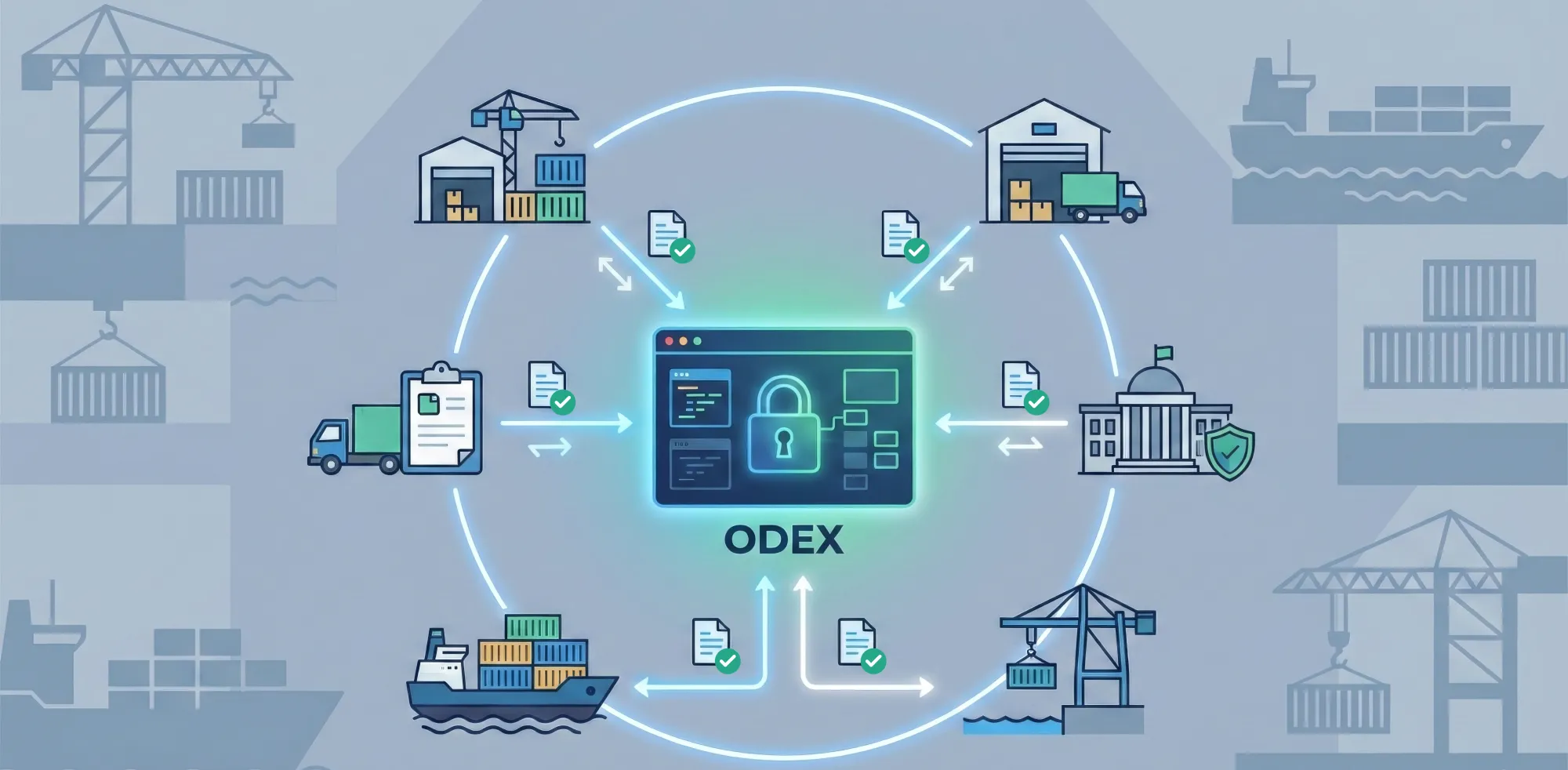
ODEX (Online Documents eXchange) is India's leading digital platform for shipping documentation, cargo tracking, and invoice payments. It connects all EXIM stakeholders—importers, exporters, freight forwarders, shipping lines, ports, and customs on a single secure network. By submitting HBL data, VGM certificates, Form 13 gate passes, and shipping bills through ODEX instead of email, you reduce processing time from days to hours, prevent costly demurrage delays, and ensure SCMTR customs compliance.
What is ODEX? Understanding the Platform & Its Role in Shipping
ODEX stands for Online Documents eXchange—a centralized digital ecosystem designed to digitize the entire EXIM (Export-Import) shipping workflow. Instead of exchanging shipping documents via email, manual forms, and inconsistent processes, ODEX provides a unified platform where all parties involved in the ocean freight chain can submit, approve, track, and manage documents in real-time.
Think of ODEX as the "WhatsApp of shipping", but with legal compliance, payment integration, and customs connectivity built in. Every stakeholder (shipper, freight forwarder, shipping line, CFS operator, weighbridge, customs authority) is connected on the same platform, seeing the same real-time updates, eliminating miscommunication.
Who Uses ODEX?
Why ODEX Matters in 2026
ODEX became mandatory for exports under SCMTR (Sea Cargo Manifest & Transhipment Regulations, 2018) because the Government of India mandates that all manifest data must be filed digitally before vessels depart or arrive. Manual email submissions are no longer acceptable. More importantly, ODEX eliminates the biggest pain points in ocean freight:
- Before ODEX: Email HBL to shipping line → They don't respond for hours → You call them → They ask you to resend → Documents get lost → Delays at port
- With ODEX: Submit e-HBL on ODEX → Instant confirmation → Automatic notification to shipping line → Real-time status update → No delays
ODEX Core Modules: What Each Feature Does
Module 1: e-VGM (Electronic Verified Gross Mass)
VGM = Verified Gross Mass. It's the official weight of your container, certified by a weighbridge. Since 2016, SOLAS (Safety of Life at Sea) regulations mandate that every container must have a VGM before it can be loaded onto a vessel. Without VGM, shipping lines won't accept your cargo.
Module 2: e-Form 13 (Terminal Gate Pass)
Form 13 is unique to Indian ports. It's a Terminal Gate Pass that permits your container to enter the port gate (gate-in) at discharge. Without Form 13, your container cannot be unloaded from the vessel.
Module 3: e-HBL (Electronic House Bill of Lading)
HBL = House Bill of Lading. When a freight forwarder consolidates shipments from multiple shippers into one container, each shipper gets an HBL. The forwarder then submits all HBLs to the shipping line, who links them to the Master BL. Traditionally, this was done via email, causing delays and mis-matches.
Module 4: e-VGM & e-Form 13 Integration with SoftLink Logisys
For Advanced Users:If you use SoftLink Logisys (freight forwarding ERP software), you can integrate it directly with ODEX. This means:
- VGM data auto-syncs from your freight management system to ODEX
- Form 13 submissions happen with a single click
- No manual re-entry of data
- Eliminates copy-paste errors
Module 5: e-Invoice & Payment Management
Shipping lines send invoices for various charges like, freight charges, origin charges, destination charges etc., all these can be done via Odex.
Module 6: e-Shipping Bills (For Exports)
Shipping bills are export documents that declare outgoing cargo to Indian Customs. They're filed by exporters to comply with SCMTR regulations before the vessel departs.
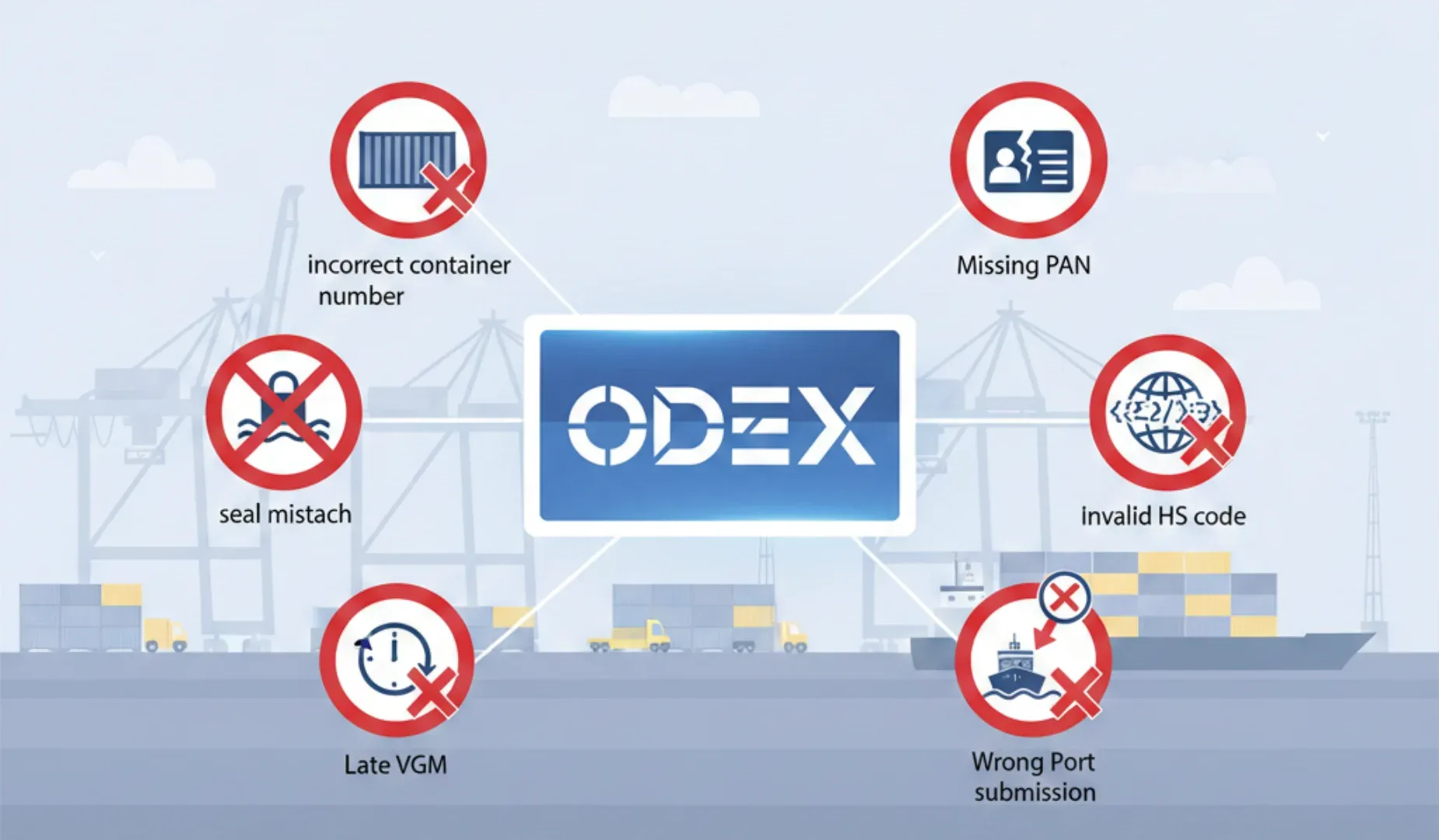
Common ODEX Rejection
Mistake #1: Incorrect Container Number Format
You enter "CN123456" but it should be "TEMU123456XY" (15-character code with shipper prefix + check digit). System rejects: "Invalid Container Number Format".
Mistake #2: Seal Number Mismatch
Seal number on ODEX doesn't match seal actually affixed on container. System rejects: "Seal Number Does Not Match Physical Seal".
Mistake #3: Missing Consignee PAN Number
ODEX rejects: "Consignee PAN Number Missing or Invalid". Indian Customs mandates PAN for all importers. If consignee is an NVOCC or freight forwarder, their PAN must be declared (not the shipper's PAN).
Mistake #4: Incorrect HS Code
ODEX rejects: "HS Code Does Not Match Cargo Description" or "HS Code Invalid".
Mistake #5: Description Too Generic
ODEX rejects: "Cargo Description Too Vague. Please Specify."
Mistake #6: Late VGM Submission
Container is already at port. VGM not submitted. ODEX rejects: "VGM Not Found for This Container" or "VGM Submission Deadline Passed"
Mistake #7: Form 13 Submitted for Wrong Port
ODEX rejects: "Discharge Port Mismatch. Form 13 for Nhava Sheva Cannot Be Used for Chennai Port"
Mistake #8: Invoice Value Missing or Entered as Zero
ODEX rejects: "Invoice Value Required for FROB Cargo Transiting Domestically". FROB = Free on Board. If cargo is being transshipped within India, invoice value is mandatory.
FAQ: Frequently Asked Questions on ODEX
Is ODEX mandatory for all shippers/forwarders in India?
Yes, ODEX is now mandatory for exports (since May 2025). For imports, most major shipping lines require e-HBL and Form 13 submission via ODEX. Manual email submission is increasingly not accepted.
Can multiple users from the same company access ODEX simultaneously?
Yes. You can add unlimited users during registration and manage permissions separately.
What happens if ODEX rejects my Form 13 submission? Can I resubmit?
Yes. ODEX tells you exactly why it was rejected. Fix the error and resubmit immediately—no re-submission fees.
What if I submit VGM, but weight changes before vessel departure?
Submit a new VGM immediately (replacement VGM), and ODEX cancels the old one automatically.