BIS Certification in India: A Practical Importer’s Guide (2026)
Importing to India in 2026? Check BIS applicability, choose compliant suppliers, verify on Manak Online, and cover WPC & LMPC before you ship.
Listen to article
Audio version (0% complete)
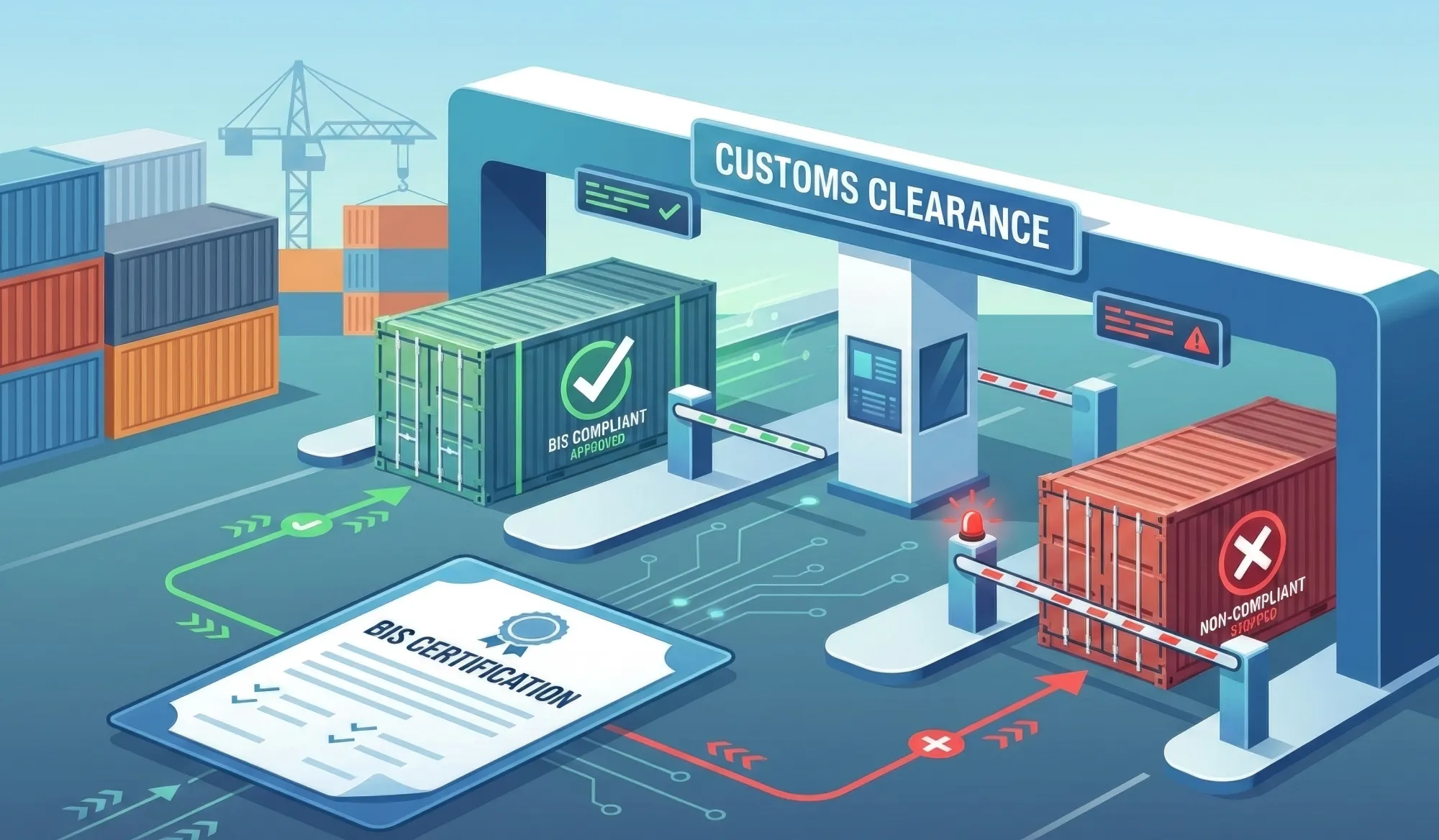
BIS certification is one of the most critical compliances for importers, this decides whether your goods go smoothly through customs or end up stuck in a warehouse for weeks. If your product falls under BIS control and you don’t comply, customs will simply not clear it. BIS certification is mandatory for 450+ product categories in India. Hence, Importing products without it will result in confiscation and penalties.
What Does BIS Certification Mean?
BIS stands for Bureau of Indian Standards, Its India's national standards body under the Ministry of Consumer Affairs. It sets quality, safety, and performance benchmarks for products sold in India. It sets Indian Standards (IS) for products and runs certification schemes to ensure only safe, compliant products reach Indian consumers.
In simple terms, BIS certification means
- The product was tested in a BIS-recognized lab.
- The manufacturing process is controlled and audited.
- The product bears a BIS mark (ISI or CRS “R-number”) with licence/registration details.
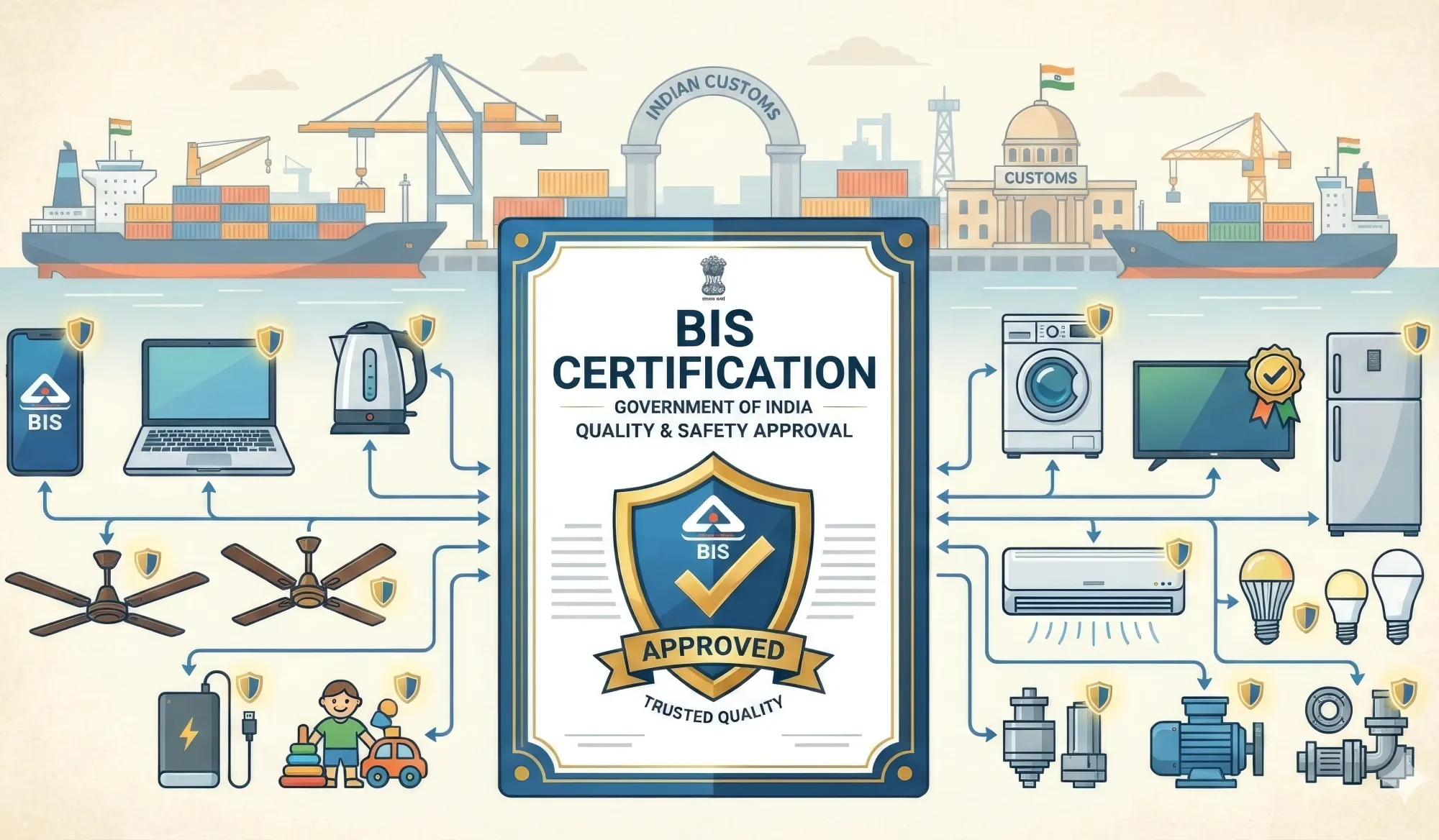
Typical Product Groups Under Mandatory BIS/QCO
- Electronics & IT products – laptops, power supplies, LED lamps, TVs, set-top boxes, power banks.
- Toys & baby products – toy scooters, toy cars, educational toys.
- Steel and cables – specific steel grades, electrical cables, conduits.
- Appliances & safety items – certain pumps, switches, helmets, pressure cookers, LPG stoves.
Important Steps for Importers
Step 1: Identify exact product & HS code.
Step 2: Check BIS “Compulsory Certification” / “Compulsory Registration Scheme” lists (or ask your customs broker/compliance consultant).
Step 3: If listed, confirm which BIS scheme applies (ISI vs CRS vs FMCS).
Step 4: Verify your manufacturer already has a valid BIS licence/registration for your exact model/specification.
Key BIS schemes for importers
Scheme | Typical product types | Who applies | What importer must ensure |
ISI (Standard Mark Scheme) | Steel products, cables, helmets, appliances, many items covered by QCOs | Manufacturer (including foreign, via FMCS route) | Imported goods carry valid ISI mark & licence number matching the exact product/plant |
CRS (Compulsory Registration Scheme) | Electronics & IT items (LED lamps, chargers, TVs, etc.) | Manufacturer (Indian or foreign) | Each model has a BIS “R-number”; label and documents show correct model & brand |
FMCS (Foreign Manufacturer Certification Scheme) | Non-CRS products made outside India needing ISI mark | Foreign manufacturer via Indian representative | Your overseas supplier holds active FMCS licence for the exact product |
“Scheme X” (Others – e.g., Hallmarking, Eco Mark, sectoral schemes) | Gold jewellery, some environmental labels, niche products | Largely Indian manufacturers/brand owners | If your category is notified, confirm Indian partner/brand has the right certification before importing |
Importer Workflow:
It is very important to check your product's compliance before shipping to avoid BIS-related customs problems.
Step 1: Confirm BIS Applicability + Scheme
Before placing a purchase order, check whether your product is on the mandatory BIS list. Don't rely on your supplier's word alone, verify independently.
Step 2: Choose Supplier Correctly
Your manufacturer must hold a valid BIS registration/certification for the exact product model, brand, and factory location you're importing from. A BIS certificate for "Model A" from "Factory X" does not cover "Model B" from "Factory Y."
Step 3: Verify Labeling and Marking
Products must carry the BIS Standard Mark with R-number (for CRS) or ISI Mark with license number (for Scheme I) on the product and/or packaging. Missing marks = customs rejection.
Step 4: Collect Documentation
Prepare your clearance file:
- BIS registration certificate / FMCS license copy
- Test report references (lab name, report number)
- Commercial invoice and packing list
- Product photos showing BIS marking
Step 5: Pre-Shipment Verification
Before goods leave the origin country, re-check certificate status and validity dates on the BIS portal. Certificates can expire, get suspended, or be revoked between the time you place an order and when goods arrive.
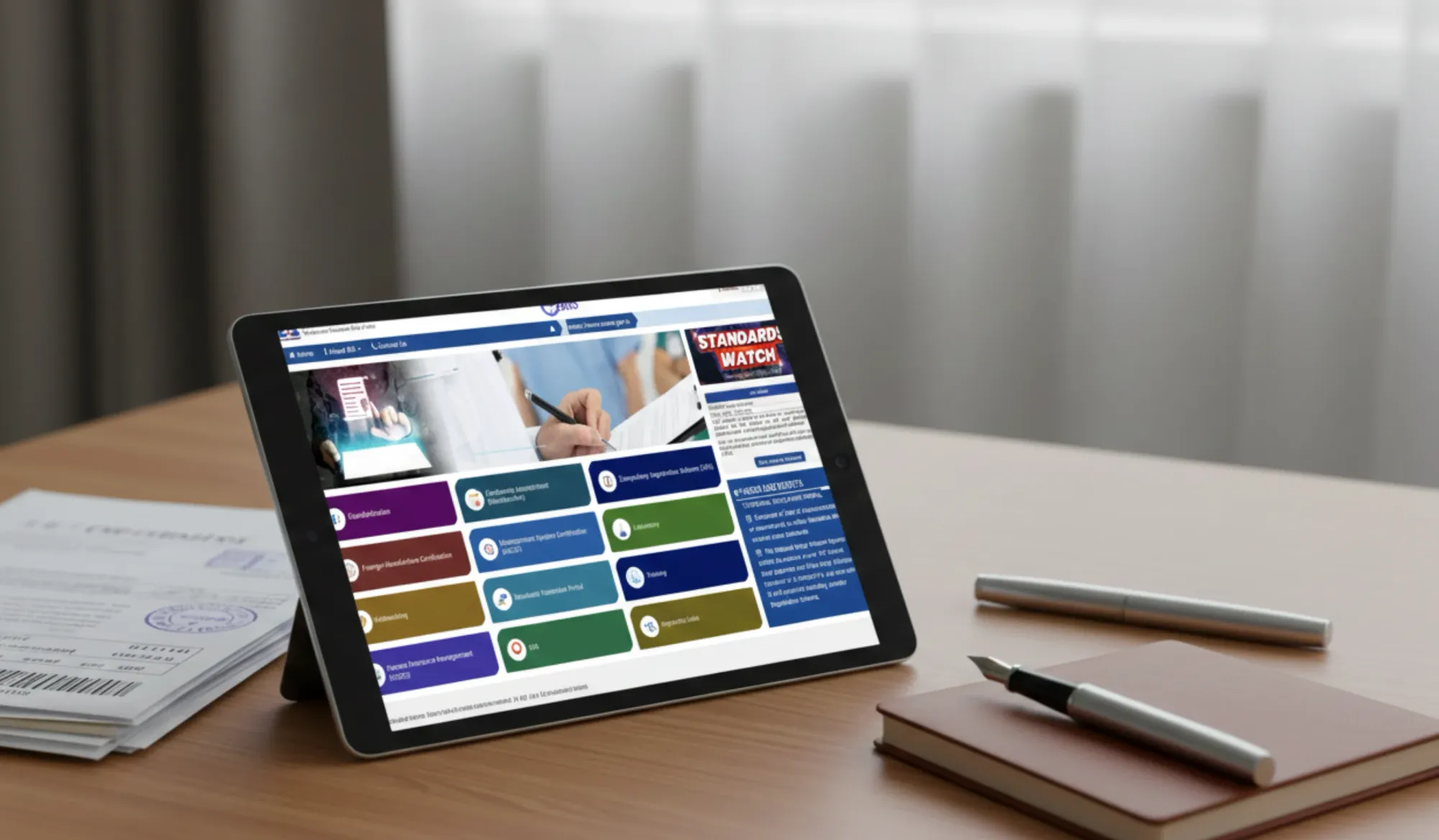
Manak Online: How to Use BIS Portal for Verification
Manakonline (manakonline.in) is BIS’s online portal. Manufacturers use it heavily to apply for new licences, upload test reports, pay fees, etc. As an importer, you mostly need it for verification and basic tracking.
What you can do on Manakonline
- Search / verify licences
- Check if a BIS licence/registration number shared by a supplier is genuine and active.
- Confirm product category, IS number, brand, model, and plant address.
- Track applications (if you or your Indian entity are co-applicant/authorized representative)
- See status: submitted, under scrutiny, query raised, granted, suspended, etc.
- Download documents
- Licences, approval letters, sometimes scope documents for your internal compliance files.
BIS + WPC + LMPC: Do You Need More Than One?
Here's where many importers get confused. BIS is not the only compliance requirement for imports into India. Depending on your product, you may need additional certifications.
If your product has Bluetooth, Wi-Fi, NFC, Zigbee, RFID, or any wireless/RF functionality, you need WPC ETA (Equipment Type Approval) from the Wireless Planning & Coordination Wing under DoT. This is separate from BIS and must be obtained before import.
A Bluetooth speaker, for example, needs both BIS CRS registration AND WPC ETA certification.
If your product is pre-packaged for retail sale (displays MRP, net quantity, manufacturer/importer details), you need LMPC registration under the Legal Metrology Act. This applies to nearly all consumer goods, from electronics to food to cosmetics. Without LMPC, customs can restrict clearance of pre-packaged goods.
BIS vs WPC vs LMPC
Regulator | Focus | Typical trigger for importer | Example product needing it |
BIS | Safety & quality standards | Product in BIS/QCO compulsory list | LED bulbs, toys, steel bars |
WPC | Wireless / spectrum use | Any RF/Wi‑Fi/Bluetooth module | Bluetooth speaker, Wi‑Fi camera |
LMPC | Labelling & quantity on retail packs | Pre-packaged goods sold to consumers | Ready to sell product box with MRP, weight |
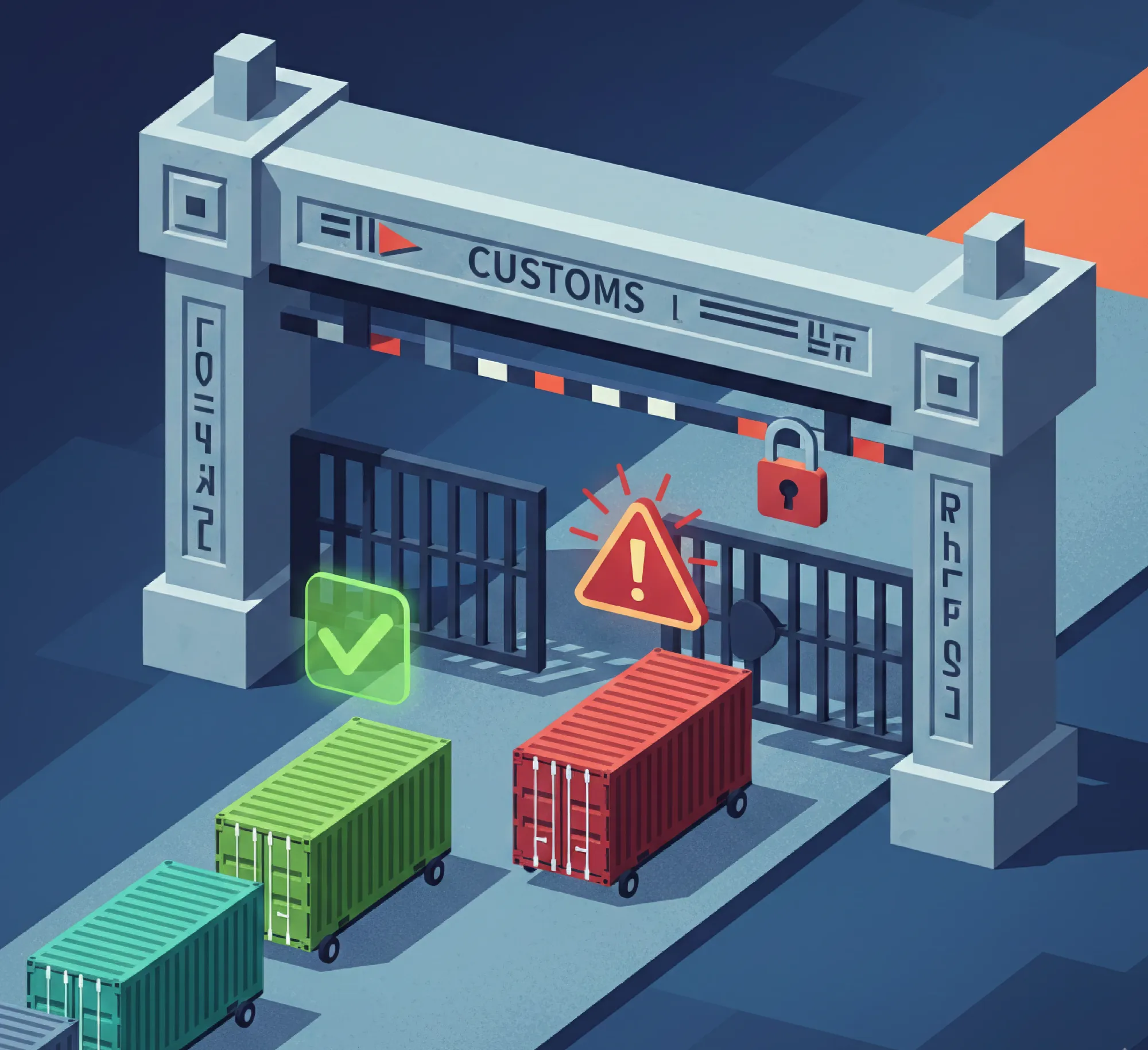
Common Importer Mistakes
Mistake #1: Assuming BIS is "optional" or can be arranged after goods arrive in India. It cannot. Goods without valid BIS certification will not clear customs.
Mistake #2: Checking the wrong product category. Your supplier's BIS registration for "Model ABC" does not cover "Model XYZ." Model-level matching is mandatory.
Mistake #3: Not verifying certificate validity before shipping. BIS certificates expire, get suspended, or get revoked. Always check status on manakonline.in before dispatch.
Mistake #4: Using outdated product lists. BIS adds new QCOs every quarter. Furniture became mandatory in February 2026. Household appliances standards updated in March 2026. Stay current.
Mistake #5: Missing labeling requirements. Product must physically carry the BIS mark (ISI or R-number). A valid certificate with no mark on the product is non-compliant.
Mistake #6: Ignoring WPC and LMPC when applicable. BIS alone is not enough for wireless or pre-packaged products.
FAQs: BIS Certification for Importers
Frequently Asked Questions
BIS (Bureau of Indian Standards) is India’s national standards body. It sets Indian product standards and runs certification schemes to ensure goods sold in India meet those standards.
No. BIS is mandatory only for products listed under specific Quality Control Orders or Compulsory Registration lists. But if your product is on those lists, you cannot legally import or sell it without valid BIS compliance.
Start with your HS code and product description, then:
- Check the latest BIS compulsory lists/QCOs, or
- Ask your customs broker/compliance consultant to map your product to any notified standard.
- CRS: Compulsory Registration Scheme—mainly for electronics/IT, with an “R-number” but no traditional ISI logo.
- ISI: Standard Mark scheme—classic ISI logo on products like steel, cables, helmets, appliances.
Use the Manakonline/BIS online search to verify licence/registration numbers. Confirm: status (active/suspended), product, brand, model, and manufacturing location.
Yes. If your product has wireless functions, you may need WPC approvals. If it’s pre-packaged for retail sale, you must also meet LMPC labelling rules. BIS covers standards and safety; WPC and LMPC cover different legal requirements.