Section 195 TDS on Payments to Non-Residents: What It Became in 2026
Section 195 became Section 393(2) Sl. 17 on 1 April 2026. The new rates, codes, Form 144 filing, and what breaks if you quote the old section.
Listen to article
Audio version (0% complete)

Section 195 of the Income-tax Act, 1961 required you to deduct tax at source before paying a non-resident anything chargeable to tax in India. That obligation still exists. The section number does not.
For any payment where the earlier of credit or payment falls on or after 1 April 2026, the governing provision is Section 393(2), Table Sl. No. 17 of the Income-tax Act, 2025. Same duty, same rates, different reference, and the reference is the part that bites, because the filing utility validates against it.
If you are quoting section 195 on a challan or a return today, you are quoting a repealed Act.
What replaced Section 195
The 2025 Act collapsed more than forty scattered TDS provisions into a single table-driven section. Section 393 sits in Chapter XIX and splits three ways: 393(1) for payments to residents, 393(2) for payments to non-residents, and 393(3) for payments to any person, covering event-based items like winnings and large cash withdrawals.
Everything that used to live in section 195 now sits at one row of that middle table.
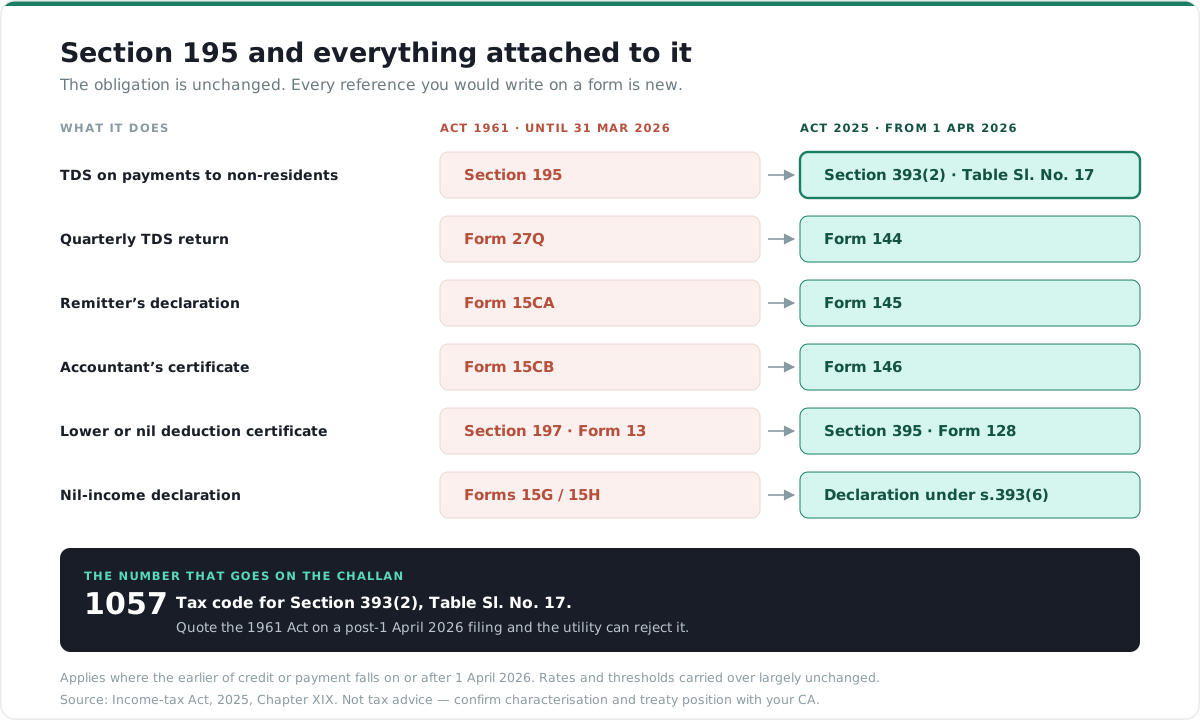
What it was | What it is now |
Section 195 - TDS on payments to non-residents | Section 393(2), Table Sl. No. 17 |
Nature of payment | Any interest or other sum chargeable under the Act, excluding salary |
Tax code for challan and return | 1057 |
Form 27Q - quarterly TDS return | Form 144 |
Form 15CA - remitter's declaration | Form 145 |
Form 15CB - accountant's certificate | Form 146 |
Section 197 / Form 13 - lower or nil deduction | Section 395 / Form 128 |
Forms 15G and 15H - nil-income declaration | Declaration under Section 393(6) |
The rates did not move. The Act's own transition FAQs are explicit that the reform is structural and does not alter the underlying tax incidence. What changed is every number you would write on a form.
Why the number matters more than it sounds
For transactions on or after 1 April 2026, deductors are required to quote the relevant table entry under Section 393. Continuing to reference the 1961 Act - section 195, or for that matter 194C or 194J - can produce system-level validation errors and force corrective filings.
That is the practical cost. Not a penalty notice on day one, but a rejected return, a mismatch, and a correction cycle that lands while your supplier is waiting to be paid.
When Section 393(2) Sl. 17 applies
The test is chargeability, not size. If the sum you are paying a non-resident is chargeable to tax in India, you deduct. If it is not chargeable, you do not.
There is no threshold. This is the single biggest difference from domestic TDS, where thresholds of ₹20,000, ₹30,000 or ₹50,000 give you room to ignore small payments. On a payment to a non-resident, a ₹5,000 chargeable payment attracts the obligation exactly as a ₹50 lakh one does.
The obligation falls on the payer, and the payer category is deliberately wide — individuals, HUFs, firms, companies, NRIs, foreign companies and other juristic entities. An individual or HUF with no tax-audit requirement is still on the hook when the payee is a non-resident.
Deduction is triggered at the earlier of credit or payment. Crediting the supplier's account in your books starts the clock even if the money has not moved.
The rates, by nature of remittance
The rate depends on what the payment is for, and each nature of remittance carries its own code that goes on the return.
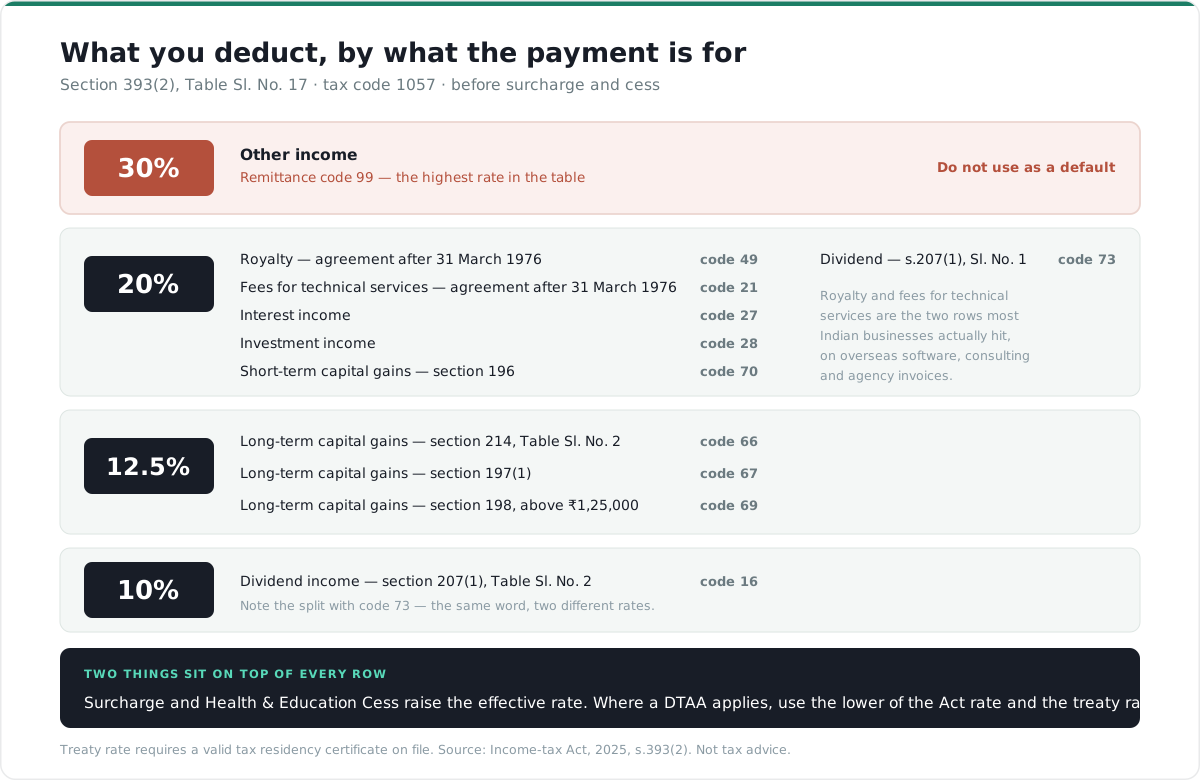
Nature of remittance | Code | Rate |
Interest income | 27 | 20% |
Dividend - section 207(1), Table Sl. No. 1 | 73 | 20% |
Dividend - section 207(1), Table Sl. No. 2 | 16 | 10% |
Investment income | 28 | 20% |
Long-term capital gains - section 214, Table Sl. No. 2 | 66 | 12.5% |
Long-term capital gains - section 197(1) | 67 | 12.5% |
Long-term capital gains - section 198, above ₹1,25,000 | 69 | 12.5% |
Short-term capital gains - section 196 | 70 | 20% |
Fees for technical services - agreement after 31 March 1976 | 21 | 20% |
Royalty - agreement after 31 March 1976 | 49 | 20% |
Other income | 99 | 30% |
Two things sit on top of these. Surcharge and Health & Education Cess apply, so the effective rate is higher than the table rate. And where a Double Taxation Avoidance Agreement exists, the applicable rate is the lower of the Act rate and the treaty rate.
For most Indian businesses paying overseas software, consulting and agency invoices, the rows that matter are royalty, fees for technical services, and other income - 20%, 20% and 30% before surcharge and cess. The gap between 20% and 30% is decided by how the payment is characterised, which is why the characterisation argument is worth having before you remit, not after.
The transition line
Contracts that straddle 31 March 2026 split on the same test that governs everything else here.
Payments or credits up to 31 March 2026 stay with the Income-tax Act, 1961 and section 195. Payments or credits on or after 1 April 2026 fall under Section 393(2). The determining criterion is the earlier of credit or payment, unchanged from the old regime.
Circulars, notifications and instructions issued under the 1961 Act remain in force where they are not inconsistent with the 2025 Act, so the interpretive material you have relied on for years has not evaporated. Only the section numbers have.
Getting the rate reduced
Two mechanisms, and they are not the same thing.
Section 395 certificate, on Form 128. This replaces the old section 197 route and Form 13. The Assessing Officer examines the estimated income and issues a certificate authorising deduction at a lower rate, or none. Section 395 now covers all TDS provisions rather than a specified list, and it is open to companies, firms, LLPs and non-residents. Where the payee is a non-resident, the Indian payer is generally the one who initiates the application, because the payer carries the deduction liability.
Section 393(6) declaration. This is the successor to Forms 15G and 15H, a self-declaration by a recipient whose estimated total income for the year is nil, allowing the payer not to deduct. The payer must forward the declaration to the tax authorities within the prescribed time.
Neither of these is Form 145 or Form 146. Those two are the remittance-side documents your bank needs, and they are a separate obligation that runs in parallel - covered in full in our guide to Form 15CA and 15CB, now Form 145 and 146.
Where this sits in the payment chain
Deduction is one step in a sequence, and the money does not leave India until every step is done
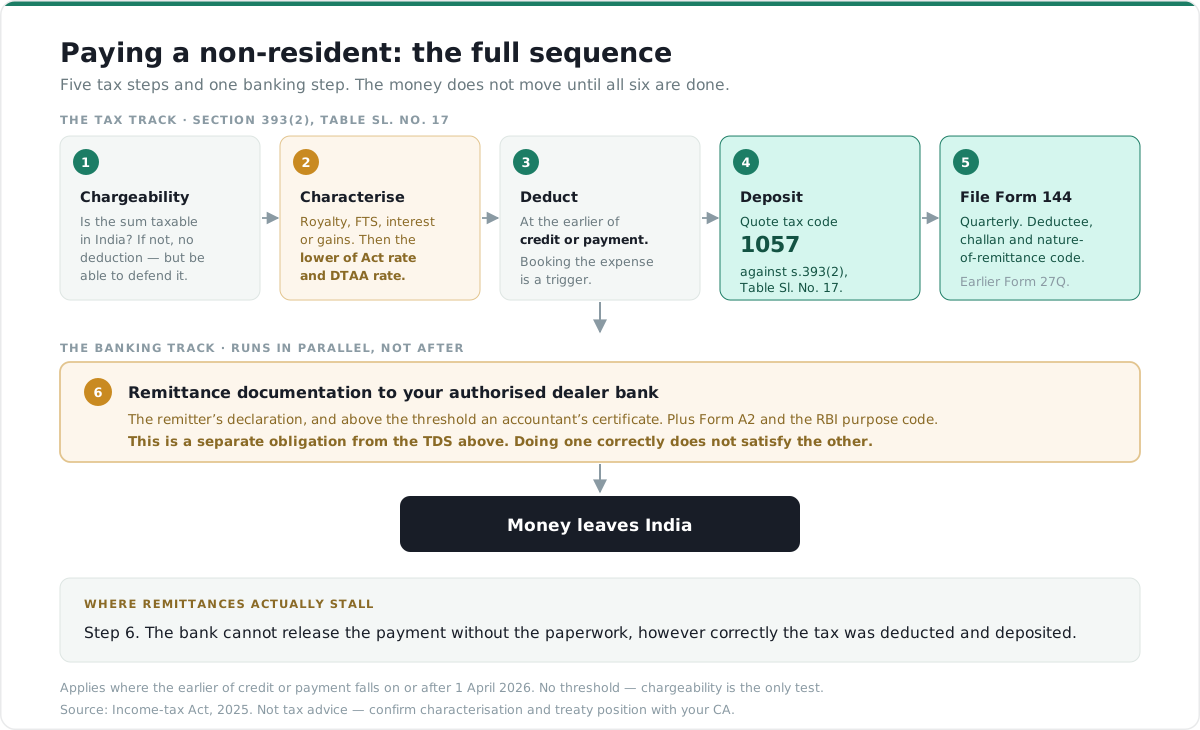
- Determine chargeability. Is this sum taxable in India? If not, no deduction, but be able to defend the position.
- Characterise the payment and pick the rate. Royalty, fees for technical services, interest, capital gains or other income. Compare the Act rate against the DTAA rate and apply the lower, with a tax residency certificate on file.
- Deduct at the earlier of credit or payment.
- Deposit the tax, quoting code 1057 against Section 393(2) Table Sl. No. 17.
- File Form 144 quarterly, reporting the deductee, challan and nature-of-remittance details. The mechanics of preparing and validating a TDS return are covered in our guide to filing a TDS return online.
- Complete the remittance documentation - Form 145, and above ₹5 lakh a Form 146 certificate from an accountant - so your authorised dealer bank will release the payment.
Step 6 is where remittances actually stall. The bank cannot send the money without the remittance paperwork, regardless of whether the tax has been correctly deducted and deposited. Getting the TDS right and the remittance forms wrong leaves you in the same place: money stuck in India.
Where people get this wrong
Assuming a threshold exists. There isn't one. Small chargeable payments to non-residents carry the same obligation as large ones.
Deducting on the invoice date instead of the credit date. The trigger is the earlier of credit or payment. Booking the expense is a trigger.
Applying the DTAA rate without a tax residency certificate. The treaty rate is available where the treaty applies and is evidenced. Without the TRC and the supporting declaration, you are exposed to the Act rate.
Forgetting surcharge and cess. The table rate is not the effective rate.
Treating "other income" as a safe default. It carries 30%, the highest rate in the table. Characterising a payment as other income because nobody wanted to argue the royalty or FTS position is an expensive shortcut, and over-deduction is not automatically recoverable by the payee without a refund claim.
Quoting section 195 after 1 April 2026. It is the cleanest way to have a return rejected.
Related reading
Before money leaves India there is a parallel set of requirements at your bank - the Form A2 declaration and the RBI purpose code that classifies the transaction. Exporters holding foreign currency should also look at how an EEFC account changes the conversion decision, and individuals remitting abroad are governed separately by the Liberalised Remittance Scheme.
Frequently asked questions
Frequently Asked Questions
Not for current transactions. For any payment where the earlier of credit or payment falls on or after 1 April 2026, the governing provision is Section 393(2), Table Sl. No. 17 of the Income-tax Act, 2025. Section 195 of the 1961 Act continues to govern payments and credits up to 31 March 2026.
Section 393(2), Table Sl. No. 17. The tax code for challans and returns is 1057.
No. The rates and thresholds carried over largely unchanged. The reform restructured how the provisions are organised, not what is owed.
No. If the sum is chargeable to tax in India, the deduction obligation applies regardless of amount.
Form 144, filed quarterly. It replaces Form 27Q.
Apply for a certificate under Section 395 using Form 128, which replaces the old Section 197 route and Form 13. Where the payee is a non-resident, the Indian payer usually makes the application.
Where a treaty applies, the rate is the lower of the Act rate and the treaty rate, supported by a tax residency certificate.
Referencing the 1961 Act for a post-1 April 2026 transaction can trigger validation errors in the filing utility and require a corrective return.