EDF Form and IDPMS for Services: What FEMA 2026 Changed for Importers and Exporters
From 1 Oct 2026, service exporters file an EDF form and services imports enter IDPMS. How to file it, deadlines and what your bank decides
Listen to article
Audio version (0% complete)

From 1 October 2026, services crossing India's border run through the same two systems as goods: your bank enters an import of services in IDPMS, and a business exporting services files an EDF form, the Export Declaration Form. Both come from the Foreign Exchange Management (Export and Import of Goods and Services) Regulations, 2026, Notification No. FEMA 23(R)/2026-RB dated January 13, 2026, as amended on September 22, 2026. If you pay a foreign software vendor, consultant or agency, or you bill overseas clients for services, this now applies to you.
What the rule was, and what it is now
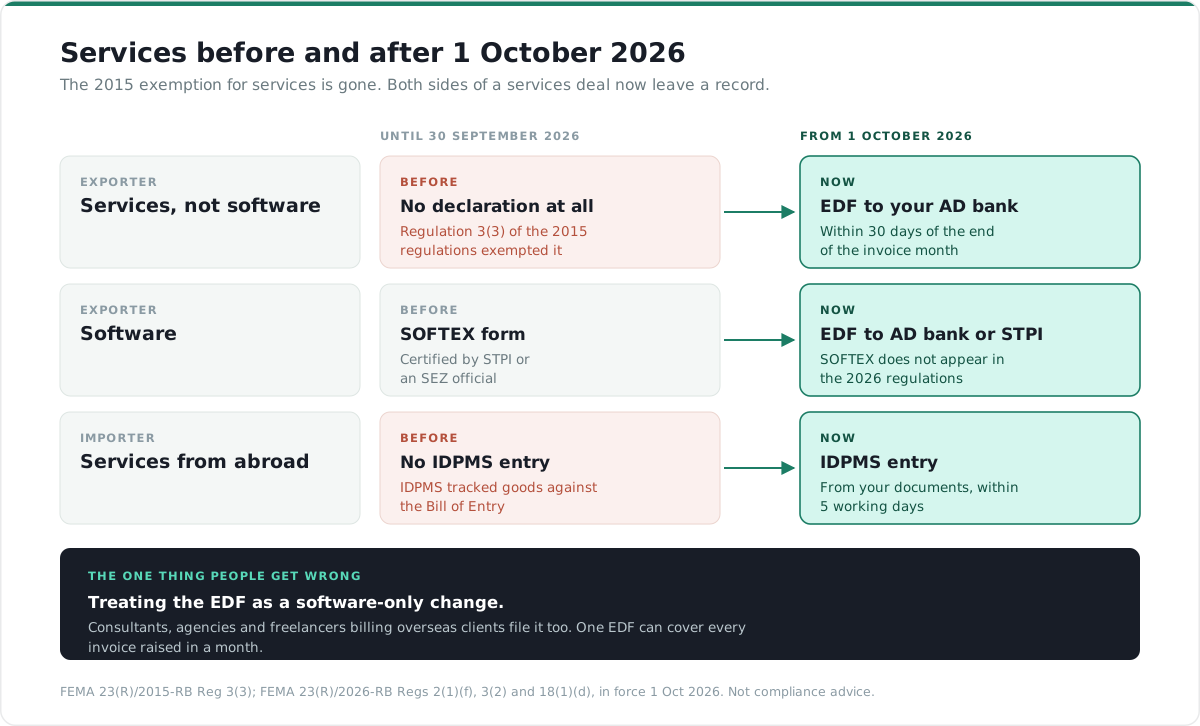
Until 30 September 2026, Regulation 3(3) of the 2015 regulations said an exporter of services not covered by a specified form "may export such services without furnishing any declaration". Only software went on a form, the SOFTEX. On the import side, IDPMS was built to match payments against Bills of Entry for goods. Regulation 18(1)(d) now requires banks to enter imports of services in it as well.
From 1 October, every exporter of services files an EDF (Regulation 3(2)), and the AD bank enters every import of services in IDPMS from the documents the importer submits (Regulation 18(1)(d)). SOFTEX does not appear anywhere in the 2026 regulations.
Working off the old picture now has a cost. An exporter who files nothing has no EDF in EDPMS for the bank to match the money against. An importer who submits nothing leaves an outward payment sitting in IDPMS with nothing to close it, and the bank is now required to follow up on every open entry (Regulation 18(1)(f)).
The short answer
You import services (software, SaaS, consulting, design, any service from a foreign vendor): give your AD bank the invoice and supporting documents. The bank enters the import in IDPMS within five working days, and the entry closes once you have paid. Up to ₹10 lakh per invoice, your own declaration closes it, and you can file that declaration quarterly in bulk.
You export services other than software: file an EDF with your AD bank within 30 days from the end of the month in which you raised the invoice. One EDF can cover the whole month. You may also file on or before the day the payment arrives.
You export software: the same 30-day EDF, filed with your AD bank or with STPI.
You are an SEZ unit: the EDF goes to the Development Commissioner of the SEZ.
You export goods through an EDI port: nothing new to file. The shipping bill counts as the EDF.
The rule to remember: for services, the realisation clock starts on the invoice date and runs nine months, or twelve if the export is invoiced or settled in rupees.
What changed on 1 October 2026
- Service exporters now file an EDF. Regulation 3(2) requires a declaration of the full export value of services within 30 days from the end of the invoice month. The 2015 exemption for services is gone, and software moved from SOFTEX to the same EDF.
- Imports of services now sit in IDPMS. Under Regulation 18(1)(d), the AD bank enters an import of services "as declared and submitted by the importer" within five working days of receiving the documents.
- Up to ₹10 lakh, your declaration closes the entry. The provisos to Regulation 4(2) let an exporter close an EDPMS entry, and an importer close an IDPMS entry, on a declaration where the shipping bill, Bill of Entry or invoice is up to ₹10 lakh. Both can file it quarterly for bulk closure.
- The rulebook moved to your bank. A.P. (DIR Series) Circular No. 20 dated January 16, 2026 superseded both Master Directions on export and import and 167 circulars from 1 October 2026. Regulation 19 requires every AD bank to publish its own policy and SOP.
- The realisation period was amended before it took effect. Notification No. FEMA 23(R)/(1)/2026-RB dated September 22, 2026 replaced the January text's fifteen and eighteen months with nine and twelve.
Import of services: how the IDPMS entry works now
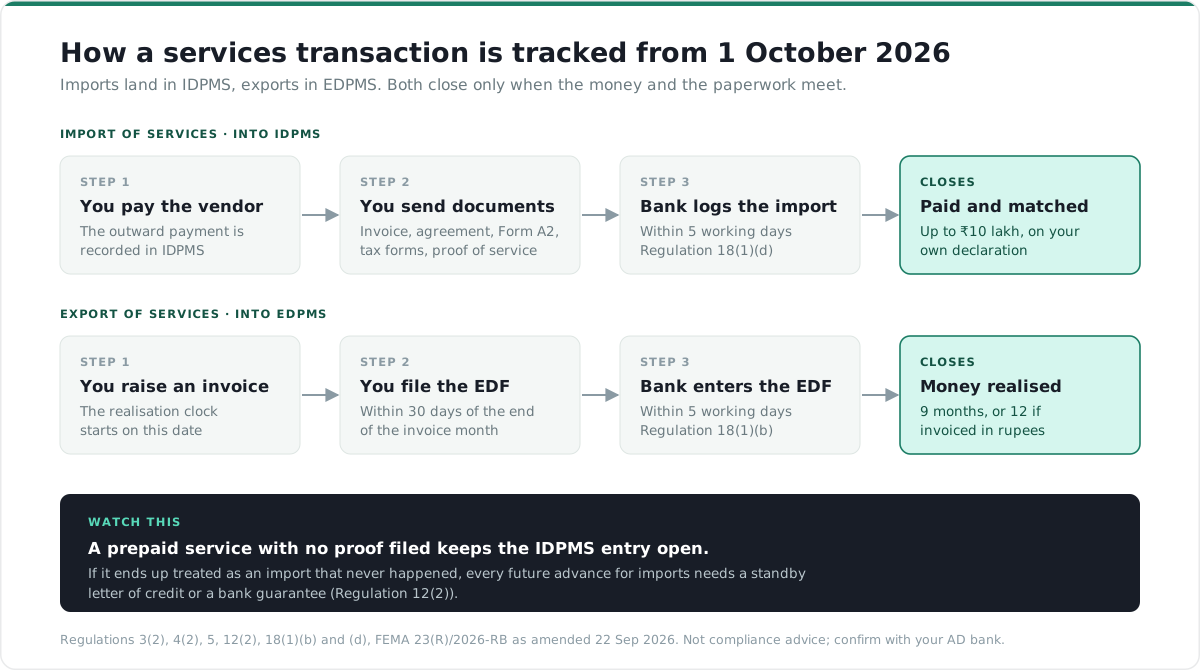
When you pay a foreign vendor for a service, two things now have to meet inside your bank. The bank records the outward payment in IDPMS (Regulation 18(1)(e)). It also enters the import itself from the documents you hand over (Regulation 18(1)(d)). Once the bank has ensured the payment was made, it marks the entry off (Regulation 18(1)(h)). The payment is the half the bank already has. The documents are the half only you can supply.
What documents. The regulations do not list them; your bank's SOP does. J.P. Morgan's published SOP, effective 1 October 2026, is a useful benchmark. For a services payment it asks for the payment instruction, the invoice or debit note, the agreement or order, Form A2 where applicable, tax forms or certificates, and evidence supporting the purpose of the service. For software it adds evidence of receipt, delivery or download. SBI's customer guide goes further for non-physical imports: there is no Bill of Entry, so for software, data, designs or drawings it asks for a Chartered Accountant's certificate of receipt or proof of delivery, along with the agreement or licence and the invoice. If you already file Form 15CA and 15CB for a foreign consultancy fee, most of this pack exists. What changes is that it now closes a monitored entry, not just a remittance file.
When you must pay. Regulation 9 ties the import payment period to your contract. You pay within the period in your underlying contract, and the AD bank may extend it on request. Your bank can still question the term: SBI's policy, dated 28 September 2026, sends contract periods above six months to enhanced due diligence. Write the payment term into the order or agreement. A term that exists only in an email thread is hard to show a bank.
Advances. An advance and every payment after it must go through the same AD bank, unless you tell both banks about the change (Regulation 10(2)). Regulation 10(3) leaves the advance limits to each bank, which may set thresholds above which it wants a standby letter of credit or a guarantee. SBI's figure for import of services is USD 500,000, including outstanding advances, against USD 1 million for goods.
When the service never arrives. Regulation 12 is the part of these rules most likely to catch a services buyer. If the import does not happen within the contract period, you must bring the advance back. If the advance is not brought back, or its IDPMS entry is not closed under Regulation 18(1)(j), every future advance you make for imports needs an unconditional, irrevocable standby letter of credit or a bank guarantee (Regulation 12(2)). A prepaid retainer or platform fee with no evidence of service ever filed is the easiest way to drift into that position.
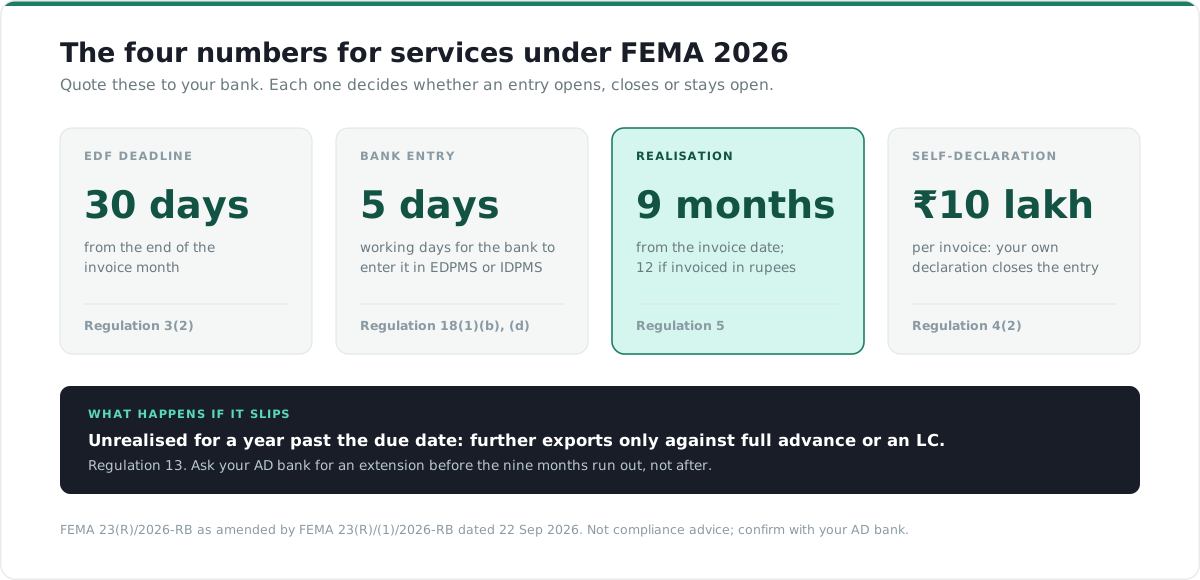
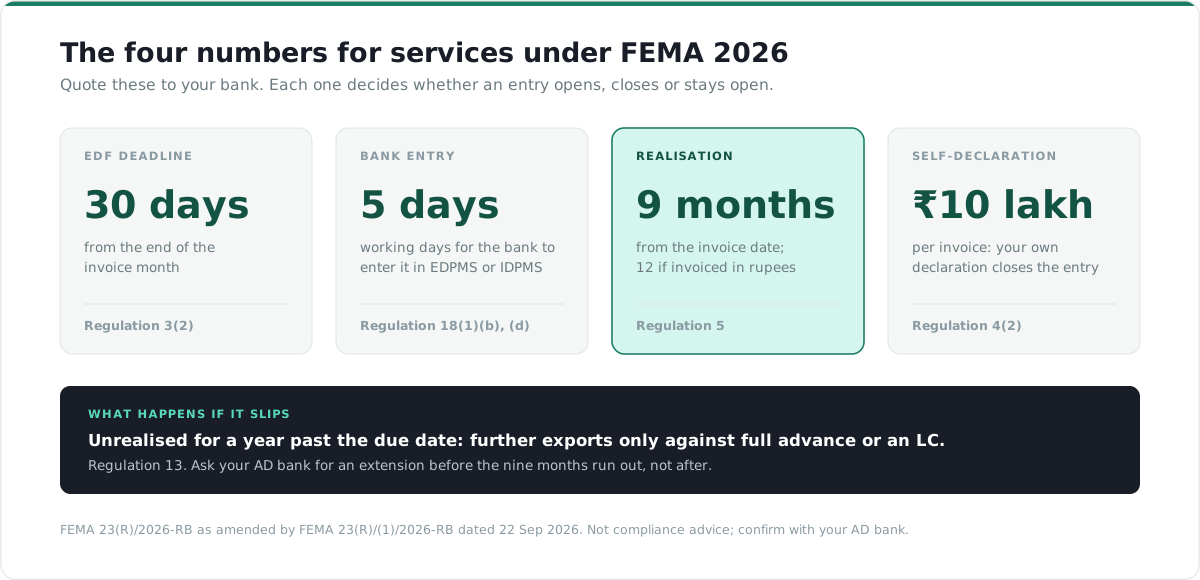
Closing the entry. Up to ₹10 lakh per invoice, your declaration that you have paid, in full or otherwise, closes it (Regulation 4(2), second proviso). Where you settled at a lower value, the bank may close the entry at that value once satisfied with your reasons (Regulation 18(1)(k)).
Paying a foreign software or SaaS vendor? EximPe is an RBI-authorised Payment Aggregator, Cross Border. Pay overseas vendors up to ₹25 lakh per transaction, and the documents your bank needs for the IDPMS entry come with the payment. Closing the entry with your AD bank stays your responsibility. Open an AD1 account.
EDF for service exporters: who files, where and when
The authority you file with depends on what you export and from where (Regulation 2(1)(f)).
| Exporter | Specified authority for the EDF | Deadline |
|---|---|---|
| Services other than software, outside an SEZ | Your AD bank | Within 30 days from the end of the invoice month; may also file on or before the date payment is received |
| Software, outside an SEZ | Your AD bank or STPI | Within 30 days from the end of the invoice month |
| Services or software from an SEZ unit | Development Commissioner of the SEZ | Within 30 days from the end of the invoice month |
| Goods through an EDI port | Commissioner of Customs, with the EDF deemed part of the shipping bill | At the time of export |
Check whether you are a software exporter. Regulation 2(1)(e) defines software as any computer programme, database, drawing, design, audio or video signal, or any information on a medium other than a physical one. A design studio sending files, a video editor delivering edits or an architect emailing drawings can fall on the software side. The difference matters: software gets no option to file on the payment date, and it can go to STPI as well as your bank.
The deadline in practice. The 30 days run from the end of the invoice month, not from the invoice date. Invoices dated 3 October and 22 October 2026 both go on one EDF due by 30 November 2026; an invoice dated 14 November is due by 30 December 2026. One EDF can cover every invoice of the month, across any number of clients (Regulation 3(2)(a)).
How to file the EDF for services, step by step
The regulations fix the form and the deadline; your bank fixes the channel, the covering format and the documents. The steps follow the form at the Annex to the regulations, with SBI's published customer guide as the worked example.
Download the blank form: Export Declaration Form, RBI (PDF). It is the Annex to the 2026 regulations.
- Get your bank's format before your first EDF is due. SBI asks for a request letter in its standard format carrying the FEMA declarations, and its authorised branch certifies the EDF. Other banks may take it through a trade portal. Your bank's policy and SOP must be on its website (Regulation 19(4)), so look there first.
- Map every service to its SAC code. Each row of the form asks for one. Settle them with your CA once.
- Log each invoice's Part 2B details as you bill, so month end is a copy job.
- Fill Part 1 once for the month, using the table below. Leave the goods fields (shipping bill, ports, LEO date) blank.
- Fill Part 2B, one row per invoice. If the full value is not known yet, as with usage-based billing, enter the value you expect to receive (note 2 to the form).
- Sign the declaration at Part 4. You undertake to bring the full value in within the realisation period and to give the bank the documents behind the form.
- Submit it with the supporting documents within the 30 days. SBI's checklist for a services export is the request letter, the service agreement or statement of work, the invoices, the EDF and proof that the service was provided, such as a delivery, milestone or usage record. Software exporters can file with STPI instead, which forwards the authenticated EDF to the bank (Regulation 3(3)).
- The bank certifies Part 5 and enters the EDF in EDPMS within five working days (Regulation 18(1)(b)). SBI's published turnaround for certifying a services EDF is one working day after it has a complete set.
- When the client pays, the bank closes the entry. Up to ₹10 lakh per invoice, your declaration closes it, filed singly or as a quarterly bulk declaration in the bank's format.
| Field | Part | What to enter for a services EDF |
|---|---|---|
| Type of export | 1 | Service |
| Mode of transport or delivery | 1 | Internet, for a service delivered online |
| IE Code, GSTIN, PAN | 1 | All three appear on the form; SBI asks for IEC and PAN before you start |
| AD code, AD name and address | 1 | The bank you file with and receive the payment through |
| Mode of realisation | 1 | L/C, BG, or Others, which covers advance payment and remittance |
| Third party name, address and relationship | 1 | Only if someone other than your client pays |
| Description and total services value in words (INR) | 1 | A summary of the month |
| Recipient name, address and country | 2B | One row per invoice |
| Invoice number, date, currency and amount | 2B | As on the invoice |
| Net realisable value | 2B | What you expect to receive after commission or discount |
| Contract number and date, description, SAC code | 2B | Contract if any; a description that matches the SAC code |
If you are late. Submit the EDF anyway, with a letter giving the reason, and ask for an extension under Regulation 3(2)(c). SBI lists late submission of a services EDF as a request it decides in two working days. Being paid already does not remove the need to file: the payment-date option means filing on or before the day the money arrives, not instead of it.
Which bank. The EDF names one AD bank, which enters it and closes it against your inward remittance. If clients pay through a platform or collection account, ask which AD bank the money settles through. For what the AD code is, see what an AD code is.
After you file. The entry waits for the money: nine months from the invoice date, twelve if invoiced or settled in rupees, extendable by your bank on request (Regulation 5). If proceeds stay unrealised for more than a year beyond the due date, you can only export further against full advance or an irrevocable letter of credit (Regulation 13). Exporters already on RBI's Caution List as on 30 September 2026 stay governed by that order until removed.
Software exporters. SOFTEX does not appear in the 2026 regulations. Your AD bank can now certify a software EDF. The eBRC you generate on DGFT is a separate, DGFT-side record; see how eBRC works.
What your bank's policy now decides
Most of the detail that used to sit in RBI's two Master Directions now sits in your bank's policy, which must cover the documents, timelines and charges for each process, with an escalation and appeal route for complaints. The bank must publish the policy and the main features of its SOP on its website (Regulation 19(4)).
Here is what three of the published policies say about services:
| Bank | What its published policy says about services | Document |
|---|---|---|
| SBI | Its authorised branch certifies the EDF for services, including software. Import contract periods above six months go to enhanced due diligence. Advances for import of services above USD 500,000 need a standby letter of credit or guarantee. Software, data or design imports need a CA certificate of receipt or proof of delivery. | FEMA Policy on Export, Import and Merchanting Trade Transactions, 28 September 2026, and its customer guide |
| IDBI Bank | Enters services EDFs in EDPMS, and services imports in IDPMS, within five working days of receipt. Charges follow its Trade Finance Schedule of Charges. | Policy on Import and Export, 1 October 2026 |
| J.P. Morgan India | For services payments: instruction, invoice or debit note, agreement or order, Form A2 where applicable, tax forms or certificates, and evidence of the service. | Foreign Exchange Payment Operations SOP, effective 1 October 2026 |
Ask for your own bank's policy by name before your next transaction. Two lines in Regulation 19(3) are worth knowing when you read it: charges must be reasonable and proportional to the service, and a bank cannot levy charges or a penalty on you for a regulatory delay or violation.
Goods exporters: what stays the same
For goods leaving through an EDI port, the EDF is deemed submitted as part of the shipping bill (Regulation 3(1)), so nothing changes in your filing. At a non-EDI port, Customs authenticates the EDF and forwards it to your bank, which has five working days to enter it in EDPMS (Regulations 3(3) and 18(1)(a)). Goods sent without consideration can now be declared at nil value.
Problems that actually come up
- An invoice raised long before the money arrives. The services clock runs from the invoice date, not the payment date. If a client pays on long terms, ask your AD bank for an extension before the nine months run out, not after.
- Prepaid software with no proof of service. An annual licence paid up front is an advance. File the invoice and evidence of delivery or access so the IDPMS entry closes; if it ends up treated as an import that never happened, Regulation 12(2) applies.
- Designers and editors filing as non-software. If what you deliver is a design, drawing, database or audio or video file, check it against the software definition first. Filing on the payment date is not open to you if it is software.
- A third party pays, or you pay one. A client's parent company settling your invoice needs your bank to be satisfied the transaction is genuine (Regulation 8), and the EDF has a field for the third party and your relationship to it.
- You buy from and sell to the same overseas group. Regulation 7 lets your bank set off export receivables against import payables with the same party or its group, within the realisation period. Ask before you net anything.
- The 30-day window has passed. Request the extension in writing with the reason. Regulation 3(2)(c) lets your bank grant it; it does not let you skip the EDF.
- Treating the FIRC or FIRA as the EDF. The certificate proves money arrived; the EDF declares the export it is for.
The forms that sit around a services payment
The EDF and the IDPMS entry are the FEMA layer. On the export side the documents run in sequence: the EDF declares the export, the FIRC or FIRA records the money arriving, and the eBRC you generate on DGFT certifies the realisation for incentives and GST refunds. The tax and remittance layers have not changed. A payment for a foreign service usually needs the right purpose code on the remittance, which decides how your bank reports it; see the RBI purpose code list. Many services remittances go with Form A2, and where tax is deductible, see TDS on payments to non-residents. For how the monitoring systems themselves work, including goods and the Bill of Entry, see EDPMS and IDPMS.
Frequently Asked Questions
The deadline in practice. Invoices raised in October 2026 need their EDF by 30 November 2026. One EDF can cover every invoice of the month, across any number of clients (Regulation 3(2)(a)). If you will miss it, ask your AD bank for an extension before the date and give the reason; the bank may extend once it is satisfied the request is reasonable (Regulation 3(2)(c)).
What the form asks for. The EDF is the form at the Annex to the regulations. Part 1 records the type of export (goods or service), the mode of delivery, which includes "Internet", your IEC, GSTIN and PAN, your AD code, the mode of realisation, and any third party paying on the buyer's behalf, with your relationship to it. Part 2B is what makes a monthly EDF workable: one row per invoice, with the recipient's name, address and country, the invoice number, date, currency and amount, the net realisable value, any contract reference, a description of the service and its SAC code. You then undertake to bring the money home within the period RBI sets. For what the AD code is, see what an AD code is.
What happens after you file. Your bank enters the EDF in EDPMS within five working days (Regulation 18(1)(b)). From then on the entry waits for the money: nine months from the invoice date, twelve if invoiced or settled in rupees, extendable by the bank on request (Regulation 5). Up to ₹10 lakh per invoice, your declaration closes the entry, and the same applies to reducing the export value (Regulations 4 and 6). If proceeds stay unrealised for more than a year beyond the due date, you can only export further against full advance or an irrevocable letter of credit (Regulation 13). Exporters already on RBI's Caution List as on 30 September 2026 stay governed by that order until removed.
Software exporters. SOFTEX has no place in the 2026 regulations, and an AD bank can now certify your EDF. SBI's policy names its authorised branch as the specified authority for certifying the EDF for services, including software. STPI remains an option for software outside an SEZ. The eBRC you generate on DGFT from your bank's inward remittance messages is a separate, DGFT-side record; see how eBRC works.
What your bank's policy now decides
Most of the detail that used to sit in RBI's two Master Directions now sits in your bank's policy. Regulation 19 requires each AD bank to maintain a policy and SOP covering, at minimum, the documents, timelines and charges for each process, extensions, adjustments, advances and factoring, with an escalation and appeal route for complaints. The bank must publish the policy and the main features of its SOP on its website (Regulation 19(4)).
Here is what three of the published policies say about services:
Bank | What its published policy says about services | Document |
SBI | Its authorised branch certifies the EDF for services, including software. Import contract periods above six months go to enhanced due diligence. Advances for import of services above USD 500,000 need a standby letter of credit or guarantee. | FEMA Policy on Export, Import and Merchanting Trade Transactions, 28 September 2026 |
IDBI Bank | Enters services EDFs in EDPMS, and services imports in IDPMS, within five working days of receipt. Charges follow its Trade Finance Schedule of Charges. | Policy on Import and Export, 1 October 2026 |
J.P. Morgan India | For services payments: instruction, invoice or debit note, agreement or order, Form A2 where applicable, tax forms or certificates, and evidence of the service. | Foreign Exchange Payment Operations SOP, effective 1 October 2026 |
Ask for your own bank's policy by name before your next transaction. Two lines in Regulation 19(3) are worth knowing when you read it: charges must be reasonable and proportional to the service, and a bank cannot levy charges or a penalty on you for a regulatory delay or violation.
Goods exporters: what stays the same
For goods leaving through an EDI port, the EDF is deemed submitted as part of the shipping bill (Regulation 3(1)), so nothing changes in your filing. At a non-EDI port, Customs authenticates the EDF and forwards it to your bank, which has five working days to enter it in EDPMS (Regulations 3(3) and 18(1)(a)). One small change sits in the form's notes: goods sent without any consideration can be declared at nil value.
Problems that actually come up
- An invoice raised long before the money arrives. The services clock runs from the invoice date, not the payment date. If a client pays on long terms, ask your AD bank for an extension before the nine months run out, not after.
- Prepaid software with no proof of service. An annual licence paid up front is an advance. File the invoice and evidence of delivery or access with your bank so the IDPMS entry closes. An entry left open gets your bank's follow-up, and if it ends up treated as an import that never happened, Regulation 12(2) puts a standby letter of credit or guarantee on every future advance.
- A long contract period at SBI. Above six months, expect enhanced due diligence. Have the agreement showing the term ready before you pay.
- A third party pays, or you pay one. A client's parent company settling your invoice, or you paying a vendor's group company, needs your bank to be satisfied the transaction is genuine (Regulation 8). The EDF has a field for the third party and your relationship to it.
- You buy from and sell to the same overseas group. Regulation 7 lets your bank allow export receivables to be set off against import payables with the same overseas buyer or supplier, or its group companies, within the realisation period. Ask before you net anything.
- The 30-day window has passed. Request the extension in writing with the reason. Regulation 3(2)(c) lets your bank grant it; it does not let you skip the EDF.
The forms that sit around a services payment
The EDF and the IDPMS entry are the FEMA layer. The tax and remittance layers have not changed. A payment for a foreign service usually needs the right purpose code on the remittance, which decides how your bank reports it; see the RBI purpose code list. Many services remittances go with Form A2, and where tax is deductible, see TDS on payments to non-residents. For how the monitoring systems themselves work, including goods and the Bill of Entry, see EDPMS and IDPMS.
Frequently asked questions
Frequently Asked Questions
The Export Declaration Form under the FEMA (Export and Import of Goods and Services) Regulations, 2026. It declares the full export value of goods or services to the specified authority. For services, it is due within 30 days from the end of the month in which the invoice was raised.
Yes. From 1 October 2026, software exporters file the EDF with their AD bank or STPI, or the SEZ Development Commissioner inside an SEZ.
Regulation 3(2) applies to every exporter of services and sets no size threshold. Ask your AD bank how it accepts the EDF; one form can cover all invoices raised in a month.
Fill Part 1 of the form once for the month and Part 2B with one row per invoice, sign the declaration, and submit it to your AD bank (or STPI for software) with your invoices, agreement and proof of service, within 30 days from the end of the invoice month. Your bank's published SOP sets the format and channel.
The Export Declaration Form under the FEMA (Export and Import of Goods and Services) Regulations, 2026. It declares the full export value of goods or services to the specified authority. For services, it is due within 30 days from the end of the month in which the invoice was raised.
Yes. From 1 October 2026, software exporters file the EDF, with their AD bank or STPI, or with the SEZ Development Commissioner inside an SEZ. SOFTEX does not appear in the 2026 regulations.
Regulation 3(2) applies to every exporter of services and sets no size threshold. Ask your AD bank how it accepts the EDF; one form can cover all invoices raised in a month.
Within 30 days from the end of the invoice month, so October invoices are due by 30 November. Services other than software may also be declared on or before the date payment is received.
Yes. Since 1 October 2026, the AD bank enters an import of services in IDPMS as declared and submitted by the importer, within five working days of receiving the documents.
Your bank's SOP sets the list. Typical items are the invoice or debit note, the agreement or order, Form A2 where applicable, tax forms or certificates, and evidence the service was delivered. Up to ₹10 lakh, your declaration of payment closes the entry.
Nine months from the invoice date, or twelve months where the export is invoiced or settled in Indian rupees. Your AD bank can extend it on request.
Your bank's charges must be reasonable and are set out in its published policy. Under Regulation 19(3), it cannot levy a charge or penalty on you for a regulatory delay or violation.
Within 30 days from the end of the invoice month, so October invoices are due by 30 November. Services other than software may also be declared on or before the date payment is received.
Yes. Since 1 October 2026, the AD bank enters an import of services in IDPMS as declared and submitted by the importer, within five working days of receiving the documents.
Your bank's SOP sets the list: typically the invoice, the agreement or order, Form A2 where applicable and evidence of delivery. SBI asks for a CA certificate of receipt for software, data or design imports. Up to ₹10 lakh, your declaration closes the entry.