What Is OPGSP? The Framework That Replaced It, and What Changed in 2025-26
OPGSP full form, what the framework allowed, and why it was repealed in 2025. How PA-CB replaced it, the ₹25 lakh cap, and how to check provider
Listen to article
Audio version (0% complete)

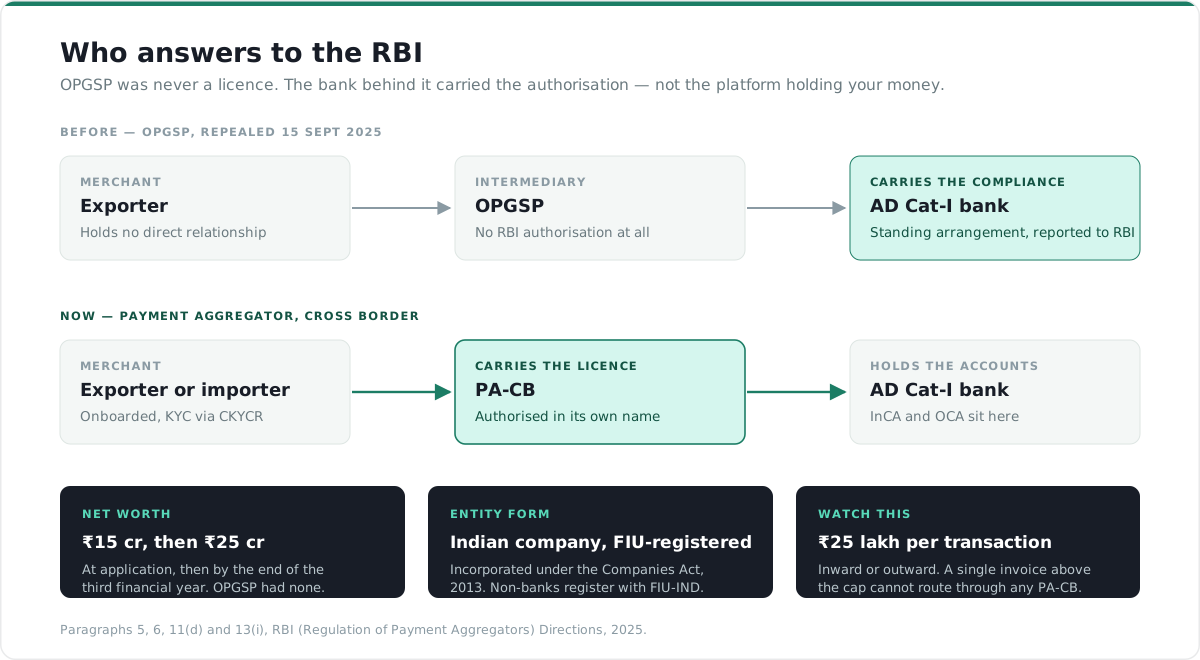
OPGSP stands for Online Payment Gateway Service Provider, the arrangement that let Indian exporters and importers collect and send small cross-border payments through an intermediary tied to a bank, rather than through their own wire transfer. It was never a licence. An OPGSP held no authorisation from the Reserve Bank of India. It worked by entering a standing arrangement with an Authorised Dealer Category-I bank, and that bank carried the compliance.
That framework no longer exists. If you are reading about OPGSP because a provider mentioned it, or because you are trying to work out which rules govern the platform holding your export proceeds, the short answer is that the OPGSP circulars were repealed on 15 September 2025 and the category was replaced by Payment Aggregator - Cross Border (PA-CB).
The dates that matter
Most material written about OPGSP points at a circular from September 2015. A newer layer points at a circular from October 2023. Both are now repealed, and the second was repealed within two years of being issued, which is why this is worth getting precisely right.
The framework in force today is the Reserve Bank of India (Regulation of Payment Aggregators) Directions, 2025, issued on 15 September 2025 under reference RBI/DPSS/2025-26/141, CO.DPSS.POLC.No.S-633/02-14-008/2025-26. It was issued under Section 18 read with Section 10(2) of the Payment and Settlement Systems Act, 2007, and Sections 10(4) and 11(1) of FEMA, 1999.
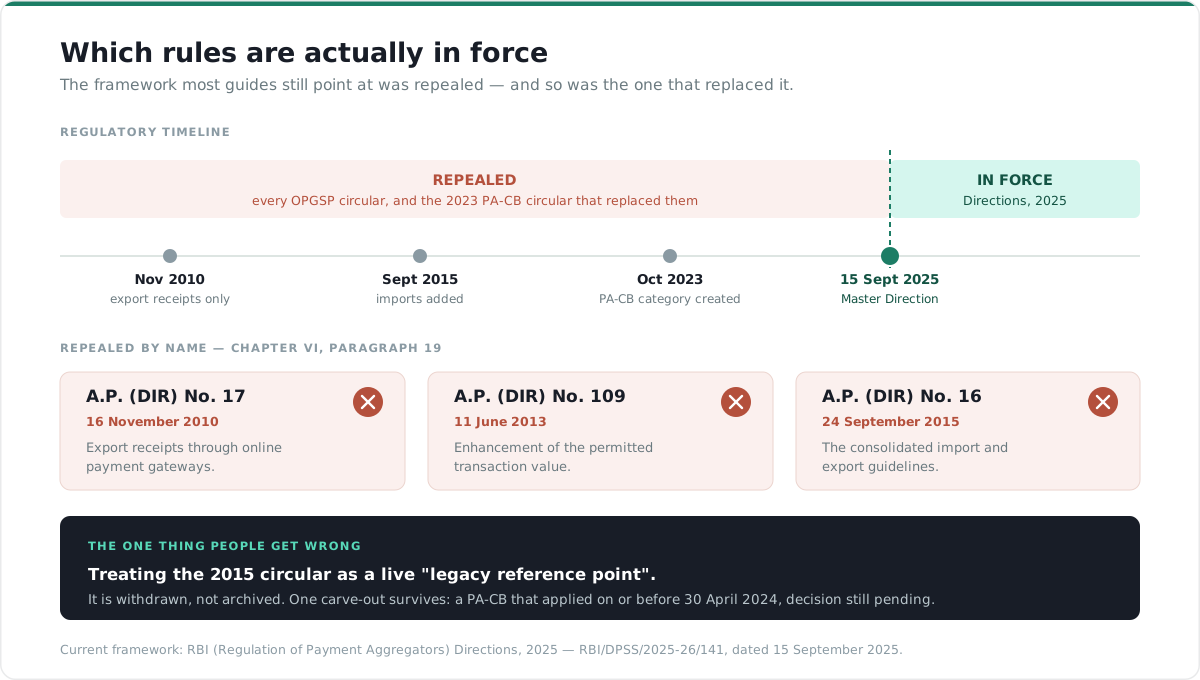
Chapter VI of the Master Direction does the demolition. Paragraph 19 repeals all three OPGSP circulars by name:
- A.P. (DIR Series) Circular No. 17 dated 16 November 2010 - export receipts through online payment gateways
- A.P. (DIR Series) Circular No. 109 dated 11 June 2013 - enhancement of transaction value
- A.P. (DIR Series) Circular No. 16 dated 24 September 2015 - the consolidated import and export guidelines
Paragraph 21 and Annexure 3 then repeal the PA-CB circular itself - CO.DPSS.POLC.No.S-786/02-14-008/2023-24 dated 31 October 2023 - along with the 2020 and 2021 payment aggregator guidelines.
Does this still apply to you?
The answer differs by which side of the flow you sit on.
If you are an exporter receiving money into India: your provider must now hold RBI authorisation in its own name. The old model, where the platform relied on its bank's standing arrangement, is closed. Your practical exposure is that an unauthorised intermediary has no legal basis to aggregate your proceeds.
If you are an importer paying money out of India: the same authorisation requirement applies to whoever routes your payment, and a hard ceiling now applies to you that did not exist in the same form before. The maximum value per transaction through a PA-CB is ₹25 lakh, inward or outward.
If you are evaluating a provider: ask for the Certificate of Authorisation, not a claim of compliance. The section on checking status below sets out what to look for.
What OPGSP actually was
Under Circular No. 16 of 24 September 2015, an OPGSP was not authorised by the RBI at all. An AD Category-I bank entered a standing arrangement with the OPGSP and reported the details of each such arrangement to the Foreign Exchange Department at RBI Mumbai. The bank opened separate export and import collection accounts, ran the due diligence, and answered for the arrangement.
The caps were the defining constraint, and they were low. Exports were capped at USD 10,000 per transaction. Imports were capped at USD 2,000, and only for goods and software permitted under the prevailing Foreign Trade Policy, not services generally. Import proceeds sitting in the collection account had to be remitted onward to the overseas exporter's bank account within two days of credit. Where exporters held notional accounts with the OPGSP, no funds could be retained in them.
Those numbers explain what the framework was built for: small e-commerce and service export receipts, not trade invoices. An importer bringing in a container never fitted inside a USD 2,000 ceiling, which is why the trade side largely ran on direct bank wires and still does for anything substantial.
OPGSP vs PA-CB: what actually changed
OPGSP (repealed) | PA-CB (current) | |
Legal basis | A.P. (DIR) Circulars 17/2010, 109/2013, 16/2015 | RBI (Regulation of Payment Aggregators) Directions, 2025 |
Authorisation | None. Standing arrangement with an AD Cat-I bank | Non-banks must hold RBI authorisation; banks need none |
Who answers to RBI | The AD Category-I bank | The PA-CB itself |
Entity form | Not specified | Company incorporated in India under the Companies Act, 2013 |
Net worth | None | ₹15 crore at application; ₹25 crore by the end of the third financial year from authorisation |
Transaction cap | USD 10,000 exports; USD 2,000 imports | ₹25 lakh per transaction, inward or outward |
Categories | Export and import arrangements | Two: PA-CB facilitating inward, and PA-CB facilitating outward |
Accounts | OPGSP export and import collection accounts | Inward Collection Account (InCA) and Outward Collection Account (OCA) |
AML registration | Via the bank | Non-bank PA must register with FIU-IND directly |
Two changes in that table catch people who last read up on this in 2024. The three PA-CB categories are gone. The October 2023 circular created export-only, import-only, and combined categories. The 2025 Directions replace them with two sub-categories defined by direction of flow: a PA-CB facilitating inward transactions (inflow of foreign exchange) and one facilitating outward transactions (outflow). And the account names changed — what was described as an export or import collection account is now the InCA and the OCA.
Two definitional exclusions are also worth knowing, because they decide whether a given flow is PA-CB activity at all. A card transaction where the foreign exchange settlement is handled by the card network and the aggregator receives payment in local currency is not PA-CB activity. And a non-bank authorised as AD Category-II facilitating current account transactions other than the purchase or sale of goods or services falls outside PA-CB as well.
The four provisions that will actually bite you
This is the part that matters operationally, and it is where the money leg meets the customs leg.
The ₹25 lakh ceiling is per transaction, and it is absolute. A single import invoice above ₹25 lakh cannot be routed through any PA-CB, no matter which one. In trade terms that is roughly a single mid-sized consignment. Splitting one invoice across multiple transactions to fit under the cap is not a workaround, it is structuring, and your AD bank will see it in the reporting. Above the ceiling, you are on a direct bank wire.
Inward and outward funds cannot be netted off. Paragraph 11(a) is unambiguous: funds relating to inward and outward transactions must be kept separate, and no co-mingling or netting off is permitted under any circumstance. If you both import and export, you cannot offset what you owe against what you are owed through the same provider. Two separate flows, two separate accounts, two separate sets of documentation.
Your provider has to hand you the documents that close your IDPMS or EDPMS entry. Paragraph 11(h) requires the PA-CB to give the exporter or importer the documents and information their AD bank needs to close the corresponding entry in the Export Data Processing and Monitoring System or the Import Data Processing and Management System. This is the clause I would ask about first. An import payment that never matches its Bill of Entry stays open in IDPMS, and an unreconciled entry is how a clean shipment turns into a compliance problem months later. Our guides to EDPMS and IDPMS and to closing an import entry in IDPMS cover what that matching actually involves.
Non-INR settlement is restricted. Paragraph 11(i) permits settlement in non-INR currencies only for merchants, Indian exporters directly onboarded by a PA-CB facilitating inward transactions. If you were onboarded through an overseas intermediary rather than directly, that option is not available to you.
A fifth rule is worth a line: a PA-CB may not buy foreign currency from, or sell it to, any entity other than an Authorised Dealer. The FX leg stays inside the banking channel regardless of who fronts the platform.
InCA and OCA: how the money is actually held
Inward Collection Account (InCA) | Outward Collection Account (OCA) | |
Held with | AD Category-I scheduled commercial bank | AD Category-I scheduled commercial bank |
Currency | Separate account for INR and for each non-INR currency | INR |
Pre-funding | Not permitted | Not permitted |
Inter-account transfer | Not permitted | Not permitted |
Interest | None payable on balances | None payable on balances |
The escrow requirements in the Directions were to be complied with by 31 December 2025. Where a PA-CB also runs domestic payment aggregation, the InCA and OCA must be kept separate from the domestic escrow account. For outward flows, funds may reach the PA's escrow account and then transfer to the OCA, or land directly in the OCA, but the onward transfer to the foreign merchant must be made by debit to the OCA.
How to check your provider is authorised
Claims of compliance are not the same as authorisation, and the distinction is now the whole point of the framework. Three states are possible, and each calls for a different response.
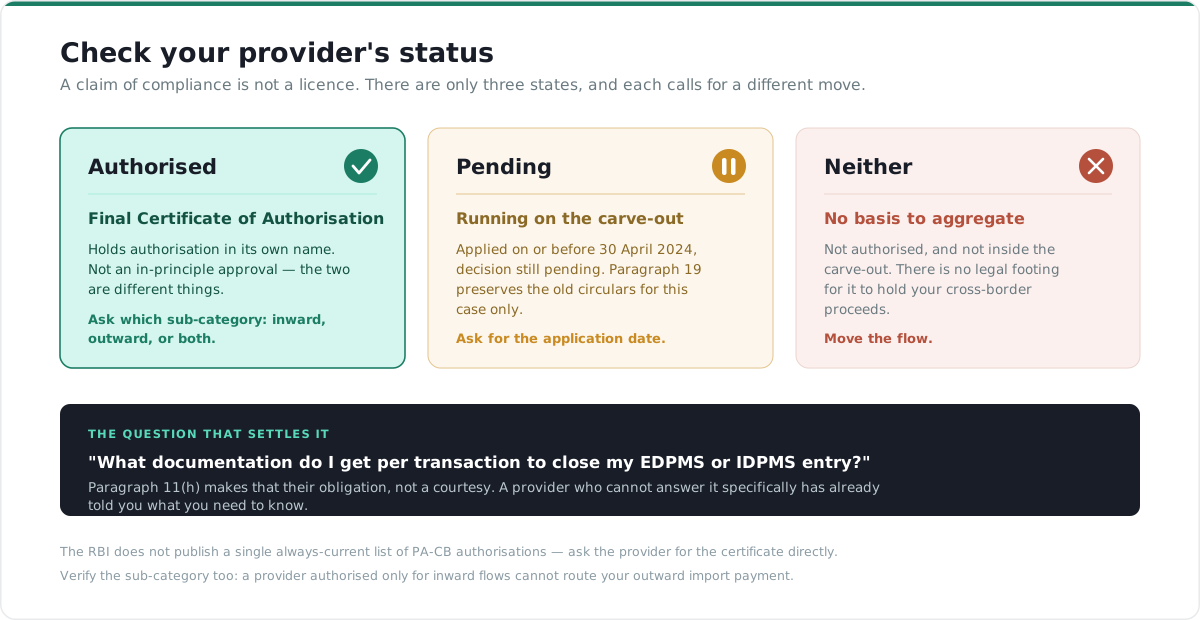
- Ask for the Certificate of Authorisation, and check whether it is a final authorisation or an in-principle approval. They are not the same thing, and in-principle approval does not confer operating authorisation.
- Confirm the sub-category, inward, outward, or both. A provider authorised for inward flows cannot route your import payment out.
- Ask whether they are relying on the 30 April 2024 carve-out. If the answer is yes, their application is still pending a decision.
- Confirm they are registered with FIU-IND. Non-bank payment aggregators are required to register, and it is a reasonable thing to verify.
- Ask what documentation you receive per transaction for your EDPMS or IDPMS closure. If they cannot answer this specifically, that is your answer.
If you want to see who currently holds authorisation, we maintain a list of RBI PA-CB licensees with the caveat that the RBI does not publish a single always-current page for this category.
The compliance layer nobody mentions until it fails
Getting the payment routed is the easy half. Two things determine whether it reconciles.
The first is the purpose code your bank reports the transaction under. It classifies why the money moved, and it is what the regulator matches against. Get it wrong and the entry does not close cleanly, our explainer on purpose codes in banking covers which one applies to what.
The second is your AD Code, which links your IEC, your bank branch, Customs and the RBI systems into one traceable chain. It is a mandatory field on the Bill of Entry and the Shipping Bill, and it is the reason a payment can be matched back to a specific consignment at all. We cover it in the guide to AD Code registration. On the export side, realisation feeds the EDPMS record that produces your eBRC.
Choosing a route for your trade payments
Once you know the framework, the decision is narrow: for cross-border collections and payouts inside the ceiling, you need a provider that holds authorisation in its own name and gives you the documentation your AD bank needs.
EximPe holds a final PA-CB authorisation from the RBI, not an in-principle approval, and handles purpose-code classification and per-transaction documentation as part of the flow, so the entry in EDPMS or IDPMS closes against the right record. You can read the framework detail on our PA-CB licence page.
The limit applies to us as it does to everyone: ₹25 lakh per transaction, inward or outward. A single invoice above that ceiling cannot be routed through a PA-CB at all, ours included - that one goes through your bank as a direct wire. Anyone telling you otherwise is describing something the Directions do not permit.
Frequently Asked Questions
Frequently Asked Questions
Online Payment Gateway Service Provider. It was an RBI framework allowing AD Category-I banks to enter standing arrangements with intermediaries to process small cross-border export and import payments.
No. The three circulars that created and governed OPGSP were repealed by Chapter VI of the RBI (Regulation of Payment Aggregators) Directions, 2025 on 15 September 2025. A narrow carve-out preserves them only for an existing PA-CB that applied for authorisation on or before 30 April 2024 and whose application remains pending.
Payment Aggregator - Cross Border (PA-CB). The category was created by an RBI circular of 31 October 2023 and is now governed by the September 2025 Master Direction, which repealed that circular too.
USD 10,000 per transaction for exports and USD 2,000 for imports of goods and software. Under PA-CB the limit is ₹25 lakh per transaction, in either direction.
No, and that was the defining feature of the framework. The OPGSP held no authorisation. Its AD Category-I bank carried the regulatory relationship. Under PA-CB, a non-bank must hold authorisation in its own name.
Two, under the current Directions: a PA-CB facilitating inward transactions and one facilitating outward transactions. The earlier export-only, import-only and combined categories no longer apply.
No. A bank does not require authorisation to carry out payment aggregator business. The requirement applies to non-bank entities, which must be companies incorporated in India under the Companies Act, 2013.
No. The cap is per transaction and splitting a single underlying invoice to fit beneath it will show in the reporting your AD bank submits. Invoices above the ceiling route through a direct bank transfer.
The Inward Collection Account holds proceeds of inward transactions and may be held in INR and in each non-INR currency separately. The Outward Collection Account holds funds for payment to overseas sellers and is INR only. Funds cannot be moved between them.