Merchant of Record in India: Who Collects the INR, and Who Owes the GST
A foreign merchant of record cannot collect INR in India, and OIDAR GST registration starts at the first sale. What that means for you.
Listen to article
Audio version (0% complete)
A merchant of record is the legal entity that sells to your customer. It takes the payment, appears on the card statement, carries the chargeback, and owes the sales tax. Most software companies use one so they can sell into forty countries without registering in forty countries.
India splits that role in a way most markets do not, and the split is the thing to understand before you sign anything.
Two facts decide everything below. A merchant of record based outside India cannot itself collect rupees from Indian customers, that requires authorisation from the Reserve Bank of India. And whoever is the merchant of record is the party on the hook for Indian GST on digital services, under a registration rule that has no minimum threshold at all.
Those are separate questions with separate answers, and conflating them is how foreign software companies end up either unable to take payment or unexpectedly registered for tax in India.
What a merchant of record actually does
When you sell through an MoR, one sale becomes two transactions. Your customer buys from the MoR. The MoR buys from you. The MoR's name is what appears on the customer's statement, and the MoR is who the customer disputes with.
That structure is what lets the MoR absorb the parts of selling internationally that scale badly: local acquiring, currency conversion, card scheme compliance, fraud, refunds, chargebacks, and indirect tax registration and remittance in each market.
You keep the product, the pricing, the customer relationship and the support. You hand over the transaction and the liabilities attached to it.
The three roles India separates
In most markets the merchant of record is also the entity that collects the money and the entity that remits the tax. One party, three jobs. In India those can be three different parties, and two of them are governed by different regulators.
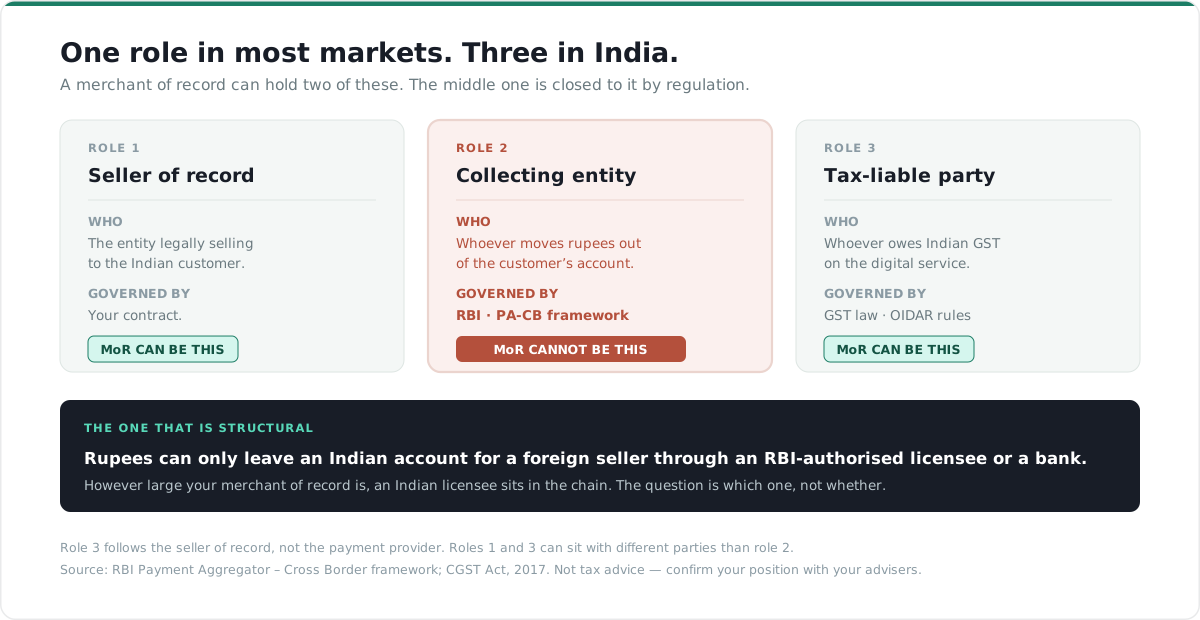
The seller of record is whoever is legally selling to the Indian customer. That is the MoR if you use one, and you if you do not.
The collecting entity is whoever actually moves rupees out of the Indian customer's bank account. Under the Reserve Bank's Payment Aggregator - Cross Border framework, this has to be an RBI-authorised PA-CB entity or a bank. A foreign MoR, however large, is not one of those. It has to sit behind an Indian licensee.
The tax-liable party is decided by GST law, not by your contract. For digital services sold to Indian consumers it follows the seller of record, and it does not care what your payment stack looks like.
A foreign MoR can occupy the first and third roles. It cannot occupy the second.
Who owes Indian GST when you sell through an MoR
This is the question that catches software companies, because the whole reason to use an MoR is not to think about sales tax.
Digital services delivered into India fall under OIDAR, Online Information and Database Access or Retrieval services. The test is three-part: the service is delivered over the internet, it is essentially automated with minimal human intervention, and it would be impossible or highly impractical to supply without information technology. Cloud hosting, SaaS subscriptions, streaming, online gaming, e-books, automated courses and API products all sit inside it. Live instructor-led teaching and genuine human consulting generally sit outside.
If you are not sure which side of the line your product falls, run it through the OIDAR Service Checker before you read further, the rest of this section only applies if the answer is yes.
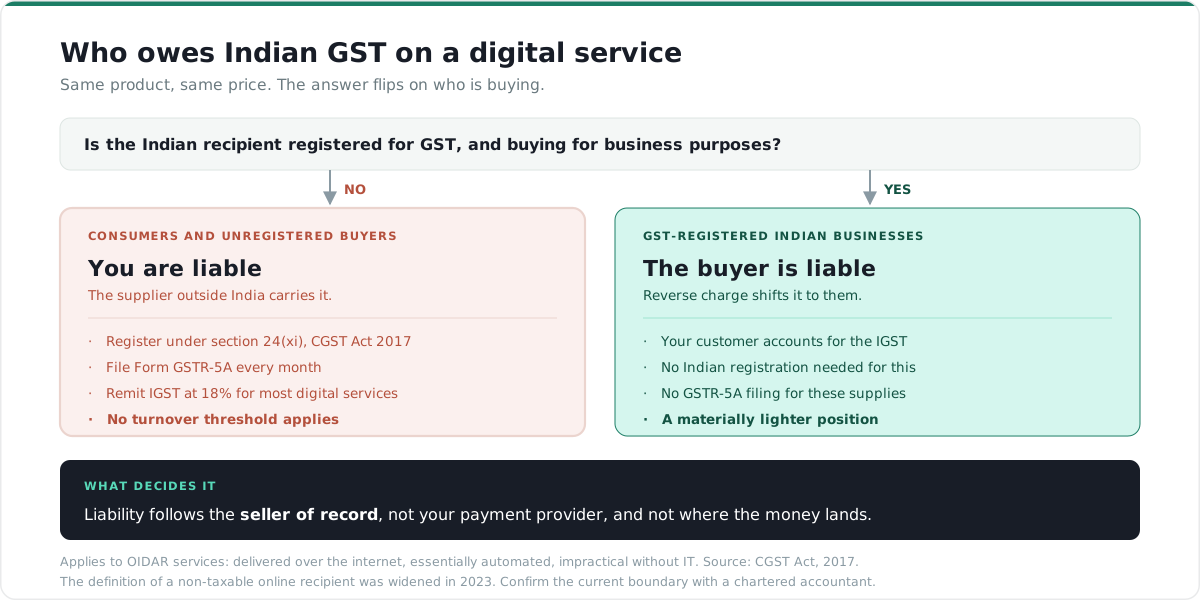
Where it lands depends on who is buying.
Selling to Indian consumers and unregistered buyers. The liability sits with the supplier outside India. Under section 24(xi) of the CGST Act, 2017, a foreign supplier of OIDAR services to a non-taxable online recipient must register for GST in India, file Form GSTR-5A monthly, and remit IGST - 18% for most digital services.
Selling to GST-registered Indian businesses. The liability flips to the buyer under the reverse charge mechanism. Your Indian business customer accounts for the IGST themselves. You are not the one registering.
So a pure B2B SaaS selling to registered Indian companies has a materially lighter position than a B2C product selling to individuals, and most products that scale in India do both.
The consequence for the MoR decision is direct. If the MoR is the seller of record for your Indian consumer sales, the OIDAR registration and the GSTR-5A filings are the MoR's, not yours. If you sell direct and only use a payment provider, they are yours. An MoR that handles VAT in Europe does not automatically hold an Indian GST registration, and that is a specific question to ask rather than assume.
The number that has no threshold
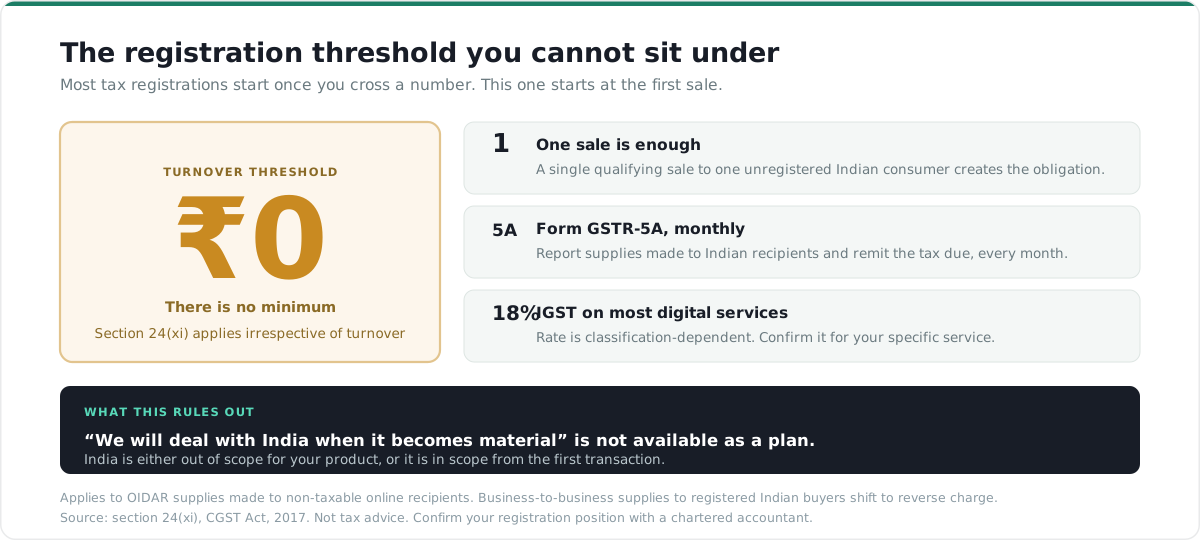
Most tax registrations start once you cross a turnover figure. OIDAR does not have one.
Registration under section 24(xi) is compulsory irrespective of turnover. One qualifying sale to one unregistered Indian consumer is enough to create the obligation. There is no small-supplier exemption to sit under and no volume at which it becomes worth doing properly, because the threshold is zero from the first transaction.
That is why "we will deal with India when it's material" does not work as a plan. India is either out of scope for your product or it is in scope from the first sale.
Collecting the money
Payment is the other half, and it is governed separately.
Rupees leaving an Indian customer's account for a foreign seller is an import of services under FEMA. It has to be routed through an RBI-authorised PA-CB entity or a bank, tagged with the correct purpose code, and reported. The customer pays in INR by UPI, card or net banking; the licensee converts and settles to your offshore account in your currency.
The practical constraints live on the payment rails rather than in the MoR contract. UPI Autopay mandates are capped, mid-cycle plan changes behave differently from what most billing systems assume, and renewals carry a mandatory notification period. We cover those mechanics in detail in the guide to UPI AutoPay for SaaS, and the licensing side in the complete list of RBI PA-CB licensees.
The point to carry into an MoR conversation is narrower: whoever your MoR is, an Indian licensee is in the chain. Ask which one.
What to ask before you sign
Six questions that separate an MoR with a real India position from one that lists India on a coverage map.
Which RBI-authorised PA-CB or bank do you route Indian collections through? There is always one. A provider who cannot name it has not thought about India specifically.
Do you hold an Indian GST registration for OIDAR, and do you file GSTR-5A? If they are your seller of record for Indian consumers, they should. If they do not, work out who is filing.
Which Indian payment methods do you actually present, and at what ticket sizes? UPI is how most of India pays online. A checkout that only offers international cards will convert badly and will decline often.
How do subscription upgrades behave on Indian mandates? Indian recurring mandates authorise a fixed amount. Billing logic that charges immediately on upgrade tends to fail here.
What is the settlement currency and the FX spread on the INR leg? This is frequently the largest real cost and the least visible one.
Who is named on the customer's statement, and who handles an Indian chargeback? It determines your support load and your dispute exposure.
If you are selling across APAC
India is usually the outlier in an APAC rollout. Singapore, Australia and Japan can generally be served by a conventional MoR arrangement without a local licensed intermediary in the payment chain. India adds the RBI-authorised collector as a structural requirement, and adds a zero-threshold tax registration that most other markets in the region do not.
Plan India as its own work stream rather than one row in a coverage table, and the rest of the region gets simpler by comparison.
Where EximPe fits
EximPe is an RBI-authorised Payment Aggregator - Cross Border licensee. We collect from Indian customers in INR over UPI, cards and net banking, tag the transaction against the correct FEMA purpose code, and settle to your offshore account, without you setting up an Indian entity.
The limitation, stated plainly: that is the collection role, not the seller-of-record role. Using EximPe does not make us your merchant of record, and it does not move your OIDAR registration or your GSTR-5A filings onto us. If you need someone to become the legal seller to your Indian customers, that is a separate arrangement and you should confirm the tax position with your own advisers.
If you want to see the payment side working, the UPI for global merchants page covers the collection flow.
Frequently asked questions
Frequently Asked Questions
Not directly. Collecting INR from Indian customers for a foreign seller requires an RBI-authorised PA-CB entity or a bank in the chain. A foreign MoR has to work through one.
No. You can collect through an RBI-authorised PA-CB licensee and settle offshore without incorporating in India. A GST registration for OIDAR is a separate question from having an entity.
It follows the seller of record. If the MoR sells to your Indian consumers, the OIDAR registration and GSTR-5A filings are theirs. If you sell direct, they are yours. Sales to GST-registered Indian businesses shift to reverse charge and the buyer accounts for the tax.
No. Registration under section 24(xi) of the CGST Act is compulsory irrespective of turnover. A single sale to an unregistered Indian recipient triggers it.
Most digital services attract IGST at 18%. Confirm the rate for your specific service classification.
The monthly return a foreign OIDAR supplier files to report supplies made to Indian recipients and remit the IGST due.
It is if it is delivered over the internet, essentially automated with minimal human intervention, and impractical to provide without IT. The OIDAR Service Checker tests a service against those criteria.
You never needed one. The licence requirement falls on whoever aggregates the cross-border collection, which is why an RBI-authorised licensee sits in the chain regardless of your MoR arrangement.