How to Apply IEC Code (2026): Full Form, Check Status and Renew It - Step by Step Process
IEC full form is Importer Exporter Code. How to apply, check your IEC status, and complete the annual renewal before your code gets deactivated.
Listen to article
Audio version (0% complete)
IEC stands for Importer-Exporter Code, Before 2017 it used to be a 10-digit unique identification number but after introduction of GST in 2017 the Importer-Exporter Code for firms in India became the same as their PAN (Permanent Account Number), though you still need to apply it via the Directorate General of Foreign Trade (DGFT) under India's Ministry of Commerce and Industry. Without an IEC, no shipment can legally clear customs, and no government trade incentives can be accessed for import export transactions. An IEC is a one-time registration document that needs to be updated every year between April 1st and June 30th, making it the foundation of every import-export business in India.
What Is an IEC Code?
IEC full form: Importer-Exporter Code. Before GST, it was a standalone 10-digit number. Since 2017, your IEC is your PAN, same 10 characters. But here's the catch that trips up first-timers: having a PAN does not give you an IEC. You still have to formally apply through DGFT and receive IEC status against that PAN. The PAN is the identity; the IEC is the permission.
It has lifetime validity, it never expires. It's issued once, online, for ₹500. And it's the single credential that links your business into every downstream trade system: customs clearance, FEMA-compliant bank remittances, GST reconciliation, and the IDPMS (imports) and EDPMS (exports) monitoring systems that RBI runs through ICEGATE.
The IEC Format: Understanding the 10 Digits
After 2017 IEC is PAN-based, meaning it's the same as your PAN number that you get from the Income Tax Department. But, you still have to separately apply for it via DGFT.
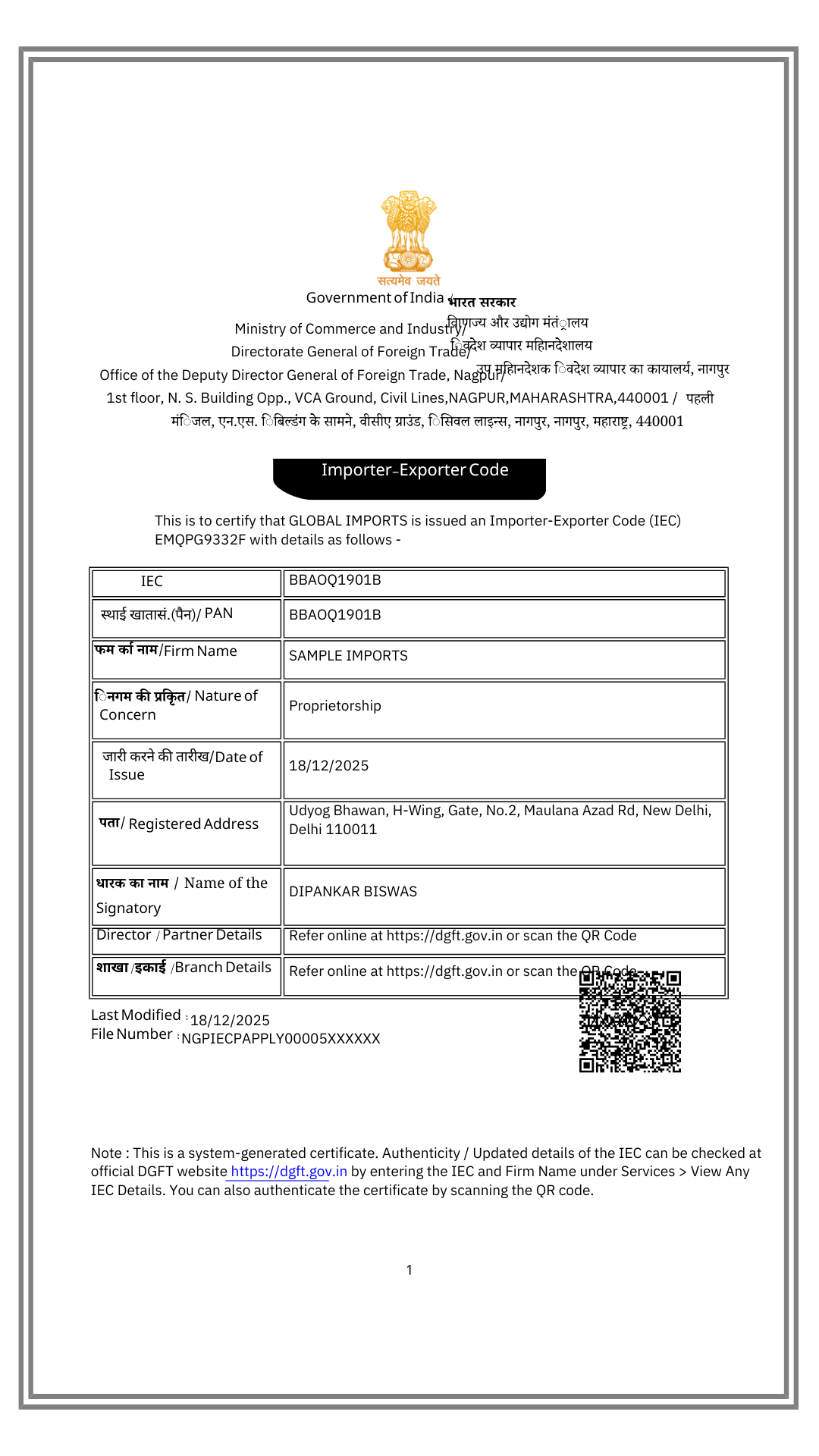
IEC vs PAN vs AD Code vs Import Licence - stop confusing these
Four things get misinterpreted constantly. They are not interchangeable:
Credential | What it is | Who issues it | When you need it |
PAN | Your tax identity | Income Tax Dept | Always - it's the base your IEC sits on |
IEC | Permission to import/export | DGFT | Before your first shipment or trade remittance |
AD Code | Your bank's Authorised Dealer code, registered at a port | Your bank + Customs | Before you file a Shipping Bill at a specific port |
Import Licence | Permission for restricted goods | DGFT | Only if your product is on the restricted list |
Most goods are freely importable and need no import licence, just the IEC. But your IEC alone won't let you file at a port; for that you also register your bank's AD Code against your IEC at port you ship from. Different credential, different job.
Who needs an IEC, and who's exempt
If you import or export goods for commercial purposes, you need one, regardless of size, turnover, or whether you're a proprietor, partnership, LLP, or company. Service exporters are a grey area: IEC isn't strictly mandatory just to receive foreign exchange for services, but the moment you want to claim a Foreign Trade Policy benefit, you need it, so most get it anyway.
Genuine exemptions are narrow: goods imported or exported strictly for personal, non-commercial use, and specific government departments. Everyone else trading commercially needs the code. If you think you qualify for a waiver, check the current DGFT Handbook of Procedures before assuming, exemptions shift with policy.
NRIs: you can apply from abroad, but you must register an Indian entity (proprietorship, LLP, Pvt Ltd) with India-based address and contact details, and sign with a DSC or an authorised Indian representative.
How to get an IEC: the full step-by-step process
The whole thing is online at dgft.gov.in, on Form ANF-2A, and costs a one-time ₹500 government fee. Have these ready before you start: PAN, Aadhaar (for OTP e-sign), an active bank account in the entity's name with a cancelled cheque or bank certificate, address proof, and a photograph.Have them as PDFs/JPEGs within the per-field size limits.
Part A - Create your DGFT account
Step 1 - Open the DGFT portal and click Register.
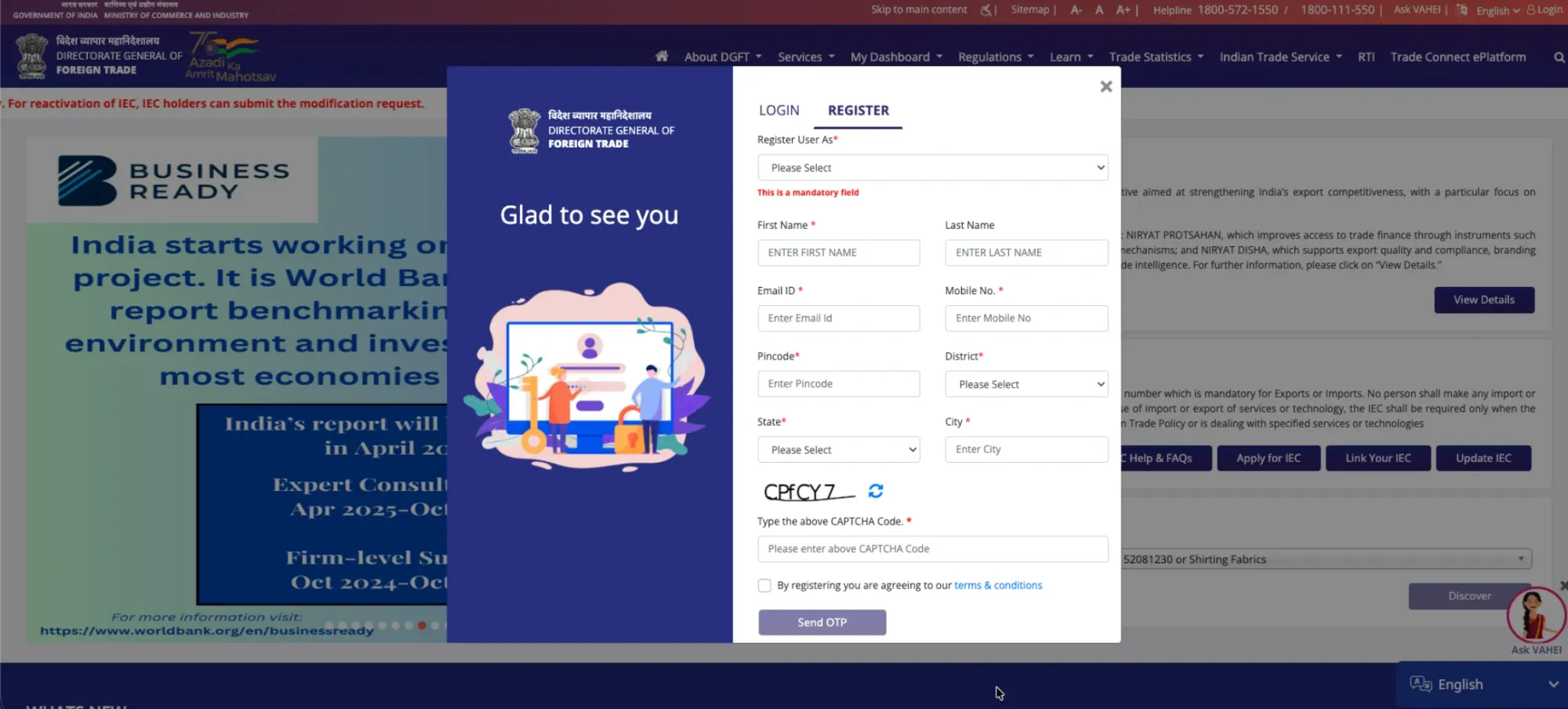
Step 2 - Fill the registration form and verify by OTP.
Choose your Register As category (for most, Importer/Exporter), then enter name, firm name, email, and mobile. Submit, enter the OTP sent to your mobile and email, and set a password. Your DGFT account is created.
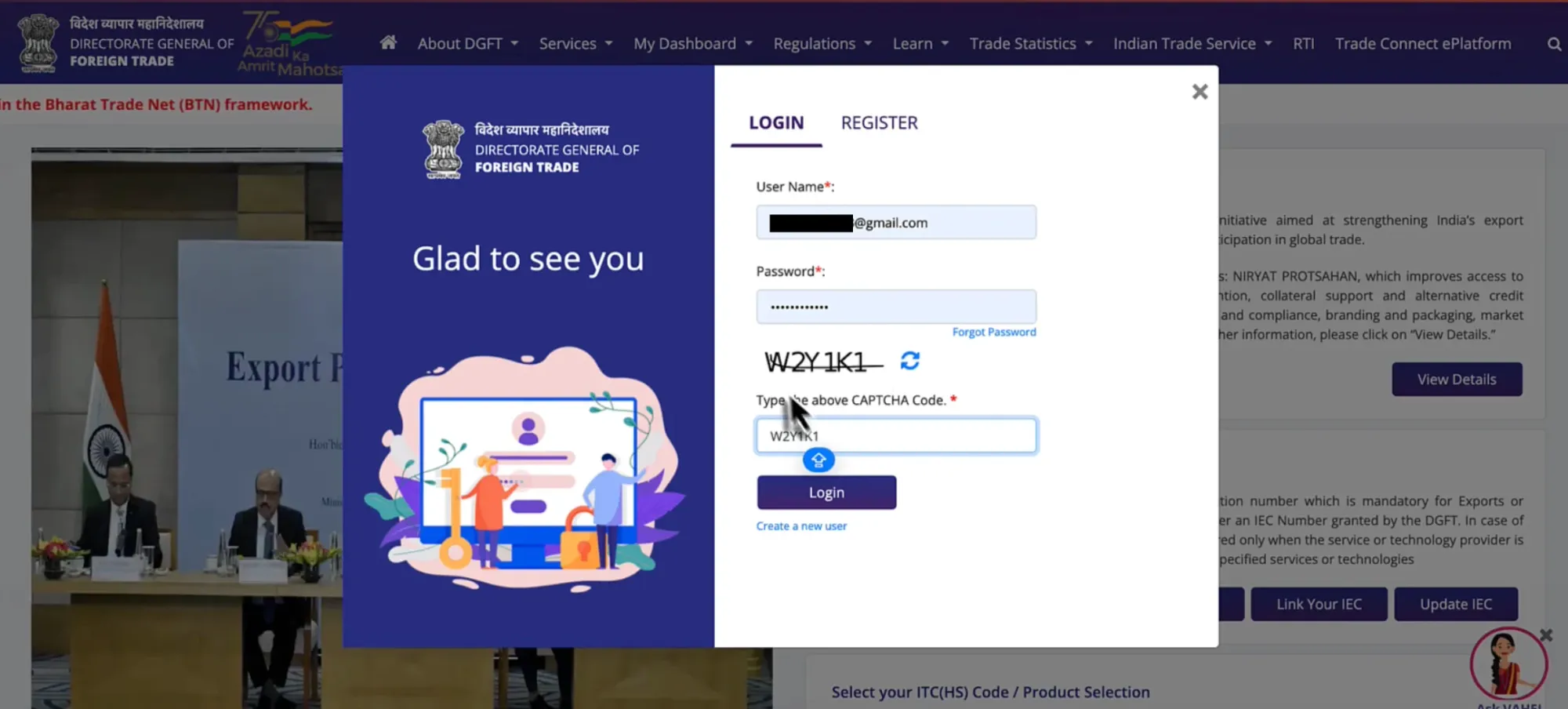
Part B - Fill Form ANF-2A
Step 3 - Log in and open the IEC application.
Log in with your username and password. From the top menu, go to Services → IEC → Apply for IEC.
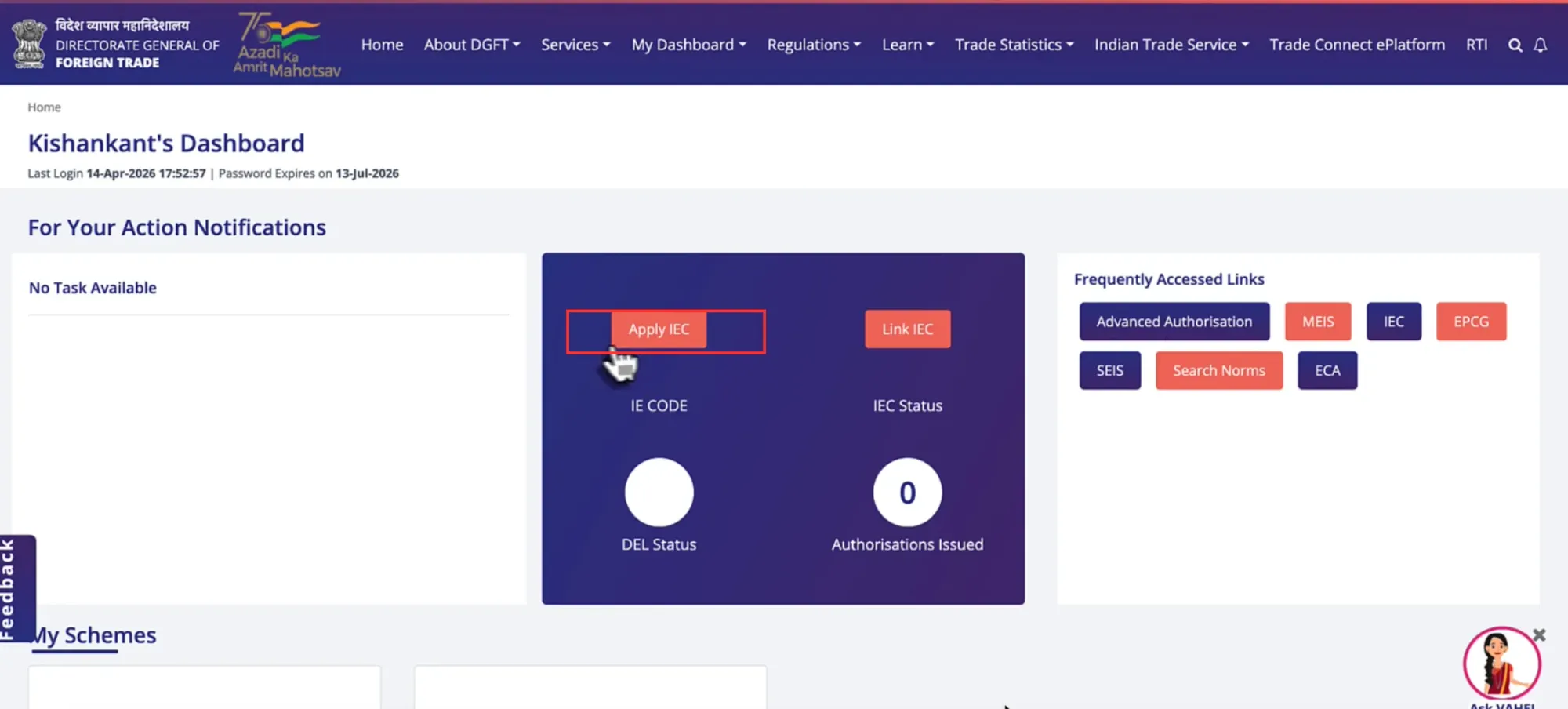
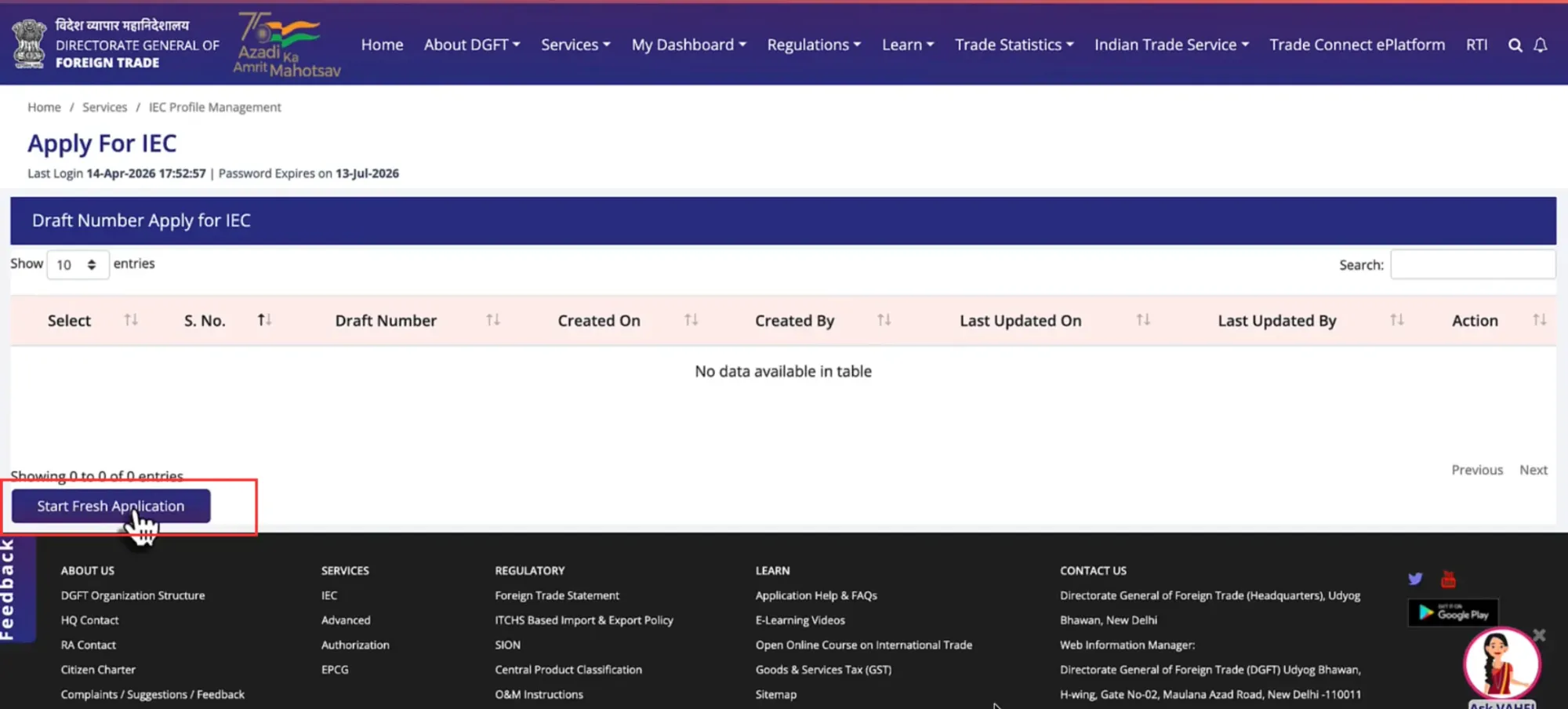
then click Start Fresh Application. (If you've started before and have a saved draft, use the linked-application option to resume.)
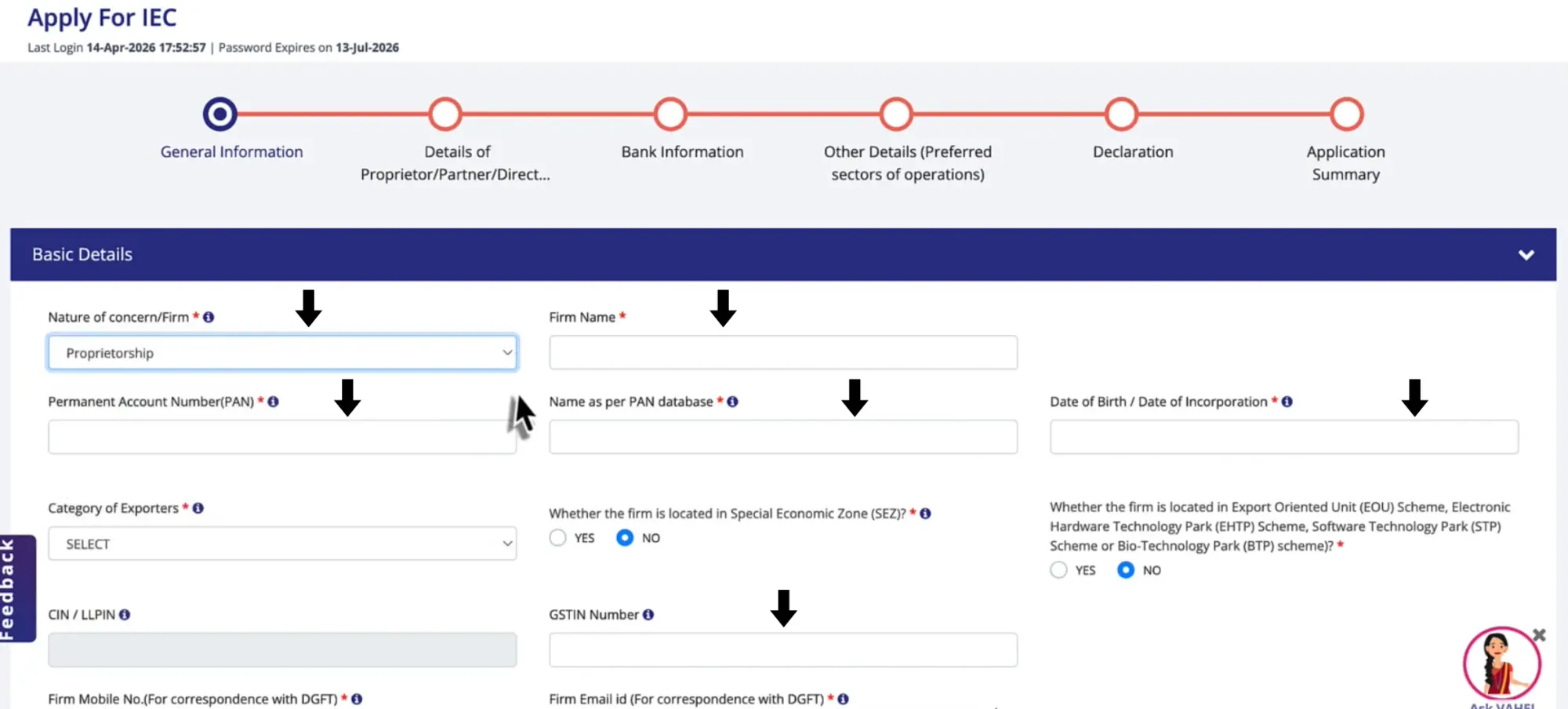
Step 4 - Enter general information (PAN auto-fetch).
The form opens on General Information. Enter your PAN - the portal validates it against Income Tax records and auto-fills your name/entity. Select your firm/entity type (Proprietorship, Partnership, LLP, Pvt Ltd, etc.) and nature of concern. This is where a name mismatch surfaces, so confirm the auto-filled name matches your bank records exactly.
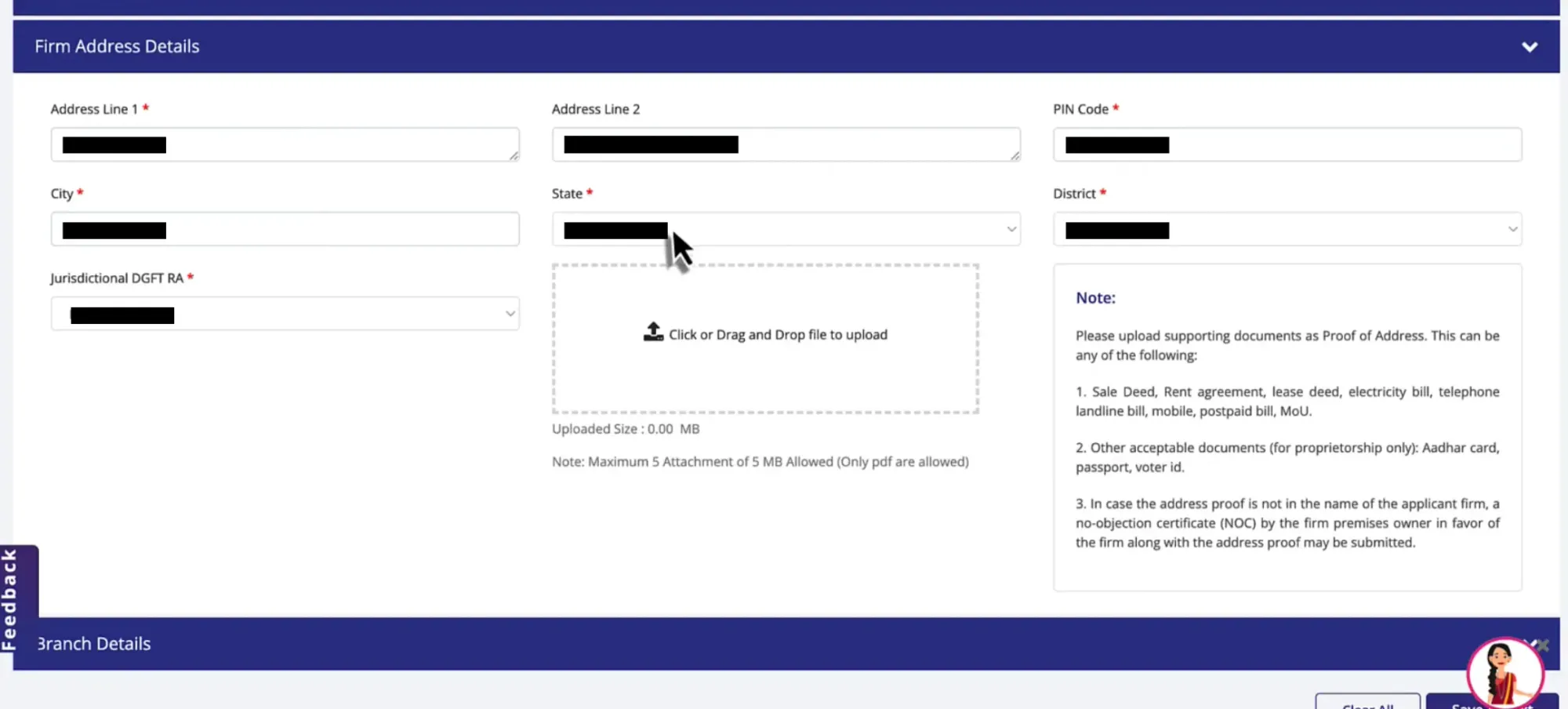
Step 5 - Add your address and branch details.
Enter the principal place of business and any branch addresses. The address must match your uploaded address proof - a mismatch here is one of the most common rejection triggers.
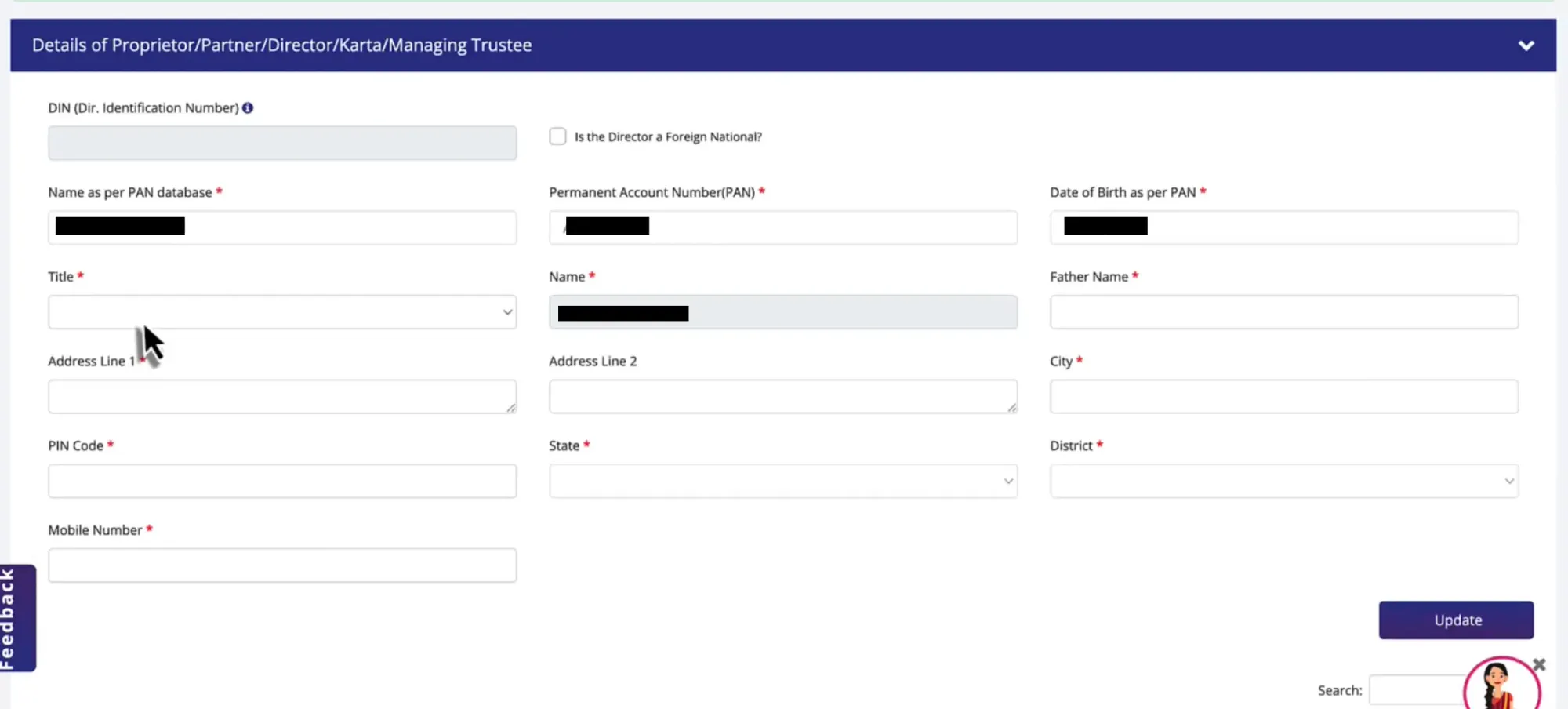
Step 6 - Add proprietor / partner / director details. Enter the details of the proprietor, partners, or directors as applicable to your entity type, including their PAN and contact details.
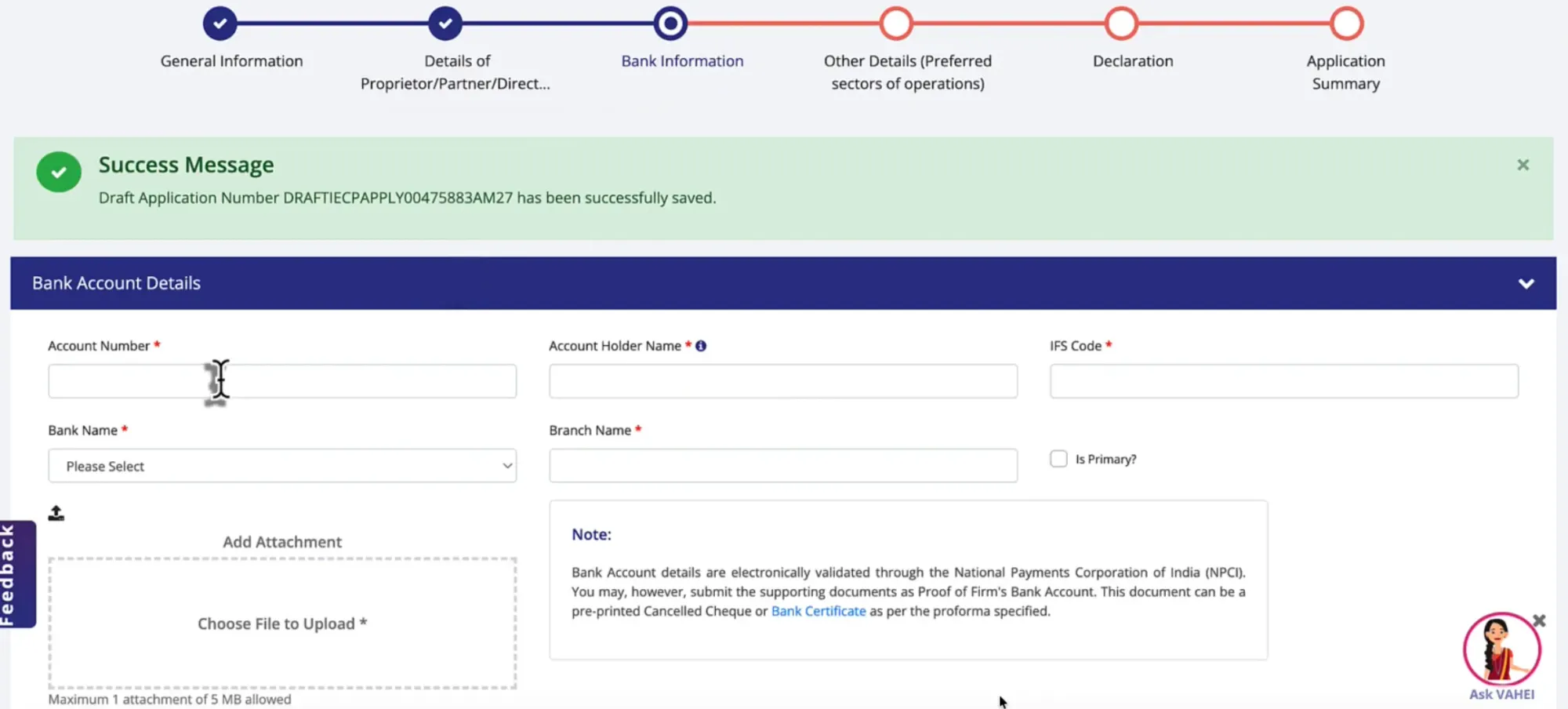
Step 7 - Enter bank details and upload the bank proof. Enter the account number and IFSC of your business account, then upload a cancelled cheque or bank certificate. The account-holder name must match the firm name on your PAN character-for-character - this is the single field that gets the most applications moved to manual review.
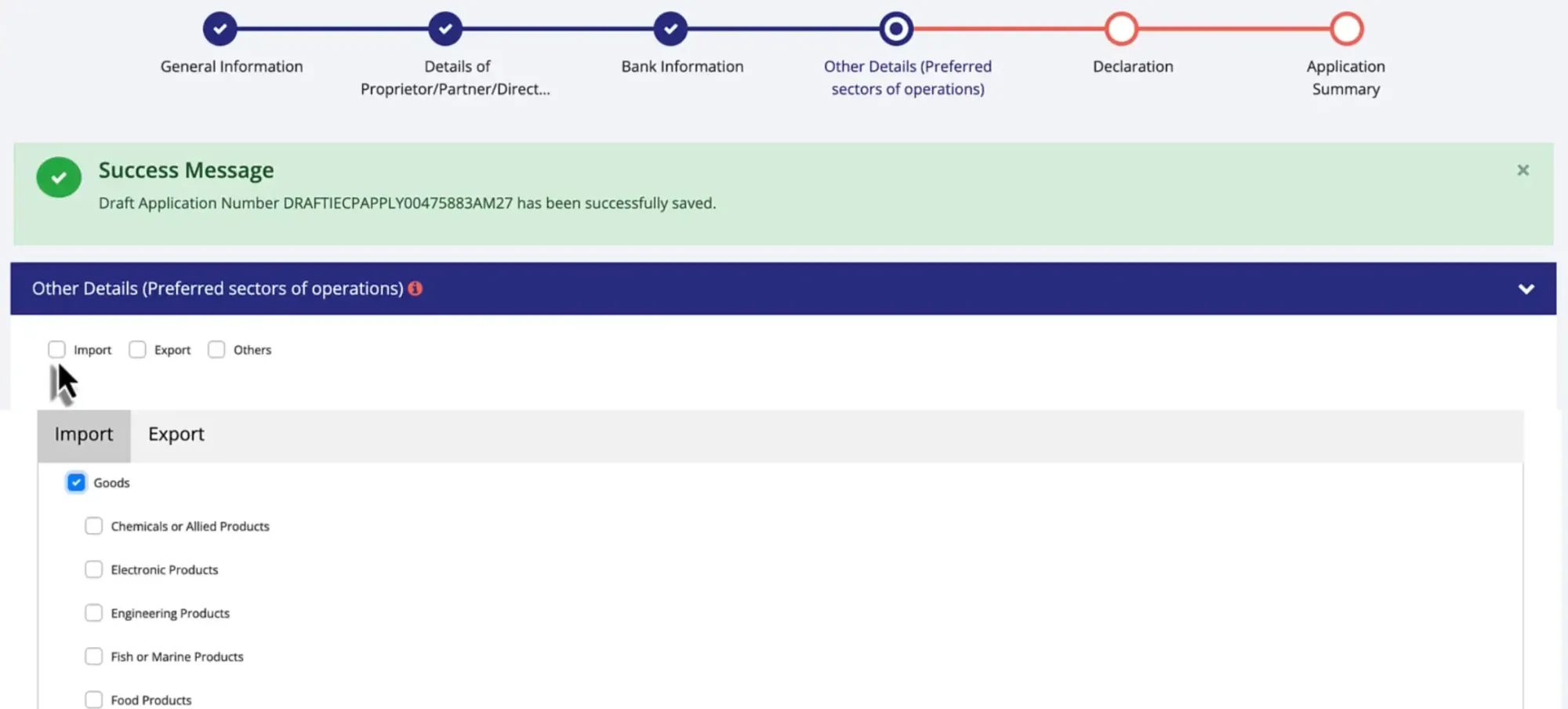
Step 8 - Upload remaining documents and select your sectors. Upload the firm's address proof and select your preferred export sectors / activities. Check every uploaded file opens correctly before moving on.
Part C - Review, sign, pay, submit
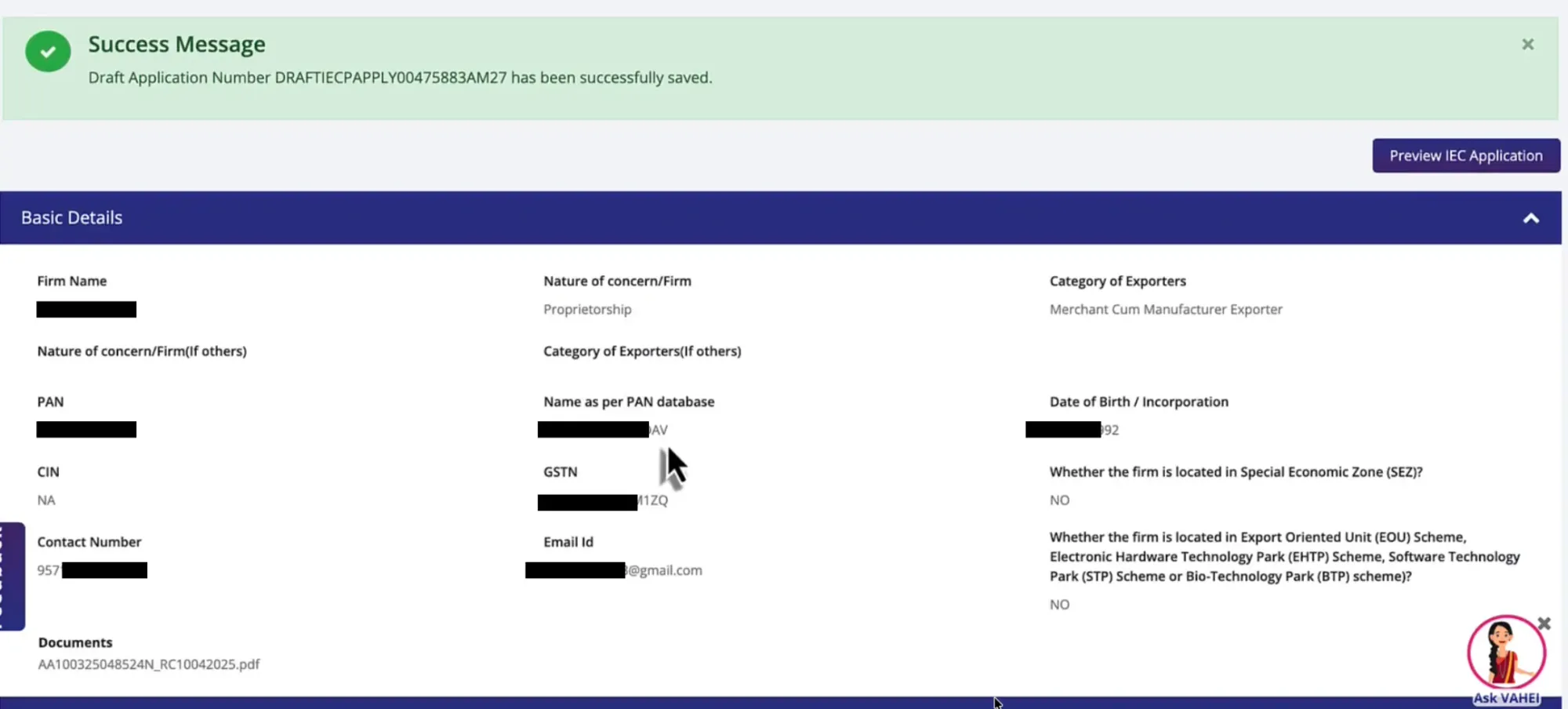
Step 9 - Preview and review the full application. Open the application summary and read it end to end. Blank mandatory fields and name/address mismatches are far cheaper to catch here than after a rejection.
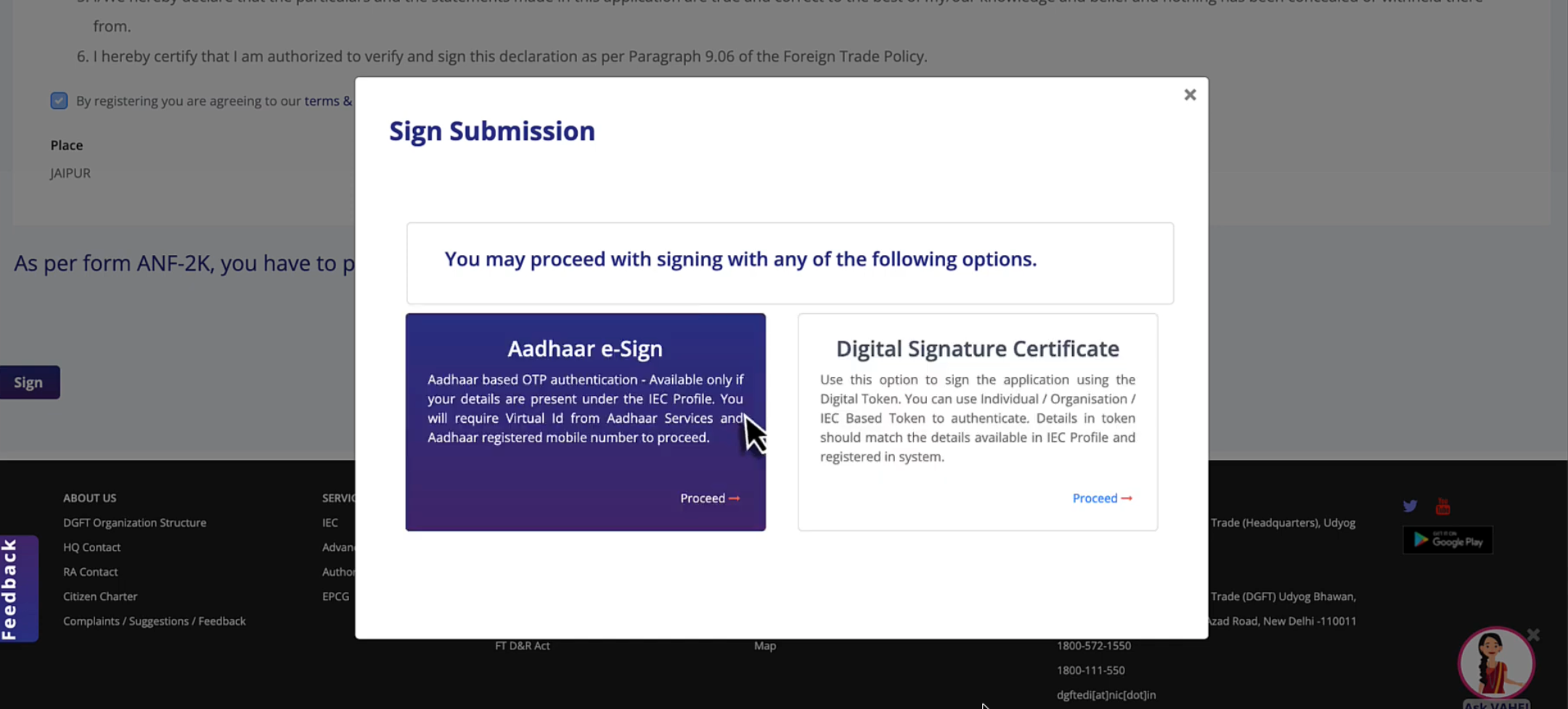
Step 10 - Sign the application. Click Sign and authenticate: Aadhaar-based OTP e-Sign works for proprietors; companies and LLPs sign with a DSC token.
Step 11 - Pay the ₹500 fee. You're redirected to the payment gateway (BharatKosh). Pay the ₹500 government fee via net-banking, debit/credit card, or UPI.
Step 12 - Get your ARN, then download the e-IEC. On successful payment the portal generates an Application Reference Number (ARN), save it. The e-IEC certificate is issued in 1-3 working days (often in real time for a clean file), emailed to you and downloadable any time from Services → IEC → Print IEC. That certificate carries a QR code you'll use for verification later.
The mistake that causes most rejections: it's rarely a missing document, it's a name or address mismatch. The bank-account name must match the firm name on your PAN exactly; even "Pvt Ltd" versus "Private Limited" can flag a manual review. Reconcile your PAN, bank, and address-proof names before you file, not after. (For just the document checklist and fee breakdown in one place, keep that reference handy.)
The annual update that quietly deactivates your IEC
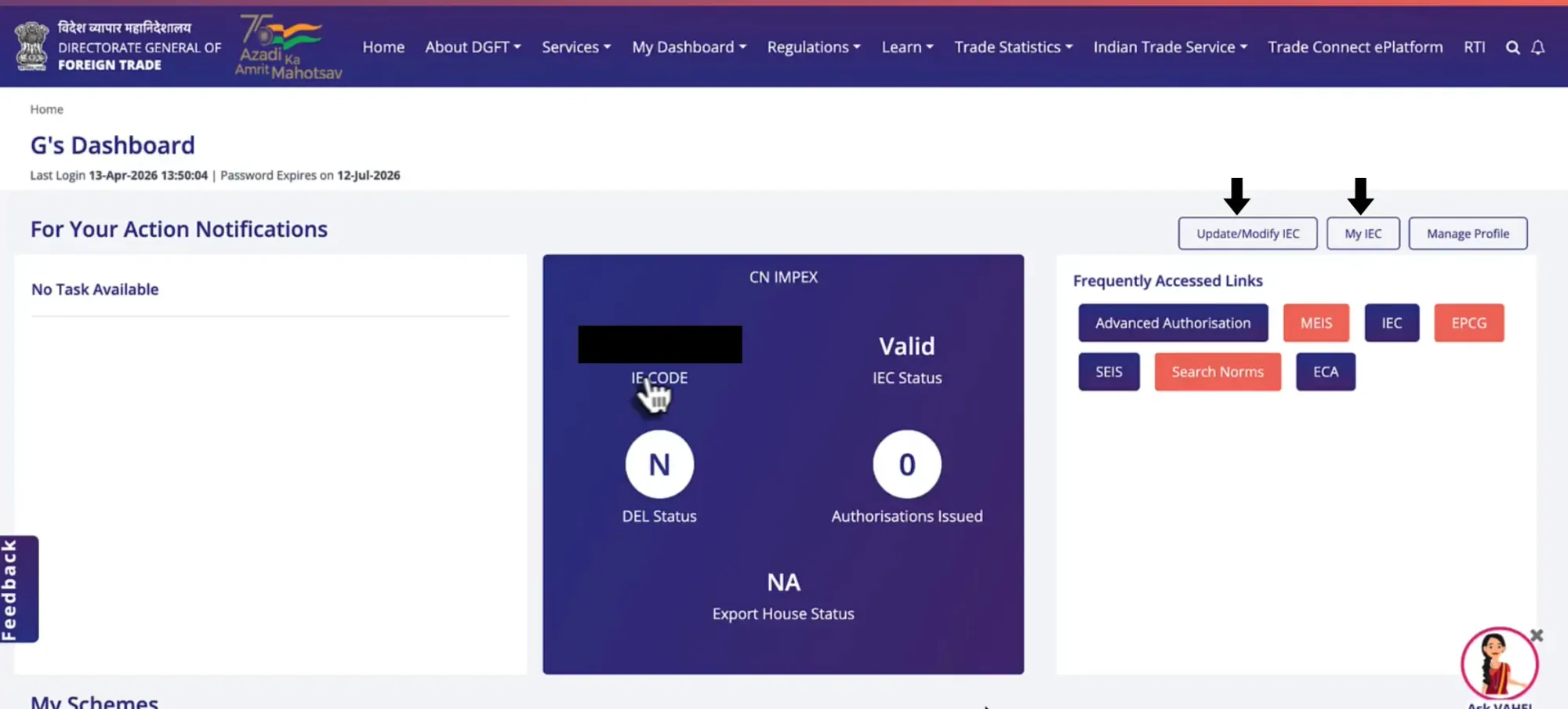
Your IEC has lifetime validity, but you must log in and update or confirm it on the DGFT portal every year between 1 April and 30 June. This was made mandatory by DGFT Notification No. 58/2015-2020, dated 12 February 2021, and it applies even if nothing about your business has changed.
Miss the 30 June window and DGFT automatically deactivates your IEC from 1 July. A deactivated IEC means customs won't clear your consignments, banks block your trade remittances, and pending incentive claims freeze - often while a container sits at the port racking up demurrage. The update itself is free if you're only confirming details; ₹200 applies if you're modifying address, bank, or director details.
Reactivation is straightforward but not instant: complete the overdue update on the portal and the system reactivates the IEC automatically, though the "Valid" status can take a few working days to propagate across systems like ICEGATE, during which trade stays blocked. Set a calendar reminder for 1 April. (The exact steps to update or reactivate it are worth bookmarking before your first April rolls around.)
How to verify or check an IEC status
DGFT portal - the authoritative source. Open DGFT → go to Services → View IEC Related Details → Enter IEC Number, First Name and Captcha. This is where you confirm your status reads Valid, not Deactivated.
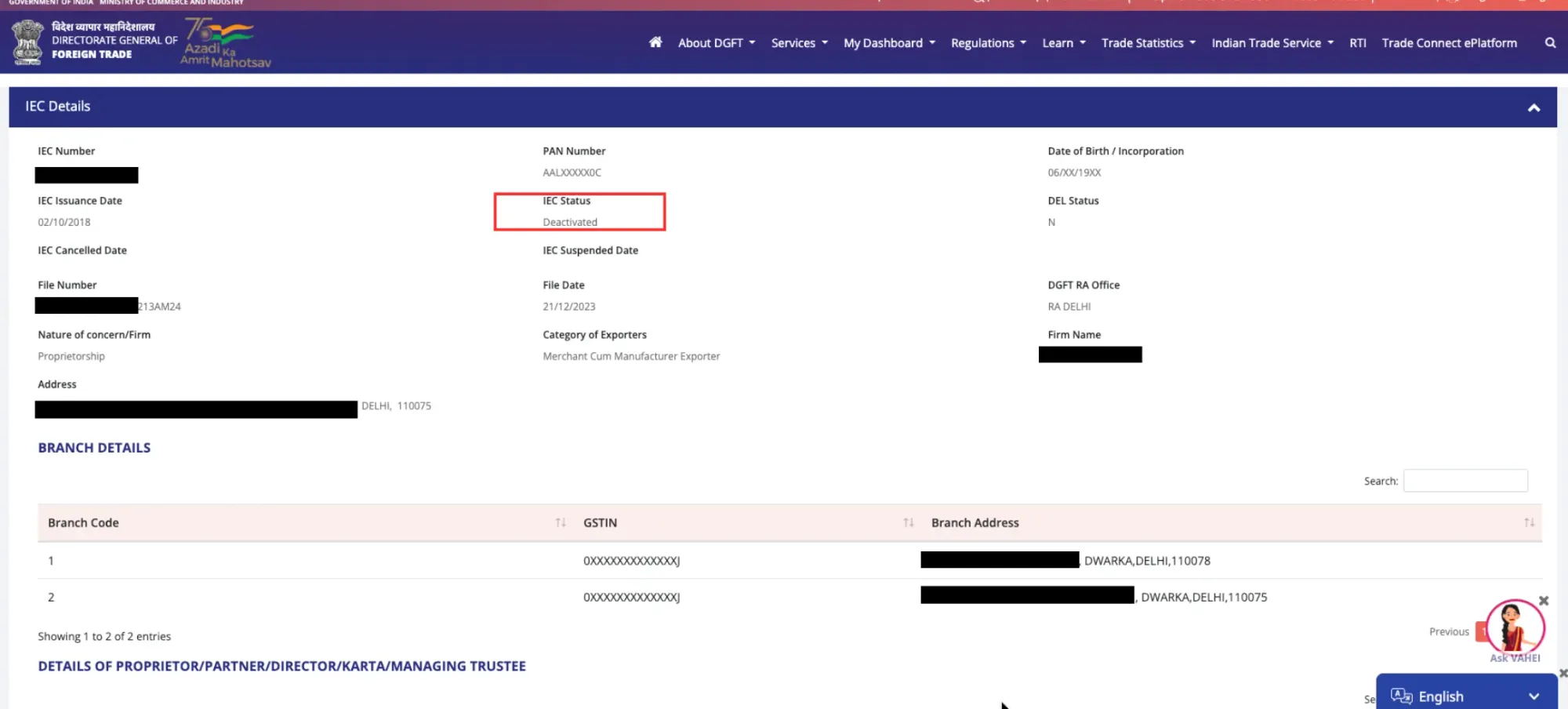
Checking a counterparty's IEC before you commit to a deal is the cheapest due-diligence you'll ever do - a deactivated or mismatched IEC on their end can becomes your stuck shipment.
What actually breaks when your IEC goes inactive
- Because the IEC is a live status, not a filed-and-forgotten document, its deactivation cascades:
- Customs won't process any Bill of Entry or Shipping Bill against it.
- Banks refuse inward and outward trade remittances - your export proceeds can't be credited and your import payments can't go out, because the IEC is part of their FEMA check. This is also where the purpose code your bank files against the remittance depends on a valid IEC.
- Incentives (RoDTEP and the like) freeze.
- Monitoring systems flag it: every export you file flows into EDPMS on the export side, and imports into IDPMS, both keyed to your IEC via ICEGATE.
- Once your IEC is active, the next credential most exporters need is a customs-portal login - so register on ICEGATE to file electronically, then register your AD Code at your port. IEC first, always, it's the credential everything else hangs off.
Frequently Asked Questions
Importer-Exporter Code - a 10-digit number issued by DGFT that authorises a business to import or export from India.
Since 2017, yes - the IEC number is your PAN. But you must still formally apply for IEC status through DGFT; a PAN alone doesn't authorise trade.
₹500, paid online on the DGFT portal via Form ANF-2A. It's usually issued in in real time. sometimes can take upto 1–3 working days.
No - it has lifetime validity. But you must update or confirm it on the DGFT portal every year between 1 April and 30 June, or it's automatically deactivated.
DGFT deactivates your IEC from 1 July. Customs stops clearing your goods and banks block your trade remittances until you complete the overdue update, which reactivates it (free for a plain confirmation; ₹200 for modifications).
An individual can, as a proprietor using their personal PAN. Proprietorship, partnership, LLP, and company are all eligible; each has one IEC linked to one PAN.
Not strictly to receive foreign exchange for services - but you need it to claim Foreign Trade Policy benefits, so most service exporters obtain one anyway.