High Sea Sales in India (2026): Meaning, GST Treatment & Where to Report It
What high sea sales means, why it's no supply under Schedule III since Feb 2019, where to report it in GSTR-1 and GSTR-9, and customs valuation.
Listen to article
Audio version (0% complete)
A high sea sale is the sale of imported goods while they are still in transit, after the shipment has left the foreign port and before it is cleared for home consumption in India. Ownership passes by endorsing the bill of lading to the new buyer, who then becomes the importer of record, files the Bill of Entry in their own name and pays the customs duty and IGST.
Two things about high sea sales changed after most of the standard explanations were written, and both change what you actually do. Since 1 February 2019, a high sea sale is not a supply at all under GST - not an exempt supply, not a non-GST supply, but a transaction that falls outside the definition of supply entirely. That single classification decides where it goes in your returns, and whether you reverse input tax credit. Separately, RBI's new Foreign Exchange Management (Export and Import of Goods and Services) Regulations, 2026 take effect on 1 October 2026, and they matter for the part of a high sea sale that nobody writes about: how the original importer closes an outward remittance against a Bill of Entry filed under someone else's IEC.
The short answer
If you're the high sea seller (the original importer): you do not charge GST, you do not file a Bill of Entry, and the transaction does not appear in your GSTR-1 or GSTR-3B. You do not reverse input tax credit on the CHA, freight or bank charges you incurred. You report it once a year, in GSTR-9 Table 5F.
If you're the high sea buyer (the final buyer): you are the importer. You file the Bill of Entry under your own IEC, you pay basic customs duty and IGST on the last sale price, and you claim the IGST as input tax credit. You need the full document chain from the original foreign invoice down to your purchase, because customs will ask for it.
If you're the accountant asking where to show it in GSTR-1: nowhere. There is no outward supply to declare. The detail and the reasoning are below, because this is the answer that gets argued about most.
What a high sea sale actually is
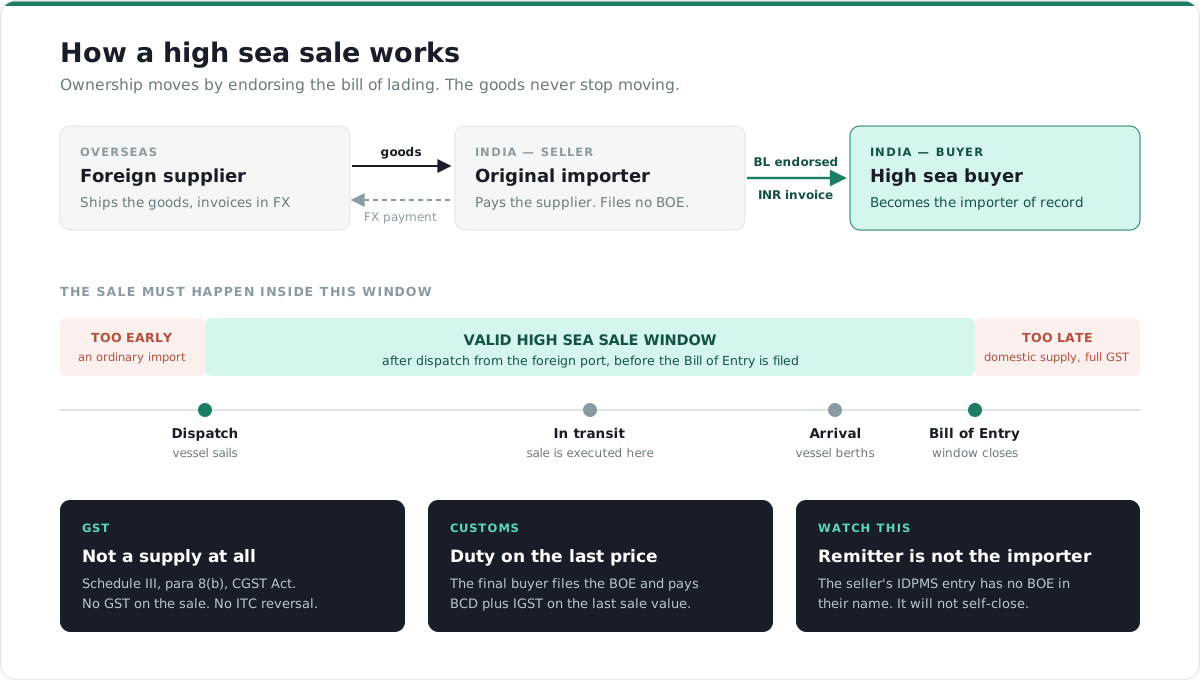
The mechanics are simpler than the terminology. An Indian buyer contracts with a foreign supplier and the goods are shipped. While the vessel is in transit, the Indian buyer finds a domestic buyer for the same consignment. Rather than clearing the goods, paying duty and then selling them domestically, the first buyer sells them in transit, endorsing the bill of lading in favour of the second buyer and executing a high sea sale agreement. The second buyer clears the goods.
The commercial logic is straightforward: the first buyer skips the working capital cost of duty, the warehousing and the domestic GST on a resale, and takes a margin on a transaction they never physically handle. The second buyer gets goods that are already on the water rather than waiting for a fresh shipment cycle. Traders in commodities - steel scrap, chemicals, edible oils, coal run on this.
Timing is the whole thing. The sale must happen after the goods are dispatched from the port of loading and before they are entered for customs clearance in India. Sell before dispatch and it isn't a high sea sale. It's a straight import by the second party. Sell after arrival but after the Bill of Entry has been filed, and it's a domestic supply attracting full GST. The window is real and customs checks it against the dates on your documents.
There can be more than one high sea sale on the same consignment. The chain is
Regular import | High sea sale | |
Who files the Bill of Entry | The original importer | The final high sea buyer, under their own IEC |
Who pays duty and IGST | The original importer | The final buyer, at clearance |
Value assessed | The foreign supplier's invoice value | The last high sea sale price |
GST on the domestic leg | IGST or CGST+SGST on the onward sale | None, the sale in transit is not a supply |
Who remits to the foreign supplier | The importer, who also files the BOE | The original buyer, who does not file the BOE |
Currency of the domestic invoice | INR | INR, the high sea sale invoice must be in rupees |
The GST treatment, and why the classification matters
Paragraph 8(b) of Schedule III to the CGST Act, inserted by the CGST (Amendment) Act, 2018 and effective from 1 February 2019, covers the supply of goods by the consignee to any other person, by endorsement of documents of title, after the goods have been dispatched from the port of origin outside India but before clearance for home consumption. Schedule III lists activities that are treated as neither a supply of goods nor a supply of services.
That wording is doing a lot of work. A high sea sale is not exempt, not nil-rated, not a non-GST supply. It is not a supply. The distinction sounds academic and is not, because three practical consequences flow from it.
IGST is collected once, at import. CBEC Circular No. 33/2017-Cus dated 1 August 2017 confirmed the GST Council's decision that IGST on high sea sale transactions of imported goods, whether one sale or several is levied and collected only at the time of importation, when the import declarations are filed. Multiple high sea sales in a chain do not each attract tax. The last buyer pays IGST on the last transaction value, and value added along the chain is captured in that figure.
No input tax credit reversal. The Explanation to Section 17(3) provides that "value of exempt supply" excludes the value of activities specified in Schedule III, other than paragraph 5 and paragraph 8(a). High sea sales sit in paragraph 8(b). So Rule 42 and Rule 43 do not apply, and the input tax credit you claimed on the CHA's fees, the freight forwarder's invoice and your bank charges stays where it is. If your accounting software is treating high sea sales as exempt turnover and computing a proportionate reversal, it is costing you money on a position the law does not require.
And it doesn't go in your monthly returns. Which brings us to the question everyone actually searches for.
Where to show high sea sales in GSTR-1
Nowhere. There is no entry for it.
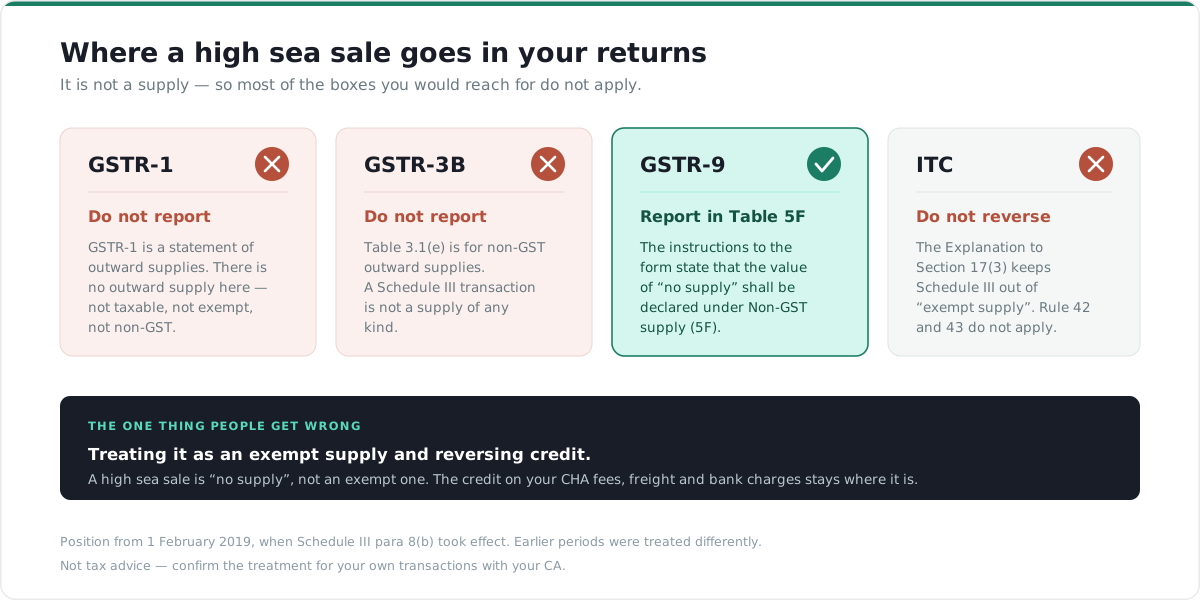
GSTR-1 is a statement of outward supplies. A high sea sale is not a supply, so there is no outward supply to declare, not as a taxable supply, not as exempt, not as a non-GST outward supply. The same logic applies to GSTR-3B: table 3.1(e) is captioned "non-GST outward supplies," and a Schedule III transaction is not a supply of any kind, so it does not belong there either.
The annual return is where it surfaces. GSTR-9 Table 5F is captioned "Non-GST supply (includes 'no supply')" - that parenthetical is the hook the law hangs Schedule III transactions on, and it is the correct place for your high sea sale turnover.
Return | Report the high sea sale? | Why |
GSTR-1 | No | It is not an outward supply. No table applies. |
GSTR-3B | No | Table 3.1(e) covers non-GST outward supplies. A Schedule III transaction is not a supply. |
GSTR-9 | Yes, Table 5F | Captioned "Non-GST supply (includes 'no supply')" |
ITC reversal (Rule 42/43) | No | Explanation to Section 17(3) excludes Schedule III paragraph 8(b) from "value of exempt supply" |
Documentation | Bill of supply | Not a tax invoice, there is no tax to charge |
Two things worth knowing before you rely on this. First, the position for transactions before 1 February 2019 was different: high sea sales were then treated as non-GST supplies, they did appear in GSTR-1 and GSTR-3B, and proportionate ITC reversal applied. If you are reconciling old years or dealing with a legacy assessment, the earlier treatment is the one that applies to that period. Second, if you have historically declared high sea sales in GSTR-1 as non-GST outward supplies, stopping mid-year creates a reconciliation gap between your returns and your books. Fix it deliberately, document why, and keep the Schedule III reference with the working papers.
The customs side: valuation and who files
The final buyer files the Bill of Entry. Under the ICEGATE workflow this is a home consumption Bill of Entry filed under the buyer's own IEC - one of several types of Bill of Entry an importer needs to know the difference between.
Assessable value is the last high sea sale price. Circular No. 32/2004-Cus dated 11 May 2004 established the practice of appropriating the price paid by the last high sea sale buyer into the customs valuation, and Circular 33/2017-Cus reaffirmed it. Where there is more than one sale in the chain, the last price governs, because that is the price at which importation was actually caused. This holds even where the high sea sale price is lower than what the original buyer paid the foreign supplier, a scenario that arises when a shipment is delayed and the market moves.
There is a legacy point worth being ready for. The 2004 circular also described a practice of loading the CIF value by 2% as notional high sea sale charges where the actual contract price could not be established. Tribunals have since held that where the actual price paid by the ultimate buyer is available, that price governs and a notional 2% addition is not warranted. In practice, declare the actual last sale price and hold your documents, but expect a field query at some ports, and have the chain ready rather than arguing the principle at the counter.
The document chain is the whole defence. Circular 33/2017-Cus is explicit that the last buyer must furnish the entire chain - the original foreign supplier's invoice, the high sea sale contract, and details of any service charges or commission, to establish the link between the first contracted price and the last transaction. What customs is testing is continuity. Assemble it before filing:
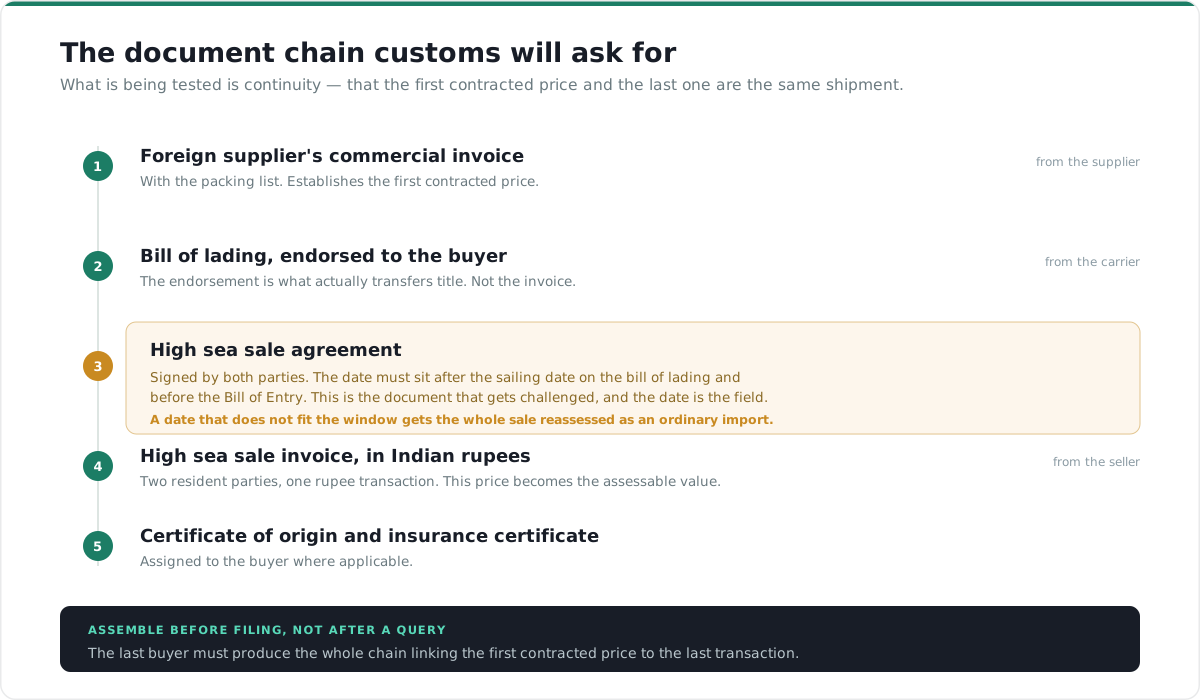
- The foreign supplier's commercial invoice and packing list
- The bill of lading, endorsed in favour of the high sea buyer
- The high sea sale agreement, signed by both parties and dated inside the valid window
- The high sea sale commercial invoice, in Indian rupees
- Certificate of origin and insurance certificate, assigned to the buyer where applicable
The high sea sale agreement is the document that gets challenged. It must be executed after dispatch and before the Bill of Entry, and the date on it has to be consistent with the sailing date on the bill of lading and the arrival date on the manifest. An agreement dated before the vessel sailed, or backdated to fit a window it doesn't fit, is the single most common reason a high sea sale gets reassessed as an ordinary import with duty recalculated on the wrong value and the domestic leg exposed to GST.
The payment problem: your remittance and your Bill of Entry are in different names
Here is the part that catches people out weeks after the cargo has cleared, and it has nothing to do with GST.
In a high sea sale, the original buyer pays the overseas supplier. But the final buyer files the Bill of Entry. So the original buyer has an outward remittance sitting in IDPMS with an Outward Remittance Message and no matching Bill of Entry under their own IEC, because the Bill of Entry exists, it just belongs to someone else.
IDPMS matches ORMs to Bills of Entry to confirm that every rupee sent abroad bought goods that actually entered India. An entry that cannot self-match stays open. Open entries accumulate, they surface as outstanding import obligations against your name, and beyond a point they restrict your ability to make further remittances, and in the worst case lead to caution listing. Most people discover this on the day their next payment gets held, months after the trade closed.
The fix is documentary and it has to be initiated by you. Your AD bank can settle the ORM against a Bill of Entry filed by the high sea buyer, but it will not happen automatically - the bank needs the high sea sale agreement, the endorsed bill of lading and the buyer's Bill of Entry to satisfy itself that the remittance and the import are the same transaction. Give your bank that file at the time of the deal, not when the entry is flagged. The mechanics of matching, and what an unresolved entry actually costs, are covered in our guide to EDPMS and IDPMS.
One forward-looking note. RBI has notified the Foreign Exchange Management (Export and Import of Goods and Services) Regulations, 2026 (Notification No. FEMA 23(R)/2026-RB dated 13 January 2026), coming into force on 1 October 2026 and superseding the 2015 regulations. They consolidate the export and import frameworks and give AD banks explicit room to permit third-party payments where the bank is satisfied of the reasons, which is directly relevant to transactions where the remitter and the importer of record are different parties. If you run high sea sales regularly, this is worth a conversation with your bank before October rather than after.
Before the money leaves India
The high sea sale itself is a rupee transaction between two Indian parties. The foreign leg, the original buyer paying the overseas supplier is an ordinary import remittance, and it carries the usual costs: an exchange rate that is rarely the mid-market rate, and correspondent bank charges that appear as a line item on nothing.
That payment, and the IDPMS reconciliation that follows it, is what EximPe's AD1 Trade Accounts are built around — an RBI-licensed Payment Aggregator - Cross Border route where the FEMA reporting sits inside the transaction and the rate is visible before you accept it.
FAQ
Frequently Asked Questions
The sale of imported goods while they are in transit, after dispatch from the foreign port and before clearance for home consumption in India. Ownership transfers by endorsement of the bill of lading, and the buyer becomes the importer of record.
Since 1 February 2019 it is covered by paragraph 8(b) of Schedule III to the CGST Act, which means it is treated as neither a supply of goods nor a supply of services. No GST is charged on the sale. IGST is collected once, from the final buyer, at the time of import.
Nowhere. GSTR-1 reports outward supplies, and a high sea sale is not a supply. It does not go in GSTR-3B either. Report it annually in GSTR-9 Table 5F, which is captioned "Non-GST supply (includes 'no supply')."
It should not be reported in GSTR-3B. Table 3.1(e) covers non-GST outward supplies, and a Schedule III transaction is not a supply of any kind.
The contract between the original importer and the subsequent buyer covering the sale of goods in transit. It must be signed by both parties and dated after dispatch from the port of loading and before the Bill of Entry is filed. The date is the field customs scrutinises most closely.
No. The Explanation to Section 17(3) excludes Schedule III paragraph 8(b) transactions from the value of exempt supply, so Rule 42 and Rule 43 reversals do not apply to input tax credit on CHA fees, freight or bank charges.
The final buyer in the chain, at the time of clearance. Duty and IGST are assessed on the last high sea sale price, not on the original foreign supplier's invoice value.
Yes. The chain is legitimate and none of the intermediate sales attract GST. The last buyer is the importer, pays duty on the last transaction value, and must produce the full chain of documents linking the first contracted price to the last.
Rupees. It is a transaction between two parties in India, and the invoice must be in Indian currency even though the underlying goods are being imported.
No, there is no tax to charge. A bill of supply is the correct document.